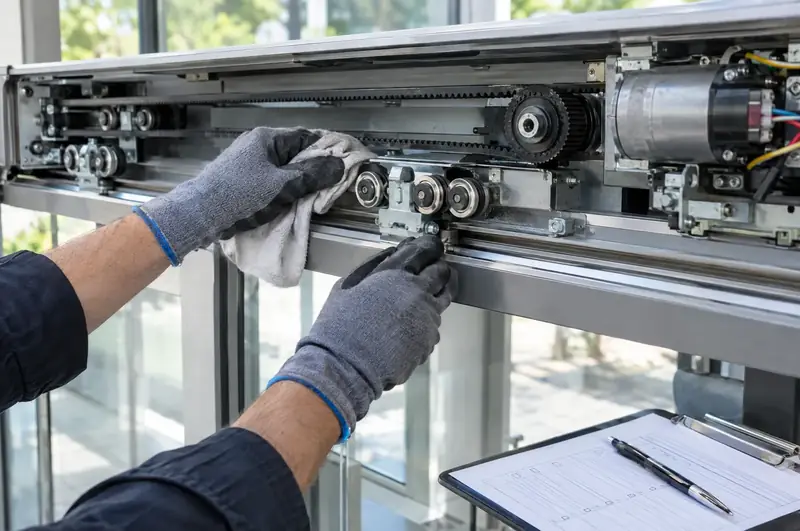
Automatic doors work hard. A busy entrance can cycle hundreds of times a day, and every cycle wears the belt, rollers, floor guide and sensors a little more. Planned servicing catches that wear early, keeps the safety functions set correctly and gives you a written record of each door's condition.
We service sliding, swing, folding and revolving doors from most makers, as single visits or under a service contract. The price of each visit is confirmed with you in writing before an engineer attends, and any repairs the engineer finds are quoted before they are carried out.
Doors in workplaces have to be kept maintained and in good working order. Regular servicing by a trained engineer, backed by a written record, is the usual way to show you are doing that, and it keeps the door safe for the people who use it every day.
- What you receive
- A written service report for each door
- Recommended check
- At least once a year by a trained engineer
- Visit price
- Confirmed in writing before each visit
- Safety reference
- BS EN 16005
What does an automatic door service include?
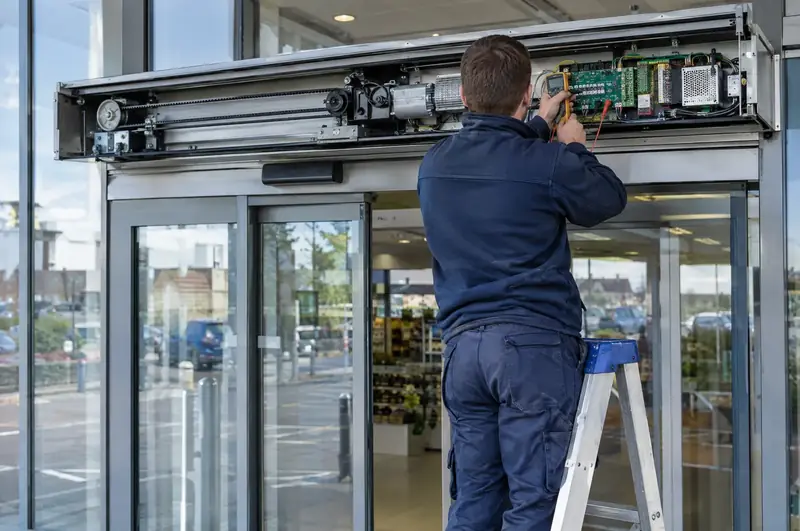
A service visit is a set checklist of cleaning, adjustment and testing carried out on each door. The exact list depends on the door type, but a typical sliding door service covers:
- asking staff about any faults or near misses since the last visit;
- isolating the door and inspecting the drive unit, belt, pulleys and wiring;
- cleaning the track and checking rollers, carriages and anti-lift devices for wear;
- checking floor guides, brush strips, seals and the threshold;
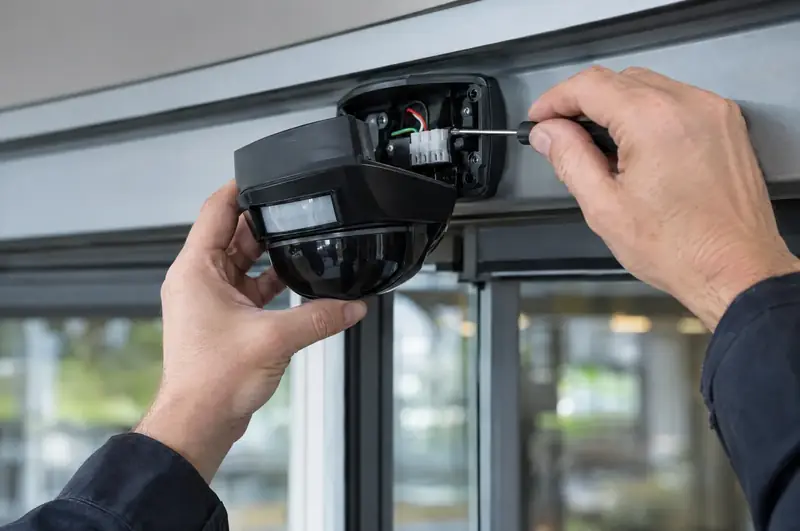
- testing the activation sensors and adjusting their detection zones;
- testing the safety sensors that protect the closing edges and the area the door moves through;
- checking opening and closing speeds, the hold-open time and how the door reacts when it meets an obstruction;
- testing the battery backup, the programme switch and any locking;
- checking break-out or power-failure opening on doors that serve escape routes;
- recording the results and any recommended work.
Swing, folding and revolving doors have their own checklists. A revolving door service, for example, adds the stop buttons, the speed control and the sensors on the moving wings.
What will I receive after each service?
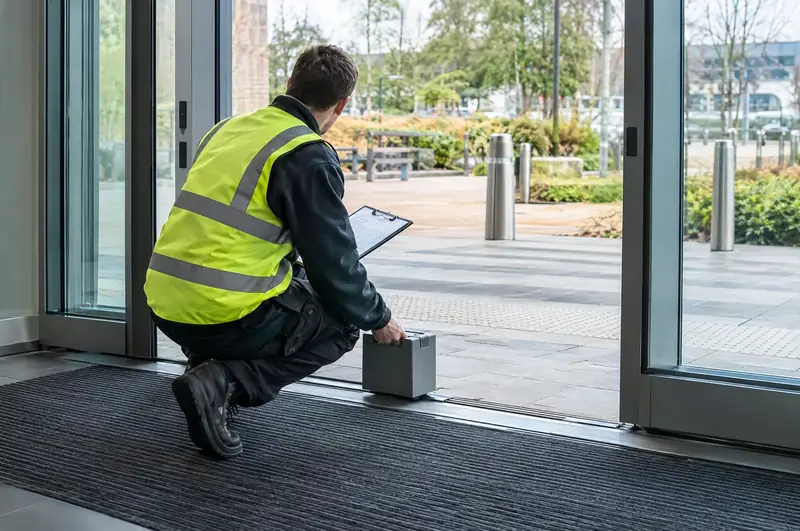
After every visit you receive a service report for each door. It records what was checked, what was adjusted, the condition of the main parts and anything that needs attention, ranked by how urgent it is.
Keep the reports together, in a logbook near the door or in a shared folder, so the full history of each door is in one place. They show anyone who asks, such as an insurer, a landlord or an enforcing authority, that the door has been looked after by a competent engineer. They also help the next engineer trace repeat faults and spot parts that are wearing faster than they should.
How often should automatic doors be serviced?
There is no legal service interval for automatic doors. Our recommendation is that a trained engineer checks the safety functions at least once a year, and that the service interval is then set by the manufacturer's instructions and how heavily the door is used.
As a rough guide, a quiet office door may need one visit a year, while a supermarket entrance, hospital door or station concourse door is often serviced every six months or more often. Weather exposure, the type of users and the door's age all play a part. Our guide on how often automatic doors should be serviced goes into more detail.
What is included in a service contract?
A service contract books your planned visits in advance at an agreed price per door. You choose how many visits each door has a year, and the contract sets out what every visit covers and how repairs between visits are charged.
- one, two or more planned visits a year for each door;
- a schedule of doors listing make, model and location;
- a service report after each visit;
- repair visits between services at the rates written into the contract, with parts quoted first;
- reminders when visits are due, so the records stay complete.
Contracts suit landlords, facilities teams and multi-site businesses that want one schedule for every door. Single visits work well if you have one door or prefer to book as you go, and a single visit is also a sensible way to see a door's condition before committing to a contract.
What checks should staff carry out between services?
Simple daily or weekly checks by someone on site catch many problems early. They take a minute and never involve opening the operator cover.
- Walk through the door and check it opens in good time and closes smoothly.
- Stand still in the doorway for a moment: the door should not close on you.
- Look and listen for new noises, juddering or the door stopping short.
- Check the floor guide and track area are clear of grit, stones and litter.
- Check the glass for cracks and that signs and markings are still in place.
- Note any fault, switch the door to a safe mode if needed and report it.
Can you service doors fitted by another company?
Yes. The engineers we send service most powered pedestrian doors from the major European operator brands, whoever installed them. On the first visit they record each door's details and condition, so later reports can be compared like for like.
If a first service finds a door is missing safety features, or its set-up no longer suits the people using it, we tell you. A safety inspection gives a fuller, documented risk assessment, and any upgrades are quoted separately so you can plan them.
Single visits or a service contract?
| Option | What it is | Best for |
|---|---|---|
| Single service visit | One planned visit booked when you need it | One door, or checking condition before a contract |
| Annual contract, one visit | One planned visit a year at an agreed price per door | Quieter doors in offices, surgeries and small shops |
| Annual contract, two visits | Two planned visits a year, roughly six months apart | Busy entrances, healthcare, care homes and retail |
| Higher-frequency contract | Three or four visits a year | Very heavy use, such as large stores and transport hubs |
| Service with safety inspection | A service combined with a documented risk assessment | Doors with no recent risk assessment on file |
How much does automatic door servicing cost?
A planned service visit for the first door on site is from £145 ex VAT (£174 inc VAT) as a guide, and further doors on the same visit cost less. The table shows what moves the price; your written quote is the price you pay.
| Item | Guide price | Notes |
|---|---|---|
| Single service visit, first door on site | £145 – £245 | checks, adjustment and service record, ex VAT; homes £174 – £294 inc VAT |
| Each additional door on the same visit | £60 – £120 | ex VAT; homes £72 – £144 inc VAT |
| Service contract, one visit a year | £145 – £245 | first door, per year, visit booked in advance at a fixed price, ex VAT; homes £174 – £294 inc VAT |
| Service contract, two visits a year | £270 – £460 | first door, per year, ex VAT; additional doors at the per-visit rate above; homes £324 – £552 inc VAT |
No law sets a fixed service interval. We recommend a safety check by a trained engineer at least once a year, and more frequent visits for busy doors. Repairs found during a service are quoted before they are done.
Standards and the law
BS EN 16005 is the current standard for the safety in use of powered pedestrian doors, and BS 7036-0:2014 is the British code of practice for risk assessment and risk reduction used alongside it. Standards are not law in themselves, but they are the recognised benchmark for showing an automatic door is safe to use, and we set up, test and document doors with reference to them.
No law sets a fixed service interval. We recommend that a trained engineer checks the safety functions at least once a year, with service intervals set by the manufacturer’s instructions and how heavily the door is used, and that someone on site carries out simple regular checks and keeps a record.
The law that applies also depends on the nation. The table shows the main differences; each county and town page carries the rules for its own nation.
| Nation | Accessibility | Building regulations guidance | Fire safety law |
|---|---|---|---|
| England | The Equality Act 2010 | Approved Document M (Volume 2): powered opening where opening force would exceed 30 N, or 22.5 N from 30° to 60°; 1000 mm clear width for public entrance doors in new buildings | Regulatory Reform (Fire Safety) Order 2005: the responsible person |
| Wales | The Equality Act 2010 | Approved Document M (Wales): powered opening where opening force would exceed 20 N; 1000 mm clear width for public entrance doors in new buildings | Regulatory Reform (Fire Safety) Order 2005: the responsible person |
| Scotland | The Equality Act 2010 | Building (Scotland) Regulations 2004, non-domestic Technical Handbook: accessible entrance with at least 800 mm clear opening; building warrant for building work | Fire (Scotland) Act 2005: whoever has control of the premises |
| Northern Ireland | The Disability Discrimination Act 1995 | Building Regulations (Northern Ireland) 2012: powered doors must not trap people and must open on power failure; access guidance in Technical Booklet R | Fire and Rescue Services (Northern Ireland) Order 2006 and Fire Safety Regulations (Northern Ireland) 2010 |
Questions about automatic door servicing
Is automatic door servicing a legal requirement?
No law names a fixed service interval, but workplace law expects doors to be kept in efficient working order under a suitable system of maintenance, with their safety features working. Regular servicing by a trained engineer, recorded in writing, is the usual way to show that. Insurers and landlords often ask to see service records too.
How long does a service visit take?
Most single doors take around an hour, depending on the door type, its condition and how much adjustment is needed. Revolving doors and doors with several sets of sensors take longer. The door is out of use for part of that time, so we can agree a quieter time of day for the visit.
What is the difference between a service and a safety inspection?
A service keeps the door working well: cleaning, adjusting and testing parts and safety functions against a checklist. A safety inspection is a site-specific risk assessment of the door's hazard zones against BS EN 16005, with a written report of any gaps. Many owners combine the two in one visit.
Do you fix faults during a service visit?
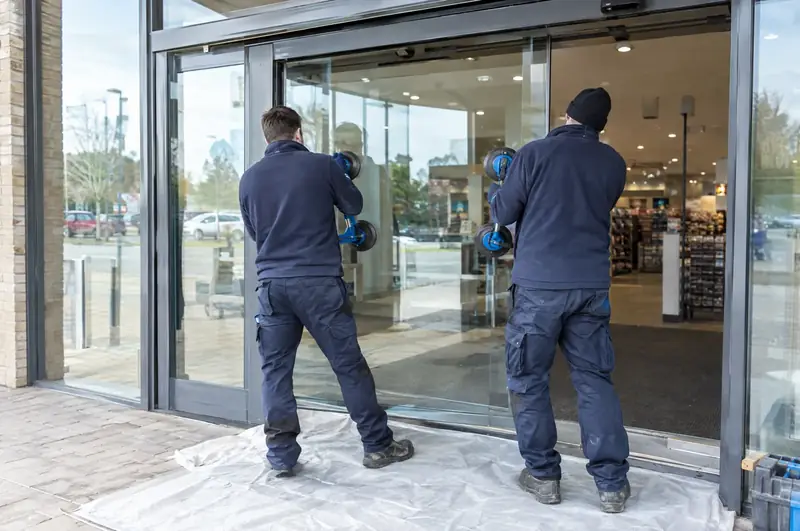
Small adjustments, such as resetting sensor zones, tightening fixings or adjusting speeds, are part of the service. If a part is worn or a repair would take longer, the engineer explains what is needed and we quote it before doing it. Nothing extra is added to your bill without your agreement.
Can you service several doors at once?
Yes. The first door on a visit carries the travel and set-up time, so each additional door on the same visit costs less. For multi-site businesses and landlords, a contract can cover every door across your buildings on one schedule with one set of records.
Will the door be out of use during the service?
For part of the visit, yes. The engineer has to isolate the door to inspect the drive and running gear, then run it through its cycles to test it. Where the door is the only entrance, it can be switched to manual or open mode for short periods, and visits can be booked for quieter times.
Do I get a certificate after a service?
You get a written service report for each door, recording the checks made, the results and any recommendations. It is a record of the door's condition on the day rather than a certificate. If you need a documented risk assessment against BS EN 16005, ask for a safety inspection alongside the service.
How are repairs between services charged under a contract?
Repair visits between planned services are charged at the rates written into your contract, so you know them in advance. As with any visit, parts and work beyond the visit are quoted first. The contract also sets out the notice period, so there are no surprises if your needs change.