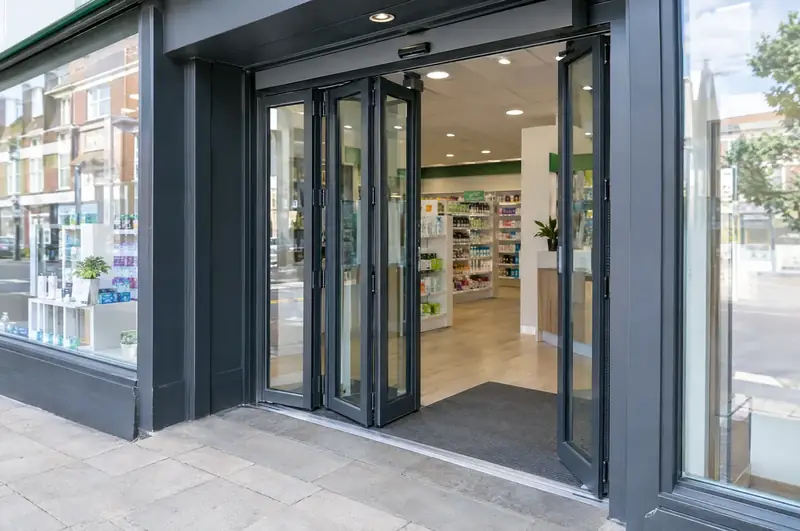
Folding doors fill the gap between sliding and swing doors. A sliding door needs wall space for its leaves to park, and a swing door needs floor space for the leaf to sweep through. A folding door needs only a little of each, because its narrow leaves fold into a compact pack at the side of the opening.
That makes it a good fit for narrow shop units, pharmacies, kiosks and older terraced frontages where the opening runs almost wall to wall, and for internal openings where a sliding door would cover a light switch, radiator or another door. Folding doors can be single-sided or bi-parting, glazed or solid, and framed to match the shopfront.
We supply and install automatic folding doors complete with operator, sensors and programme switch. Specialist automatic door engineers working under our management survey, fit and commission the door with reference to BS EN 16005, and the survey is free, followed by a fixed, itemised written quote.
- Typical clear opening
- 800 mm to 2,000 mm
- Typical lead time
- Typically 4 to 8 weeks from order
- Usually suits
- Narrow shopfronts, pharmacies, kiosks
- Safety reference
- BS EN 16005
How does an automatic folding door work?
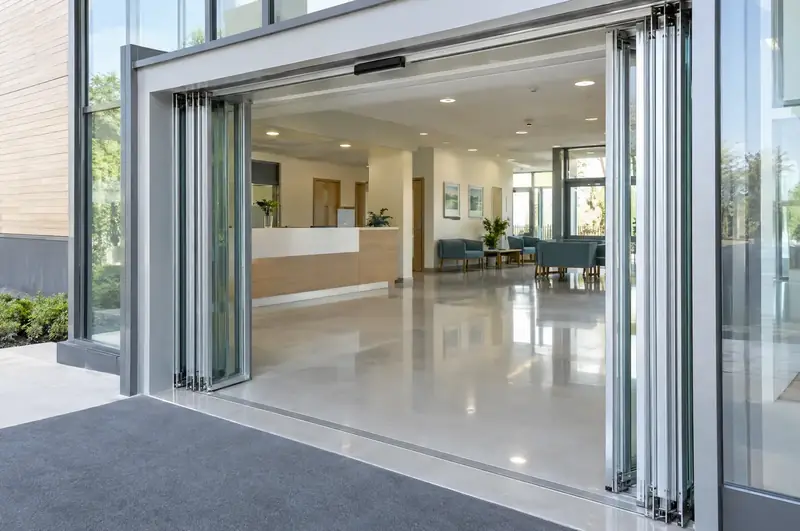
An automatic folding door works by driving the free edge of each pair of leaves along an overhead track while the other edge pivots at the side of the opening. As the free edge moves towards the pivot, the hinge between the two leaves swings out and the pair folds into a pack. Closing reverses the movement.
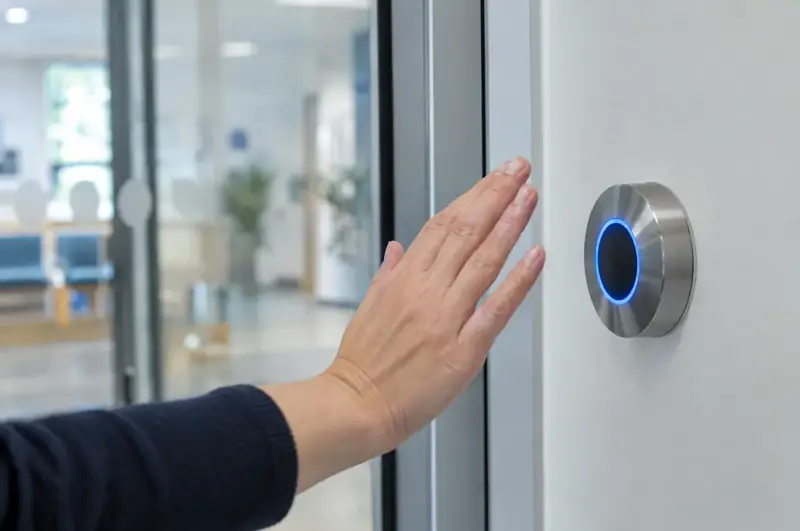
The operator sits in a header above the opening, with pivot bearings at the top and bottom on the hinge side. Activation is usually by a radar motion sensor or a push pad. Because the leaves sweep a small area as they fold, presence sensors watch that sweep zone as well as the threshold, so the door will not fold onto someone standing beside it.
When is a folding door the right choice?
A folding door is the right choice when you need a reasonably wide opening and have almost no wall space beside it. Typical examples are:
- a pharmacy or convenience store in a narrow unit where the shopfront runs from party wall to party wall
- a kiosk, ticket office or market hall unit with glass on three sides
- a terraced shop where a sliding door would mean removing part of the display window
- an internal opening next to a corner, radiator or another door
It is less suitable where the sweep zone cannot be kept clear, for example right next to a queue or a display stand, or where very heavy traffic would suit the simpler movement of a sliding door. For wide openings with a little more side space, a telescopic door is worth comparing.
How much opening does a folding door give?
A folding door gives most of the structural opening as clear width, because only the thickness of the folded pack is lost at each side. With two leaves folding to one side there is one pack; with a bi-parting four-leaf door there is a pack on each side. The survey drawing shows the exact clear width for your opening.
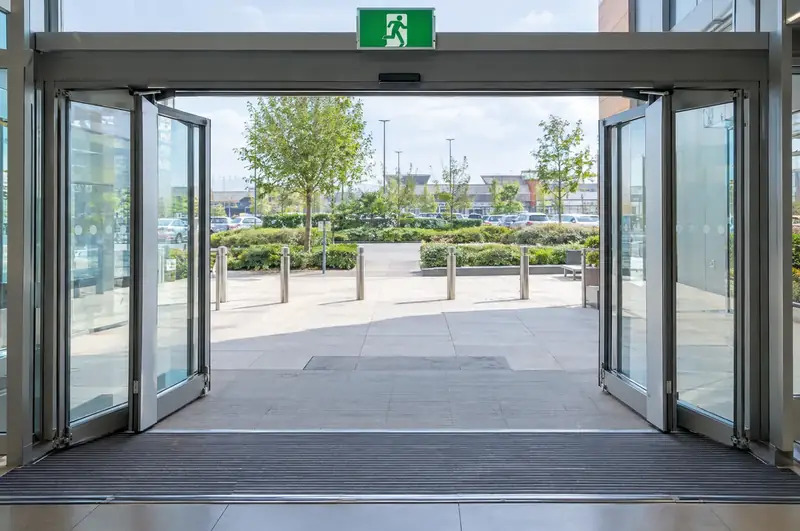
When open, each folded pair stands at right angles to the doorway, projecting by about the width of one leaf. Because the leaves are narrow, that is often only a few hundred millimetres, but the area has to be kept clear of displays, bins and signs, and it decides whether the door should fold inwards or outwards.
What specification options are there?
- Leaf layout: two leaves folding to one side, or four leaves folding to both sides from the centre.
- Fold direction: inwards or outwards, chosen to keep the sweep zone away from pavements, queues and displays.
- Glazing and panels: toughened, laminated or double-glazed glass, or solid panels for internal and service doors.
- Frame finish: powder-coated or anodised aluminium matched to the shopfront.
- Finger protection: flexible guards over the hinge gaps between leaves and on the pivot side.
- Locking and power failure: a lock in the operator or floor bolts, with battery backup or manual folding when the power is off, as the escape strategy requires.
- Break-out: some folding doors can be specified with a break-out function where the fire strategy needs one.
What does the survey look at?
For a folding door, the survey pays particular attention to what happens beside and in front of the opening. The engineer checks:
- The structural opening width and height, and what the header and pivots will fix to
- The space inside and outside for the folded leaves, and anything that sits in the sweep zone
- whether the threshold is level and the floor sound enough for the bottom pivots and guides
- pavement levels and drainage at street doors, especially where the door folds outwards
- footfall, the users and the direction most people approach from
- power for a fused spur, and whether the door is on an escape route
You then receive a drawing showing the folded position and clear width, with a fixed, itemised written quote.
How is a folding door installed and maintained?
Installation usually takes a day on site for a replacement shop door. The old door comes out, the frame and header are fitted, the leaves are hung on their pivots and hinges, and the engineer sets fold speed, closing force and sensor zones before testing and completing the risk assessment. Staff are shown the programme switch and how to fold the door by hand if needed.
Folding doors have more hinges and pivot points than sliding doors, so they benefit from regular attention. Have a trained engineer check the safety functions, hinges and pivots at least once a year, more often for busy shop doors, and ask staff to keep the sweep zone and floor pivots free of debris.
Which folding door layout suits your frontage?
| Option | What it is | Best for |
|---|---|---|
| Two-leaf single-sided | Two leaves folding to one side of the opening | Narrow shop doors and internal openings |
| Four-leaf bi-parting | Two pairs folding to both sides from the centre | Wider shop entrances and pharmacies |
| Inward-folding | Leaves fold into the building | Street doors where the pavement must stay clear |
| Outward-folding | Leaves fold away from the room | Internal doors where floor space inside is limited |
| Insulated folding | Thermally broken framing and double-glazed glass | Heated shops and exposed frontages |
How much does an automatic folding door cost?
A complete automatic folding door set is from £5,995 ex VAT as a guide, with four-leaf, insulated and break-out versions at the higher end. The table shows what moves the price; your written quote is the price you pay.
| Item | Guide price | Notes |
|---|---|---|
| Automatic folding door, up to about 2 m clear opening | £5,995 – £10,995 | installed, ex VAT |
| Folding door with break-out for an escape route | top of range or on survey | depends on the fire strategy |
| Touch-free switch or push pad, fitted | £145 – £395 | per switch, ex VAT |
| Card or fob reader tied into the door | £795 – £2,495 | per door, ex VAT |
Standards and the law
BS EN 16005 is the current standard for the safety in use of powered pedestrian doors, and BS 7036-0:2014 is the British code of practice for risk assessment and risk reduction used alongside it. Standards are not law in themselves, but they are the recognised benchmark for showing an automatic door is safe to use, and we set up, test and document doors with reference to them.
Whoever motorises a manual door, or builds an automatic door from separate parts, may take on the manufacturer’s legal duties for the finished door: a risk assessment, a technical file kept available for the authorities, a Declaration of Conformity, the conformity marking and instructions. You receive the Declaration of Conformity and the instructions at handover.
The law that applies also depends on the nation. The table shows the main differences; each county and town page carries the rules for its own nation.
| Nation | Accessibility | Building regulations guidance | Fire safety law |
|---|---|---|---|
| England | The Equality Act 2010 | Approved Document M (Volume 2): powered opening where opening force would exceed 30 N, or 22.5 N from 30° to 60°; 1000 mm clear width for public entrance doors in new buildings | Regulatory Reform (Fire Safety) Order 2005: the responsible person |
| Wales | The Equality Act 2010 | Approved Document M (Wales): powered opening where opening force would exceed 20 N; 1000 mm clear width for public entrance doors in new buildings | Regulatory Reform (Fire Safety) Order 2005: the responsible person |
| Scotland | The Equality Act 2010 | Building (Scotland) Regulations 2004, non-domestic Technical Handbook: accessible entrance with at least 800 mm clear opening; building warrant for building work | Fire (Scotland) Act 2005: whoever has control of the premises |
| Northern Ireland | The Disability Discrimination Act 1995 | Building Regulations (Northern Ireland) 2012: powered doors must not trap people and must open on power failure; access guidance in Technical Booklet R | Fire and Rescue Services (Northern Ireland) Order 2006 and Fire Safety Regulations (Northern Ireland) 2010 |
Questions about automatic folding doors
What is the difference between an automatic folding door and a bi-fold patio door?
An automatic folding door is a powered pedestrian door for everyday use by the public, with an operator, sensors and safety features set up for people walking through. A bi-fold patio door is a manual door designed to open a wall to a garden. They look similar when folded, but they are built, controlled and safety-tested very differently.
How much space does a folding door need beside the opening?
Very little along the wall, because only the thickness of the folded pack sits in the opening. The bigger question is the space in front of or behind the door: each folded pair stands at right angles to the doorway and projects by about the width of one leaf. That area needs to stay clear, so the survey checks it carefully.
Are automatic folding doors safe for children and older people?
Yes, when they are properly protected and set up. Presence sensors watch the area where the leaves fold, finger guards cover the hinge gaps, and the fold speed and closing force are set for the people using the door. The engineer tests every safety function and completes a site-specific risk assessment before handover.
Can a folding door replace a manual double door on a shopfront?
Often, yes. A four-leaf folding door can usually fit the same opening as a pair of manual doors and give a similar clear width, without the leaves swinging out across the pavement. The survey checks the header, the floor and the space for the folded leaves, and whether any change to the frontage needs planning permission.
Do folding doors work in windy locations?
They cope better than swing doors because the leaves are narrow and fold close to the frame, but strong wind can still affect them. On exposed frontages, choosing the fold direction carefully, fitting good seals and adding a canopy or lobby all help. The survey looks at exposure, and the engineer sets the operator to suit.
What happens to a folding door in a power cut?
Depending on how it is specified, a battery can keep the door working for a period or fold it open, or the leaves can be folded by hand once the lock is released. Powered doors at work must be safe if the power fails, so we agree with you whether the door should open, stay shut and be openable by hand, or keep running for a while.
Can an automatic folding door be locked at night?
Yes. An electromechanical lock in the operator holds the leaves closed, and floor bolts or a key-operated lock can be added. Laminated glass improves resistance to break-in. If the shop has a roller shutter, the door is planned so the folded leaves and the shutter guides do not clash.
How long does it take to fit an automatic folding door?
Most single entrances take about a day on site once the door is made, which is typically 4 to 8 weeks from order. Larger frontages, floor works or changes to the shopfront take longer. For shops and pharmacies, we usually plan an early start or out-of-hours slot so trading is not interrupted.