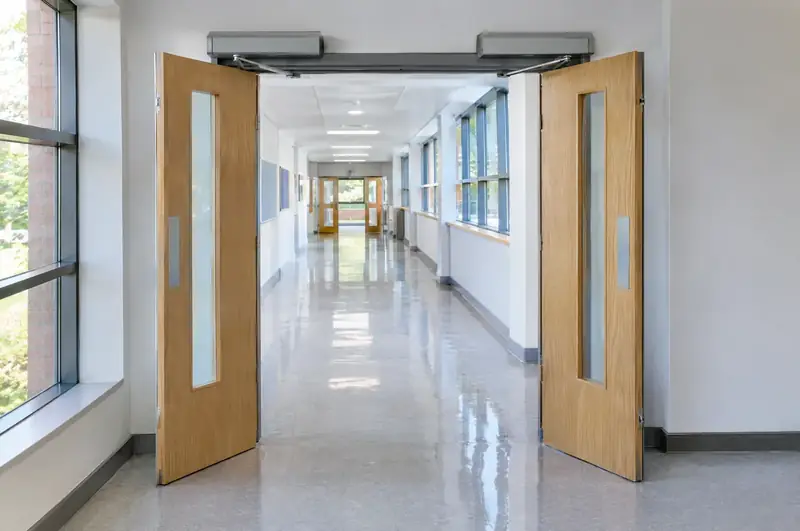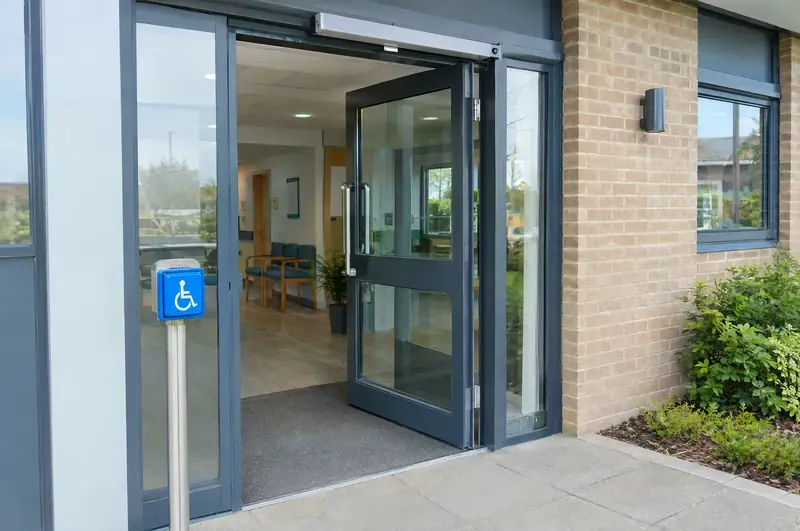
Many public doors are heavy, either because of their size or because a closer pulls them shut. That is a barrier for wheelchair users, people with walking aids, parents with pushchairs and anyone with limited strength. A low-energy operator does the pushing for them, then closes the door again under control.
These operators are usually set up within the low-energy limits in BS EN 16005, which reduces the risk of contact injuries. Because the door moves slowly and with little force, it suits doors that are not in heavy, constant use, such as surgeries, toilets, libraries, offices and community buildings, where a risk assessment shows a low risk to the people using them.
Service providers and employers have duties to make reasonable adjustments for disabled people under equality and accessibility law, and an automatic door is a common adjustment at entrances. We fit operators to new and existing doors, after a free site survey and a fixed written quote.
- Typical clear opening
- Single doors, about 800 mm to 1,000 mm
- Typical lead time
- typically 2 to 4 weeks
- Usually suits
- Surgeries, toilets, offices, community buildings
- Safety reference
- BS EN 16005
What is a low-energy door operator?
A low-energy door operator is a swing door motor set to open and close the door slowly and with limited force. The idea is that if the door does touch someone, it does so gently enough not to hurt them. A full-energy operator is different: it opens quickly for heavy traffic and relies on safety sensors to stop it striking people.
Because of that, a door kept within the low-energy limits often needs fewer safety sensors than a full-energy door. Low-energy operation is only chosen where the site risk assessment shows a low risk to the people using the door. Where users are frail, very young or have impaired sight, traffic is heavy, or there is a hazard on the swing side, sensors are added or a full-energy operator is used instead.
Our guide to low-energy and full-energy operators compares the two in more detail.
Power-assisted or fully automatic: which do you need?
A power-assisted door lets people push it open by hand with the motor helping, while a fully automatic door opens on a push pad or sensor without being touched. Many low-energy operators can do both, and the right choice depends on who uses the door.
- Power assist: the motor reduces the effort needed to push the door. Useful on staff doors and corridors where most users can manage a lighter door.
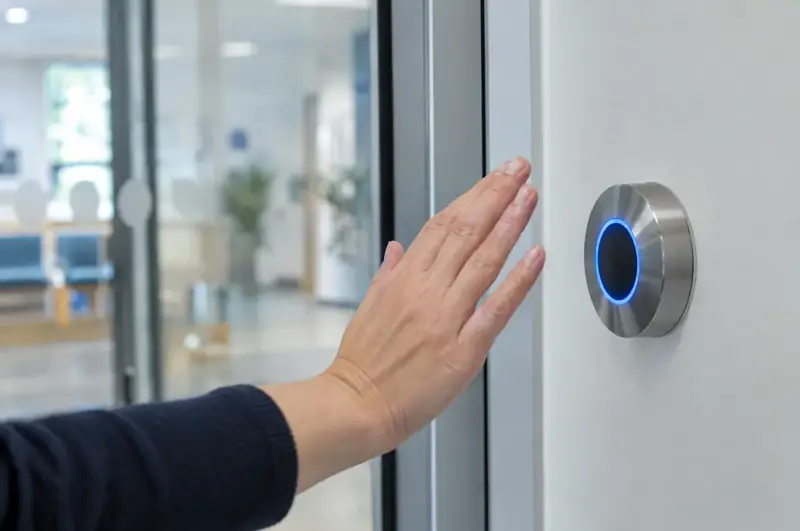
- Push-pad automatic: the door opens when someone presses a large push pad, then closes after a set time. The usual set-up at accessible entrances and toilets.
- Sensor automatic: a motion sensor opens the door as people approach. Best where hands are full or touch-free use matters.
- Mixed: power assist by default, with a push pad for anyone who needs the door to open fully on its own.
Where should push pads go?
Push pads should go where a wheelchair user can reach them without the opening door swinging towards them. That usually means on the wall to one side of the door, set back from the arc of the leaf, at a height a seated person can reach, generally between about 750 mm and 1,000 mm above the floor depending on the guidance that applies.
Pads need to contrast with the wall behind them and carry a clear wheelchair or door symbol. Keeping every pad in the building at the same height and in the same position relative to its door helps people with sight loss find them. Doors used from both sides need a pad on each side. In accessible toilets, the inside pad is often paired with a lock button so the door cannot be opened from outside while the room is in use, with an emergency release for staff.
Can an accessible operator be fitted to a fire door?
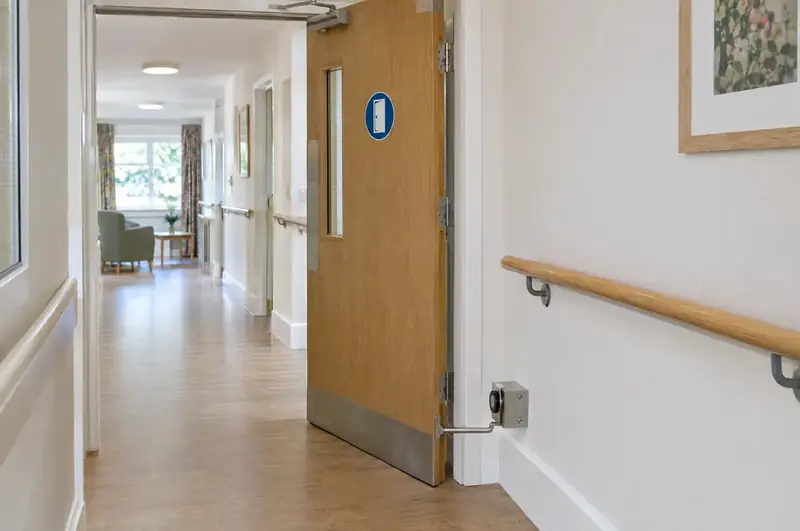
Yes, many low-energy operators are designed for fire doors, but the door must still close when the fire alarm operates. The operator is linked to the alarm so that, when it sounds, the operator stops holding or opening the door and lets it shut, as any fire door that is held open must.
The fire door itself must stay as it was tested. Fixing positions, cable routes and any glazing changes have to respect the door's fire rating, so the survey checks the door's labels or records before anything is drilled. If the door is in poor condition, fitting an operator to it will not cure that.
What does the survey and installation involve?
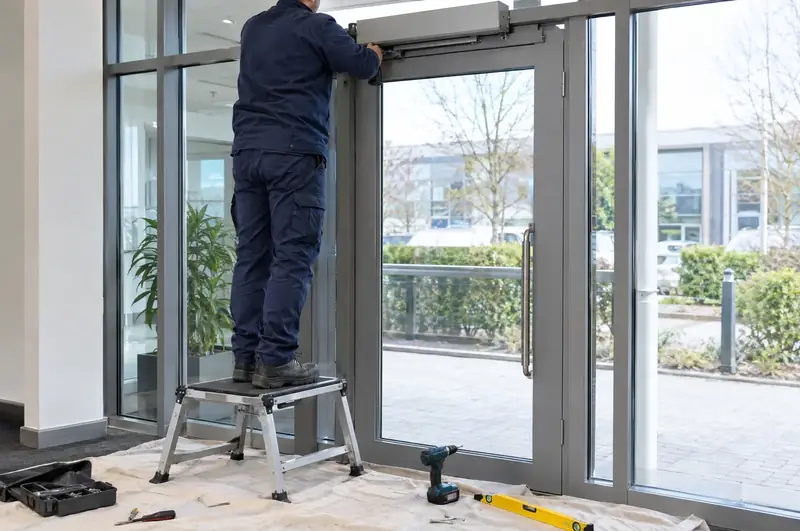
The survey checks the door, its hinges and closer, the frame and the wall above for fixing the operator, the available power and the space for push pads. Most existing doors can take an operator, but some need new hinges, a different closer arrangement or a lighter leaf first.
Lead time is typically 2 to 4 weeks from order, and fitting usually takes half a day to a day per door. The engineer sets the opening speed, force and hold-open time, tests the door, completes a risk assessment and shows staff how to use the programme switch. You receive the test record and settings in writing.
How should an accessible operator be maintained?
An accessible operator needs regular servicing like any powered door, with the opening force and speed checked to make sure it is still within its low-energy settings. Closers, hinges and push pads wear too. No law fixes the interval, but we recommend a trained engineer checks the safety functions at least once a year, with the manufacturer's instructions and the level of use deciding whether the door needs more frequent visits.
Between services, staff should report a door that opens slowly, stops part way or slams. Pressing the pad should always produce a smooth, full opening. Our servicing page explains what a visit includes.
Which accessible operator set-up suits your door?
| Option | What it is | Best for |
|---|---|---|
| Single low-energy operator | One motor on one swing leaf, with push pads | Toilets, consulting rooms and single entrance doors |
| Paired operators | Two synchronised operators on double doors | Wider entrances and corridor double doors |
| Push or pull arm | An arm set to open the door away from or towards the operator | Doors where the operator can only be fixed on one side |
| Fire-rated operator | Operator linked to the alarm so the door closes on alarm | Fire doors on corridors and stair lobbies |
| Accessible toilet kit | Operator, pads, lock button and emergency release | Accessible toilets in public and workplace buildings |
How much does an accessible door operator cost?
A low-energy operator with push pads, fitted to a single existing door, is typically £1,795 to £2,995 ex VAT as a guide. The table shows what moves the price; your written quote is the price you pay.
| Item | Guide price | Notes |
|---|---|---|
| Low-energy operator on an existing single door, with push pads | £1,795 – £2,995 | installed, ex VAT |
| Operators on an existing pair of doors | £3,795 – £6,495 | installed, ex VAT |
| Touch-free switch or push pad, fitted | £145 – £395 | per switch, ex VAT |
| Radio push-button kit | £195 – £495 | buttons and receiver, ex VAT |
| Card or fob reader tied into the door | £795 – £2,495 | per door, ex VAT |
Standards and the law
BS EN 16005 is the current standard for the safety in use of powered pedestrian doors, and BS 7036-0:2014 is the British code of practice for risk assessment and risk reduction used alongside it. Standards are not law in themselves, but they are the recognised benchmark for showing an automatic door is safe to use, and we set up, test and document doors with reference to them.
Whoever motorises a manual door, or builds an automatic door from separate parts, may take on the manufacturer’s legal duties for the finished door: a risk assessment, a technical file kept available for the authorities, a Declaration of Conformity, the conformity marking and instructions. You receive the Declaration of Conformity and the instructions at handover.
The law that applies also depends on the nation. The table shows the main differences; each county and town page carries the rules for its own nation.
| Nation | Accessibility | Building regulations guidance | Fire safety law |
|---|---|---|---|
| England | The Equality Act 2010 | Approved Document M (Volume 2): powered opening where opening force would exceed 30 N, or 22.5 N from 30° to 60°; 1000 mm clear width for public entrance doors in new buildings | Regulatory Reform (Fire Safety) Order 2005: the responsible person |
| Wales | The Equality Act 2010 | Approved Document M (Wales): powered opening where opening force would exceed 20 N; 1000 mm clear width for public entrance doors in new buildings | Regulatory Reform (Fire Safety) Order 2005: the responsible person |
| Scotland | The Equality Act 2010 | Building (Scotland) Regulations 2004, non-domestic Technical Handbook: accessible entrance with at least 800 mm clear opening; building warrant for building work | Fire (Scotland) Act 2005: whoever has control of the premises |
| Northern Ireland | The Disability Discrimination Act 1995 | Building Regulations (Northern Ireland) 2012: powered doors must not trap people and must open on power failure; access guidance in Technical Booklet R | Fire and Rescue Services (Northern Ireland) Order 2006 and Fire Safety Regulations (Northern Ireland) 2010 |
Questions about accessible door operators
Does a low-energy operator need safety sensors?
Not always. When the operator is set up within the low-energy limits in BS EN 16005, the door moves slowly and gently enough that fewer additional safety devices may be needed. The site risk assessment decides, and sensors are added where users are vulnerable, the door swings over a hazard or the traffic is heavier than low-energy suits.
Can you fit an operator to our existing door?
Usually, yes. The door needs to be in good condition, hang properly on sound hinges and have a frame and wall above that can take the operator. Very heavy or damaged doors may need work first. The survey checks all of this, and the quote shows any extra work needed.
How long does the door stay open after the pad is pressed?
That is set on the operator, usually long enough for a wheelchair user to get through comfortably, and it can be lengthened for users who need more time. If a presence sensor is fitted, many operators will also hold the door open for as long as someone is in the doorway.
What happens to an accessible operator in a power cut?
The door can be opened by hand like a normal door. Most operators act as a door closer when unpowered, so the door still shuts. Battery back-up is available if the door must keep opening automatically during a power cut, for example on a key accessible route into the building.
Can the door still be locked?
Yes. Operators work with ordinary locks, electric locks and electric strikes. With an electric lock, the operator releases it before opening, and the door can be locked by key or on a timer. A purely mechanical lock has to be opened with its key first, so the push pad will not work while it is locked.
Will an operator help us meet our duties under equality and accessibility law?
It can be part of it. Making a heavy door easy to open is a common reasonable adjustment for disabled visitors and staff. The law looks at the whole service, though, so think about the route to and through the door as well, including ramps, thresholds, signage and any inner doors.
Are low-energy operators noisy?
They are generally quiet, which is one reason they suit surgeries, offices and libraries. You will hear a soft motor sound as the door opens and closes. A noisy operator usually points to a worn gearbox, a dragging door or a misaligned arm, all of which are worth having checked.
Can an operator go on a door with a fire rating?
Yes, provided the operator is made for fire doors and is wired to the fire alarm so the door shuts when the alarm sounds. Fixings and cable routes must not weaken the door's rating. If the fire door is in poor condition, that is put right before the operator goes on.