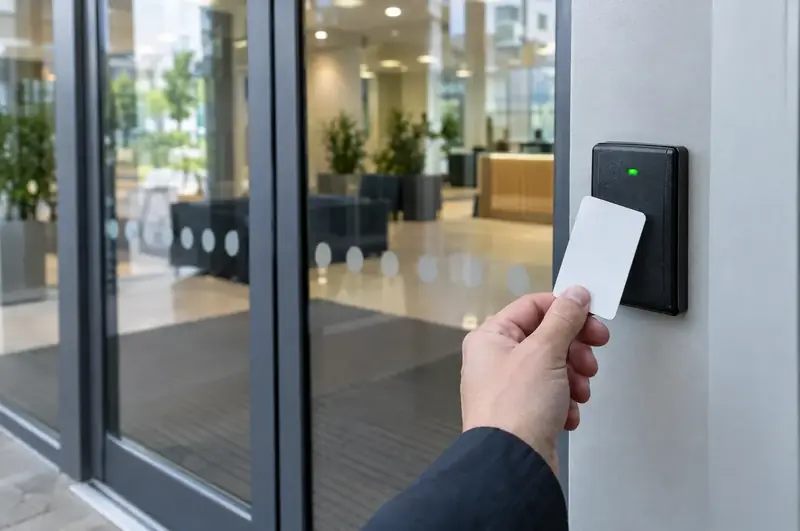
An automatic door that opens for anyone suits a shop during trading hours, but not a staff entrance, a residential block or a ward. Access control decides who the door opens for and when. The person presents a card, fob or code, the system checks it, and the lock releases and the door opens without anyone touching it.
Getting this right is mostly about how the access control system and the door operator talk to each other, and about making sure the door still lets people out safely. A badly wired system can leave a door locked when the alarm sounds or open when it should be secure.
We link access control to new and existing automatic doors, either connecting to your current system or supplying a standalone one. The work is carried out by specialist engineers working under our management, after a free survey and a fixed, itemised written quote.
- Devices
- Card and fob readers, keypads, video entry, timers
- Typical lead time
- typically 2 to 4 weeks
- Usually suits
- Offices, residential blocks, healthcare, schools
- Safety reference
- BS EN 16005
How does an automatic door receive access control signals?
An automatic door operator receives simple signals from the access control system through its control inputs. In most installations, a relay in the access controller closes a contact that tells the operator to release the lock and open, or to change mode. The operator then runs its normal opening cycle, with all its safety sensors still active.
Signals can go the other way too. Many operators can report that the door is open, closed, locked or held open, so the access control system can flag a door that has been forced or left open. Choosing which signals to use, and wiring them correctly, is the core of the job.
- The user presents a card, fob, code or calls on the intercom.
- The access controller checks the credential against its schedule and permissions.
- A relay sends an open signal to the door operator and releases any electric lock.
- The door opens, waits while the person passes and closes, with safety sensors working as normal.
- The lock re-engages and the door reports its status back to the system.
Which access control devices can be linked to an automatic door?
Almost any access control device that can provide a clean switching signal can be linked to an automatic door. The choice depends on how many people need access, how often permissions change and whether you need a record of who came in.
- Card and fob readers: the usual choice for staff and residents, with credentials added or removed centrally.
- Keypads: simple and cheap to run, best where a small group shares a code that is changed regularly.
- Video entry and intercoms: let reception or a resident see a visitor and release the door remotely.
- Remote release buttons: a button at a reception desk or nurses' station to open the door for visitors.
- Phone and app credentials: supported by many current systems as an alternative to cards.
Can the door lock itself at night and open on a schedule?
Yes. Time schedules are one of the most useful parts of access control on an automatic door. During opening hours the door can run fully automatic, opening for anyone, and outside those hours it switches to card or code entry only, with the electric lock engaged.
Night locking is usually done with an electric lock built into the operator or fitted to the leaf. Schedules can follow weekly patterns and holiday dates, and some buildings use a single command to lock all entrances at once. Where schedules change the door's mode, it is worth recording which mode the door is in at each time of day.
How do people get out when the door is secured?
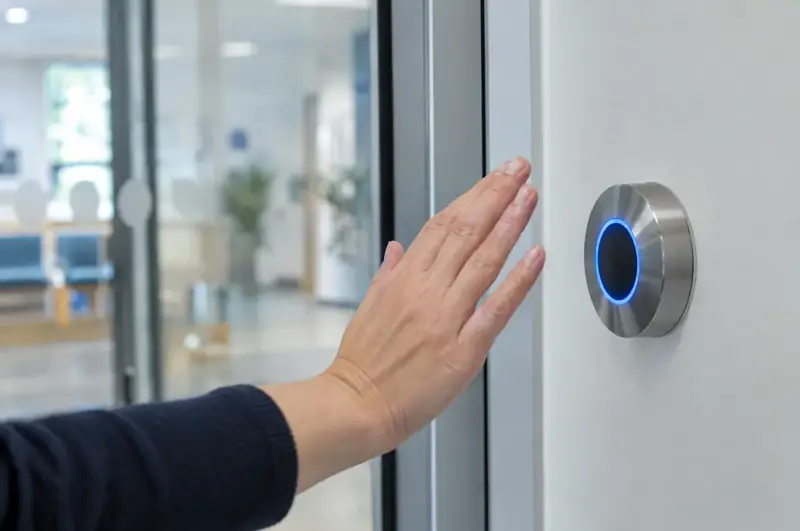
People get out of a secured automatic door using an exit device on the inside, such as a motion sensor, a push button or a wave switch, or by the door running in exit-only mode. On an escape route, the door must let people out safely in an emergency, so it is set up to open, break out or be openable by hand, whichever the building's fire strategy requires.
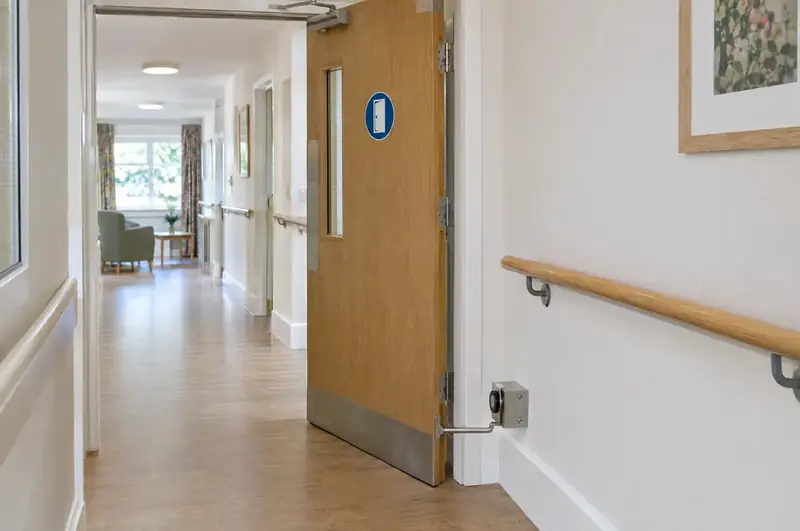
On a fire alarm signal, the access control system or the operator releases the locks and, where the strategy requires it, opens the door and holds it open. Electric locks on escape routes are normally fail-safe, meaning they release if power is lost. A green emergency door release beside the door is often fitted as well, so the lock can be released by hand.
Can access control be added to our existing door and system?
Usually, yes. Most automatic door operators have inputs for access control, and most access control systems have outputs to drive them. The survey checks that the two are compatible, that an electric lock can be fitted to the door, and where the cables will run between the reader, controller and operator.
If you already have an access control system, we can work with your security installer so the automatic door joins the existing system and its permissions. If you do not, a standalone keypad or reader can be supplied for the door. Either way, the quote sets out who is responsible for which part.
What does the survey check, and how is it tested?
The survey checks the operator and its inputs, the door's lock options, the route for cables, the power supplies, the fire alarm interface and how the door should behave at each time of day. Lead time is typically 2 to 4 weeks from order, and most single doors are wired and commissioned in a day.
Before handover, the door is tested in each mode, with each credential type, on power loss and on a fire alarm signal, and the results are recorded. The door and the access control should then be serviced together, so a fault in one does not leave the other untested. See touch-free activation for exit devices.
Which access control set-up suits your door?
| Option | What it is | Best for |
|---|---|---|
| Standalone keypad | A code pad wired straight to the door | Small offices, staff rooms and single doors |
| Card or fob reader | A reader linked to a central access control system | Offices, healthcare and multi-door sites |
| Video entry | Camera and intercom with remote door release | Residential blocks and staffed receptions |
| Timer and schedule | Changes the door's mode at set times | Buildings open to the public in set hours |
| Exit-only mode | Door opens freely from inside, locked from outside | Out-of-hours exits and one-way routes |
| Remote release button | A button at a desk that opens the door | Receptions, nurses' stations and school offices |
How much does access control for an automatic door cost?
Linking access control to an automatic door, with the reader or keypad, electric lock and wiring, is from £795 ex VAT as a guide. The table shows what moves the price; your written quote is the price you pay.
| Item | Guide price | Notes |
|---|---|---|
| Card or fob reader tied into the door | £795 – £2,495 | per door, ex VAT |
| Intercom or door entry tie-in | from £495 | priced on survey, ex VAT |
| Timed locking and night mode set-up | included with the above | programmed at commissioning |
| Electric lock added to an automatic door | on survey | depends on the door and the lock type |
Standards and the law
BS EN 16005 is the current standard for the safety in use of powered pedestrian doors, and BS 7036-0:2014 is the British code of practice for risk assessment and risk reduction used alongside it. Standards are not law in themselves, but they are the recognised benchmark for showing an automatic door is safe to use, and we set up, test and document doors with reference to them.
Whoever motorises a manual door, or builds an automatic door from separate parts, may take on the manufacturer’s legal duties for the finished door: a risk assessment, a technical file kept available for the authorities, a Declaration of Conformity, the conformity marking and instructions. You receive the Declaration of Conformity and the instructions at handover.
The law that applies also depends on the nation. The table shows the main differences; each county and town page carries the rules for its own nation.
| Nation | Accessibility | Building regulations guidance | Fire safety law |
|---|---|---|---|
| England | The Equality Act 2010 | Approved Document M (Volume 2): powered opening where opening force would exceed 30 N, or 22.5 N from 30° to 60°; 1000 mm clear width for public entrance doors in new buildings | Regulatory Reform (Fire Safety) Order 2005: the responsible person |
| Wales | The Equality Act 2010 | Approved Document M (Wales): powered opening where opening force would exceed 20 N; 1000 mm clear width for public entrance doors in new buildings | Regulatory Reform (Fire Safety) Order 2005: the responsible person |
| Scotland | The Equality Act 2010 | Building (Scotland) Regulations 2004, non-domestic Technical Handbook: accessible entrance with at least 800 mm clear opening; building warrant for building work | Fire (Scotland) Act 2005: whoever has control of the premises |
| Northern Ireland | The Disability Discrimination Act 1995 | Building Regulations (Northern Ireland) 2012: powered doors must not trap people and must open on power failure; access guidance in Technical Booklet R | Fire and Rescue Services (Northern Ireland) Order 2006 and Fire Safety Regulations (Northern Ireland) 2010 |
Questions about access control for automatic doors
Can our existing access control system run our automatic door?
Usually, yes. Most systems have outputs that can drive an automatic door operator, and most operators have inputs to receive them. We check compatibility at the survey and can work with your security installer so the door joins your existing system and permissions.
What happens to a locked automatic door when the fire alarm sounds?
On an escape route, the locks are normally set to release on a fire alarm signal and, where the fire strategy requires it, the door opens and stays open. We wire and test this at handover. Doors not on escape routes may behave differently, as set out in the fire strategy.
What is the difference between fail-safe and fail-secure locks?
A fail-safe lock releases when it loses power, so the door can be opened. A fail-secure lock stays locked without power. Doors on escape routes normally use fail-safe locks so people are not trapped. Fail-secure locks are used where security comes first and escape is provided another way.
Can the door stay open for the public by day and need a card at night?
Yes. A schedule can run the door fully automatic during opening hours and switch it to card or code entry, with the lock engaged, out of hours. Holiday dates and one-off changes can be added, and staff can override the schedule with a key switch if needed.
Can visitors be let in from reception?
Yes. A remote release button at the reception desk, or a video entry system, lets staff see who is there and open the door for them. The door then runs its normal opening cycle and closes and relocks behind the visitor.
Do you install access control for residential blocks?
Yes. Communal entrance doors in residential blocks commonly use fob readers for residents and video entry for visitors. An automatic door makes the entrance easier for disabled residents and anyone carrying shopping or pushing a pram. Fire alarm and power-loss behaviour are agreed with the building's managing agent.
Will access control slow the door down?
Only by the moment it takes to read the card or code. Once access is granted, the door opens at its normal speed. Where people arrive in groups, the door can be set to stay open for a little longer after a valid card, so the next person does not have to wait.
Who maintains the access control after installation?
That depends on how the system was supplied. If we supply a standalone system, we can maintain it with the door. If it is part of a wider security system, your security installer usually maintains the system and we maintain the door, with the link between them tested on each service.