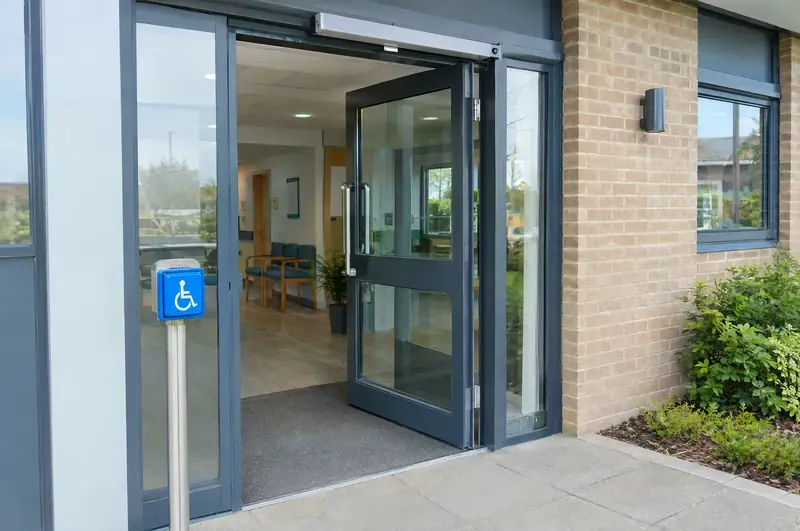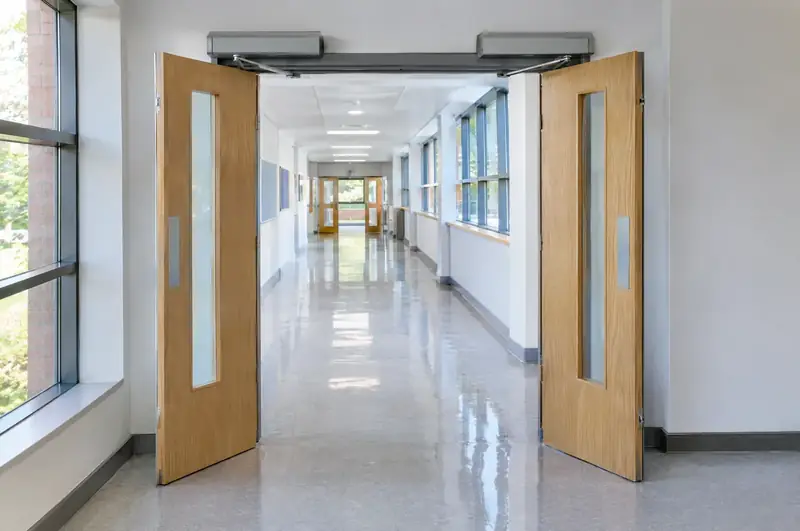
Swing doors are everywhere: corridor doors, office entrances, toilet blocks, school halls and hospital wards. When a door like that is used all day by staff with trolleys, visitors with walking aids or pupils moving between lessons, an automatic swing operator removes the push and keeps people moving.
This page covers full-energy operators, which open a door briskly and with enough power for busy routes. Because the door moves quickly and with force, it is protected by safety sensors on the leaves and guarding where needed. For quieter doors where slow, gentle movement is enough, see accessible door operators, which use low-energy operators.
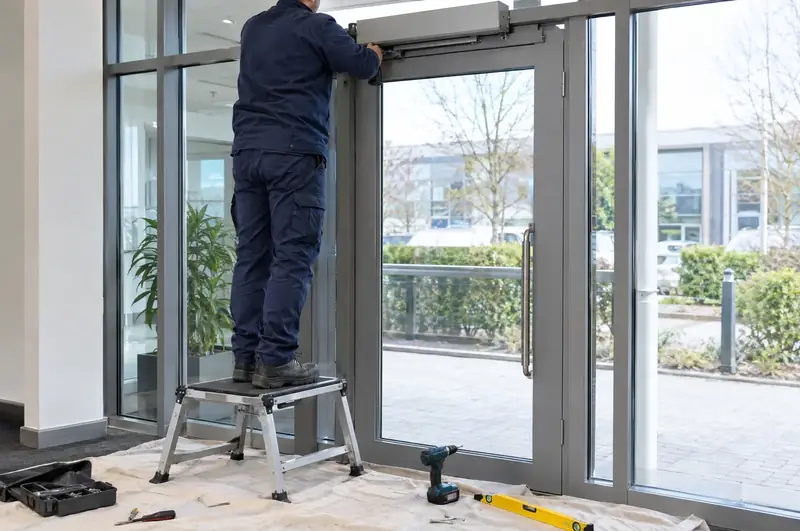
We supply and fit operators on new doors and on sound existing doors, single or double, in timber, aluminium or steel. Specialist automatic door engineers working under our management carry out the survey and installation, and every door is set up, tested and documented with reference to BS EN 16005. The survey costs you nothing and the price you are quoted is fixed.
- Typical clear opening
- 750 mm to 1,200 mm per leaf
- Typical lead time
- Typically 2 to 4 weeks for an operator on an existing door
- Usually suits
- Corridors, entrances, schools, hospitals
- Safety reference
- BS EN 16005
How does an automatic swing door operator work?
An automatic swing operator is a motor and gearbox in a slim box fixed above the door, connected to the leaf by an arm. When the operator receives a signal, it drives the arm to swing the door open, holds it for a set time and then closes it, usually with a spring inside the operator providing the closing force.
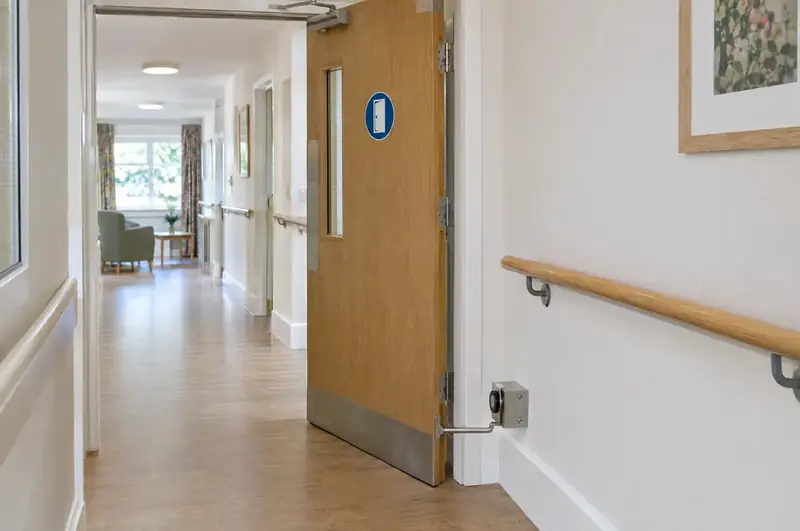
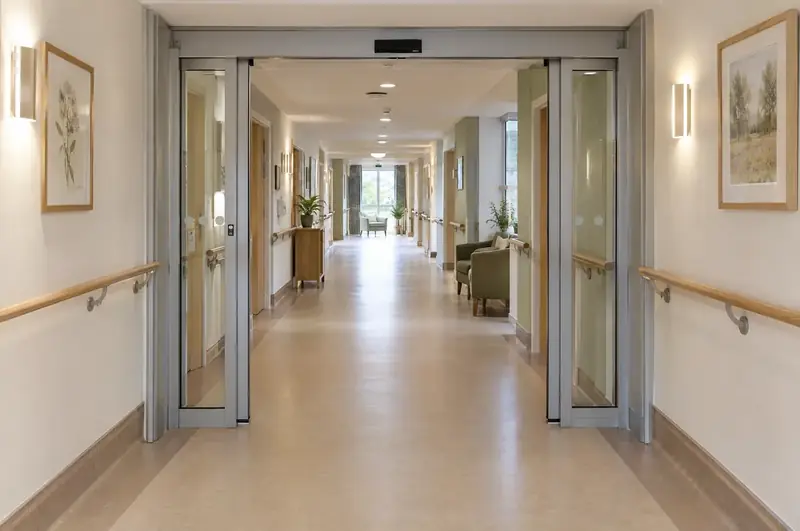
There are two arm types. A push arm is used when the door opens away from the operator side. A slide arm, running in a track on the door, is used when the door opens towards the operator side and gives a neater look. On double doors, two operators work together in sequence, so leaves with overlapping meeting edges open and close in the right order.
Full-energy or low-energy: which do I need?
The choice depends on how busy the door is and who uses it. A full-energy operator opens the door quickly and is right for busy corridors, main entrances and routes where people walk through without stopping. Because a fast-moving door could strike someone, it needs safety sensors on both faces of the leaf and, where people can walk into the swing area from the side, guard rails or other protection.
A low-energy operator moves slowly and with low force, so it can sometimes be used without leaf sensors, but only where a risk assessment shows a low risk to the people using the door. It suits a surgery consulting room or an accessible toilet, not a busy school corridor. The survey looks at the traffic and the users and recommends the right type. Our guide to low-energy and full-energy operators explains the difference in more detail.
Can my existing door be automated?
Usually, yes, if the door and frame are in good condition. The survey checks:
- that the hinges are sound, and whether they should be upgraded to heavier hinges or pivots
- The door weight and width, which decide the operator size
- that the frame or transom above can take the operator fixings
- The swing path, so nothing such as a radiator, light switch or wall is in the way
- fire door labels and records, because fire doors need a suitable operator and must close when the fire alarm operates
- existing locks, which may need replacing with an electric lock that releases before the door opens
Automating a door turns it into machinery. Whoever motorises a manual door may take on the manufacturer's duties for it, including the conformity paperwork and marking, so the Declaration of Conformity and instructions are handed over with the finished door. See automating an existing door.
What options are there for activation and locking?
- Sensors: radar motion sensors above the door for busy two-way traffic, with safety sensors on the leaves.
- Push pads and wave switches: for doors that should open only when someone asks, such as cross-corridor doors.
- Access control: card readers, fobs, keypads and intercoms wired so the lock releases and the door opens in one action.
- Electric locking: electric strikes or magnetic locks coordinated with the operator, so the lock releases before the arm moves.
- Fire alarm link: so the door closes, or opens, as the fire strategy requires when the alarm sounds.
- Programme switch: automatic, hold open, exit only and off, set by staff.
- Battery backup: where the door must keep opening during a power cut.
How is a swing door operator installed?
- The existing overhead closer, and any lock that will not work with the operator, is removed.
- The operator is fixed above the door and the arm is fitted to the leaf.
- Power is connected from a fused spur, and any links to locks, access control or the fire alarm are wired.
- Safety sensors are fitted to both faces of the leaf, with guarding where needed.
- The engineer sets opening and closing speed, back-check, hold-open time and closing force for the people using the door.
- Every safety function is tested and a site-specific risk assessment is completed.
A single door usually takes half a day to a day; a pair of doors takes a day or so. Operators for existing doors are typically 2 to 4 weeks from order.
What checks and servicing does a swing door need?
Staff should check each day that the door opens fully, closes without slamming and does not move towards someone standing in its swing path. Wedges, coat hooks and furniture should be kept out of the swing area, because they strain the operator and the arm.
Workplace doors have to be kept maintained and in good working order. A trained engineer should check the safety sensors, operator and fixings at least once a year, and busier doors in schools, hospitals and offices are often serviced more often, as the manufacturer's instructions and the level of use dictate. See automatic door servicing.
Which swing door set-up suits your door?
| Option | What it is | Best for |
|---|---|---|
| Single door, push arm | Operator on the side the door opens away from | Corridor and office doors |
| Single door, slide arm | Operator on the side the door opens towards, arm in a track | Entrances where a neat look matters |
| Double doors | Two operators working in sequence | Main corridors, halls and wide entrances |
| Fire door operator | Operator suited to fire doors, closing on alarm | Compartment and cross-corridor fire doors |
| New door and operator | A new doorset supplied with the operator fitted | Worn doors or new openings |
| Low-energy alternative | Slower, gentler operator | Quieter doors, see accessible door operators |
How much does an automatic swing door cost?
A full-energy automatic swing door is from £2,495 ex VAT as a guide for a single leaf, with double doors, fire doors and new doorsets costing more. The table shows what moves the price; your written quote is the price you pay.
| Item | Guide price | Notes |
|---|---|---|
| Full-energy operator on an existing single door, with safety sensors | £2,495 – £3,995 | installed, ex VAT |
| Operators on an existing pair of doors | £3,795 – £6,495 | installed, ex VAT |
| New single automatic swing door set (door, frame and operator) | £3,495 – £6,495 | installed, ex VAT |
| New double automatic swing door set | £7,995 – £9,995 | installed, ex VAT |
| Touch-free switch or push pad, fitted | £145 – £395 | per switch, ex VAT |
| Card or fob reader tied into the door | £795 – £2,495 | per door, ex VAT |
Standards and the law
BS EN 16005 is the current standard for the safety in use of powered pedestrian doors, and BS 7036-0:2014 is the British code of practice for risk assessment and risk reduction used alongside it. Standards are not law in themselves, but they are the recognised benchmark for showing an automatic door is safe to use, and we set up, test and document doors with reference to them.
Whoever motorises a manual door, or builds an automatic door from separate parts, may take on the manufacturer’s legal duties for the finished door: a risk assessment, a technical file kept available for the authorities, a Declaration of Conformity, the conformity marking and instructions. You receive the Declaration of Conformity and the instructions at handover.
The law that applies also depends on the nation. The table shows the main differences; each county and town page carries the rules for its own nation.
| Nation | Accessibility | Building regulations guidance | Fire safety law |
|---|---|---|---|
| England | The Equality Act 2010 | Approved Document M (Volume 2): powered opening where opening force would exceed 30 N, or 22.5 N from 30° to 60°; 1000 mm clear width for public entrance doors in new buildings | Regulatory Reform (Fire Safety) Order 2005: the responsible person |
| Wales | The Equality Act 2010 | Approved Document M (Wales): powered opening where opening force would exceed 20 N; 1000 mm clear width for public entrance doors in new buildings | Regulatory Reform (Fire Safety) Order 2005: the responsible person |
| Scotland | The Equality Act 2010 | Building (Scotland) Regulations 2004, non-domestic Technical Handbook: accessible entrance with at least 800 mm clear opening; building warrant for building work | Fire (Scotland) Act 2005: whoever has control of the premises |
| Northern Ireland | The Disability Discrimination Act 1995 | Building Regulations (Northern Ireland) 2012: powered doors must not trap people and must open on power failure; access guidance in Technical Booklet R | Fire and Rescue Services (Northern Ireland) Order 2006 and Fire Safety Regulations (Northern Ireland) 2010 |
Questions about automatic swing doors
What is a full-energy swing door operator?
It is an operator that opens and closes a swing door at a normal walking pace, with enough force for busy traffic. Because the door moves quickly, it must be protected with safety sensors and, where needed, guarding. Full-energy operators suit busy corridors and entrances, while low-energy operators suit quieter doors used mainly by people who need help opening them.
Can an automatic operator be fitted to a fire door?
Yes, with a suitable operator and set-up. Fire doors that are held open must close automatically when the fire alarm operates, so the operator is linked to the alarm and the door is checked to make sure it closes and latches. The operator and its fixings must suit the fire door, and the survey checks its labels and condition.
Which way should an automatic swing door open?
Usually the way it opens now, unless the escape route or the corridor layout suggests otherwise. Doors on escape routes normally open in the direction of escape. The survey checks what sits in the swing path on both sides, and whether the door should be rehung to open the other way when the operator is fitted.
Do I need sensors on both sides of the door?
On a full-energy door, yes. A safety sensor on the opening face stops the door striking someone in its path, and one on the closing face stops it closing onto someone. Activation sensors or push pads then trigger the door from each side. The engineer sets and tests every sensor zone before handover.
Can we still open the door by hand?
Yes. Most swing operators let the door be pushed open manually when the power is off or the operator is switched off, with the closing spring returning it afterwards. That matters on escape routes and during power cuts. How much effort it takes to open by hand is checked during commissioning.
How long does it take to automate a swing door?
A single door usually takes half a day to a day on site, and a pair of doors about a day, once the operator has arrived. Operators for existing doors are typically 2 to 4 weeks from order. New doorsets take longer because the door and frame are made to measure.
Will an automatic swing door work with our door entry system?
Usually, yes. The operator can be wired to card or fob readers, keypads, intercoms and timers, and to an electric lock that releases just before the door starts to open. Tell us what you have at the survey, and the quote will show the interface work needed and who carries it out.
Are automatic swing doors suitable for windy external entrances?
They can be, but wind makes swing doors harder to control. A stronger operator, a lobby or canopy, and careful setting of opening and closing forces all help. On very exposed entrances a sliding door is often more reliable, and the survey will tell you if that is the case for your building.