How often should an automatic door be serviced?
An automatic door should be serviced at intervals set by the manufacturer's instructions and how heavily it is used, and we recommend a trained engineer checks its safety functions at least once a year. Busy doors are often serviced every six months, and some very heavily used doors more often than that.
The table shows how we usually recommend intervals. It is a starting point, and the right interval for your door is agreed after an engineer has looked at it.
| How the door is used | Examples | Our usual recommendation |
|---|---|---|
| Light use | Internal office doors, quiet side entrances, accessible toilets | At least one service visit a year |
| Moderate use | GP surgeries, small shops, office receptions | One or two visits a year, depending on the door |
| Heavy use | Supermarkets, hospital main entrances, shopping centres, stations | Every six months, or more often where the door works very hard |
| Vulnerable users | Care homes, wards, schools, supported housing | Set by the risk assessment, often every six months |
| Exposed or harsh sites | Coastal, dusty or windswept entrances | More often than the use alone would suggest |
Doors that are part of the building's fire precautions, such as escape route doors with break-out or fail-safe opening, also need their emergency functions checked as part of the fire safety maintenance regime.
Is automatic door servicing a legal requirement?
There is no law that says an automatic door must be serviced at a set interval, but the law does require doors in workplaces to be kept in efficient working order and in good repair under a suitable system of maintenance. Regular servicing and a written record are the usual way to show that.
The workplace regulations in Great Britain and Northern Ireland set this maintenance duty, and HSE's guidance on them lists powered doors among the equipment that needs a system of maintenance. The guidance says how often maintenance is needed depends on the equipment, particularly the manufacturer's information and instructions.
Fire safety law adds a maintenance duty for doors and devices that form part of the fire precautions. In England and Wales it falls on the responsible person under the Regulatory Reform (Fire Safety) Order 2005. In Scotland it falls on the person responsible for fire safety under the Fire (Scotland) Act 2005. In Northern Ireland it falls on the person with fire safety duties under the Fire and Rescue Services (Northern Ireland) Order 2006 and the Fire Safety Regulations (Northern Ireland) 2010.
If an automatic door injures someone, records showing it was serviced, checked and repaired promptly are the clearest evidence that it was properly maintained.
What happens during an automatic door service?
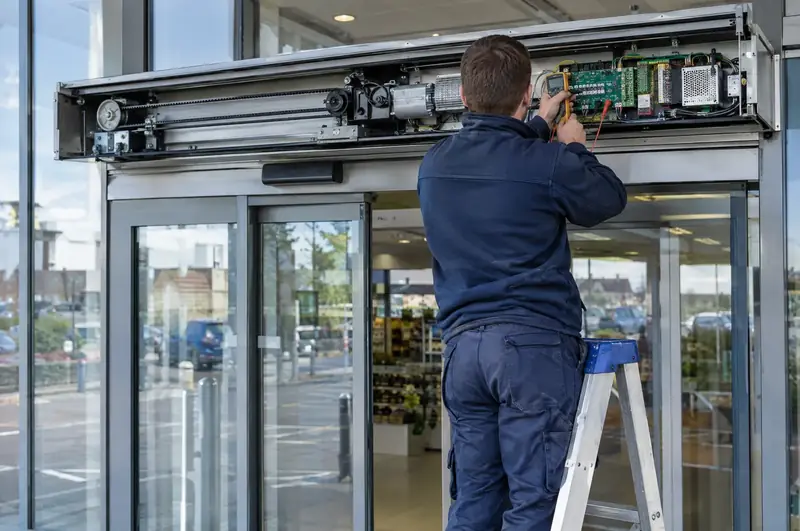
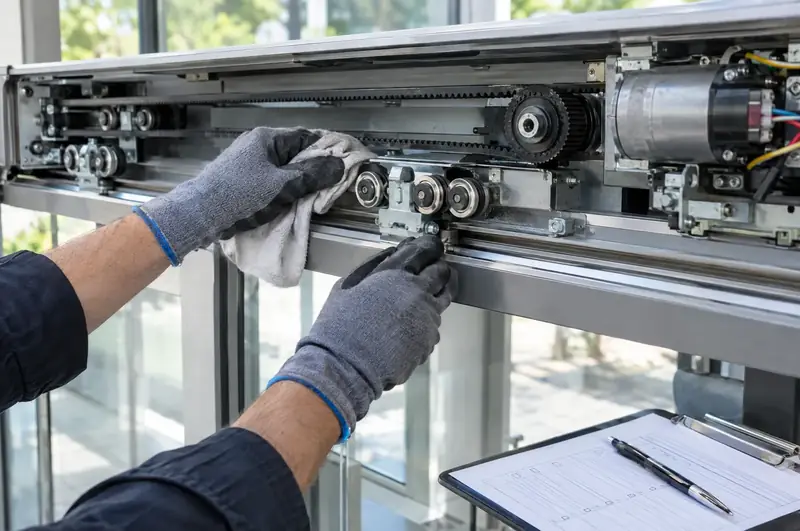
A service visit inspects, cleans, adjusts and tests the door so it keeps working and stays safe, then records what was done. On a typical visit the engineer will:
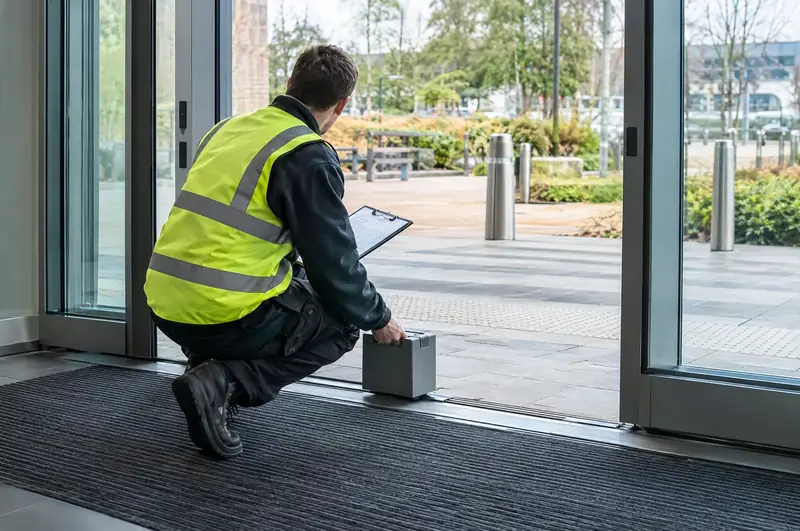
- ask site staff about faults, noises or near misses since the last visit
- inspect the operator, belt, rollers, track, floor guides and fixings for wear
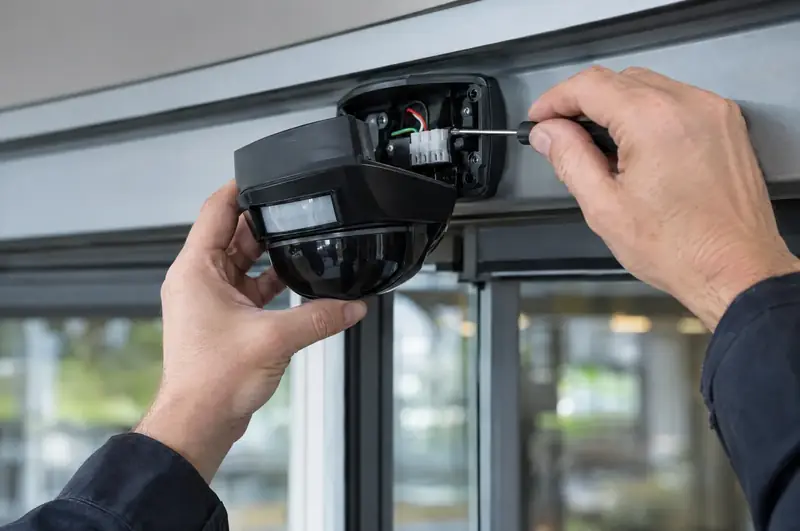
- clean the track and sensors and remove debris from the floor guide
- adjust speed, force, hold-open time and closing as needed
- test the activation and safety sensors in every hazard zone
- check power failure behaviour, battery backup and break-out where fitted
- check signs, push pads, glass and guards
- update the service record and quote for any further work needed
A service is not the same as a safety inspection. An inspection is a documented check against BS EN 16005 with a risk assessment, and the two can be combined on one visit. See safety inspections.
What checks should site staff do between services?
Between service visits, someone on site should carry out simple, regular safety checks and keep a record of them. These checks take a few minutes, often daily or weekly depending on how busy the door is, and they catch problems early.
- the door opens and closes smoothly, without jerking, noise or rubbing
- the door opens as people approach, or when the push pad is pressed
- the door stops or reverses if someone stands in its path as it closes, tested with care
- glass, leaves and guards are undamaged
- the floor guide and track are clear of stones, litter and ice
- signs are in place and readable
- nothing is stored in the door's path or swing area
- break-out leaves are back in place and locked after use
If a check fails, take the door out of automatic use as its instructions describe and arrange a repair. Do not try to adjust the operator yourself. See automatic door repairs.
What records should you keep?
Keep a log of every service, repair and safety check, because it is the clearest way to show the door is being properly maintained. A paper logbook by the door or a shared digital record both work, as long as it is kept up to date.
Each entry should show:
- the date and who carried out the work or check
- what was tested and the result
- any faults found and what was done about them
- parts replaced
- recommendations and when they were completed
Keep the log with the door's risk assessment, instructions and handover paperwork. Where machinery has a maintenance log, work equipment law may also expect it to be kept up to date.
What happens if an automatic door is not serviced?
An automatic door that is not serviced is more likely to break down, and worn parts or drifting settings can make it unsafe before anyone notices. Belts stretch, rollers wear, sensors get knocked out of alignment and batteries lose their charge, and each of these can change how the door behaves.
A door that fails at a main entrance can stop trade, block an accessible route or leave a building insecure overnight. Small faults left unchecked also tend to become bigger repairs, such as a worn roller damaging a track or a slipping belt straining the motor.
There is a liability side too. If the door injures someone and there is no record of maintenance, it is much harder for the business to show it took reasonable care.
Insurers and landlords may also ask for service records, particularly for doors used by the public. Keeping the door on a regular schedule, with a record of every visit, is usually cheaper over the life of the door than waiting for it to fail.
What are the signs an automatic door needs attention?
The signs that an automatic door needs attention before its next service are changes in how it moves, sounds or responds. Spotting them early usually means a smaller repair. Look out for:
- grinding, squealing or knocking from the operator or track
- leaves that judder, drag, bounce or stop short of fully open or fully closed
- a door that opens for people walking past, or fails to open for people approaching
- a door that is slow to react when someone stands in its path as it closes
- a swing door that slams, or a sliding door that hits its end stops hard
- error lights or codes on the operator or programme switch
- a door that will not open in a power cut when it is meant to
If you notice any of these, record it and arrange a visit. Where the door could hurt someone, take it out of automatic use until it has been checked.
Who should service an automatic door?
An automatic door should be serviced by a trained automatic door engineer who understands BS EN 16005 and the type of door you have. Servicing involves adjusting safety settings, so it is not a job for general maintenance staff, whose role is the simple site checks.
When comparing service providers, ask what each visit includes, whether safety sensors are tested in every hazard zone, whether you get a written record after every visit, and how parts and further work are priced. Work on automatic door servicing is carried out by specialist automatic door engineers working under our management, and each visit is recorded.
How much does automatic door servicing cost?
A planned service visit is from £145 ex VAT (£174 inc VAT) for the first door on site as a guide, and further doors on the same visit cost less. Service contracts with one or two visits a year spread the cost and keep the record in one place.
A safety inspection and risk assessment is typically £125 to £250 ex VAT per door, and it can often be combined with a service. Repairs found during a service are quoted before they are done, and the visit price is always agreed in writing before an engineer attends.
See automatic door servicing for contract options, or the price guide for the full table.
Questions
Do new automatic doors need servicing straight away?
A new door should have its first service at the interval in its instructions, and site checks should start from day one. Warranty terms are set out in your written quote, and they may depend on the door being serviced.
Can you service an automatic door you did not install?
Usually, yes. Servicing covers sliding, swing, folding and revolving doors from the major European operator brands. Knowing the door's make and model before the visit helps the engineer bring the right parts.
Is a service the same as a safety inspection?
No. A service keeps the door working by inspecting, cleaning, adjusting and testing it. A safety inspection is a documented check against BS EN 16005 with a site-specific risk assessment and a written report. Many sites combine the two on one visit.
Does the law require six-monthly servicing?
No. No law sets a fixed interval. The law requires a suitable system of maintenance, and the interval comes from the manufacturer's instructions and how hard the door works. Six-monthly servicing is our recommendation for busy doors, not a legal rule.
We have doors on several sites. Can they go on one schedule?
Yes. A schedule can cover every door across your sites, with one record per door and visits planned to suit each building. The price for each visit is agreed in writing before any engineer attends.