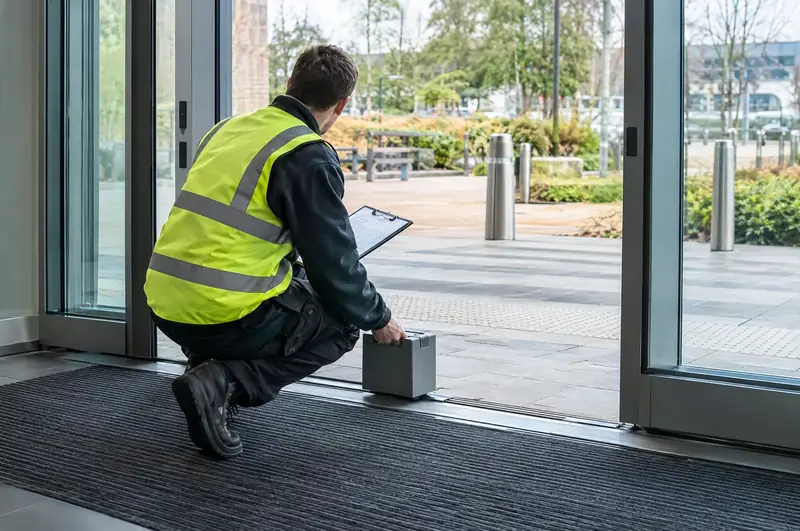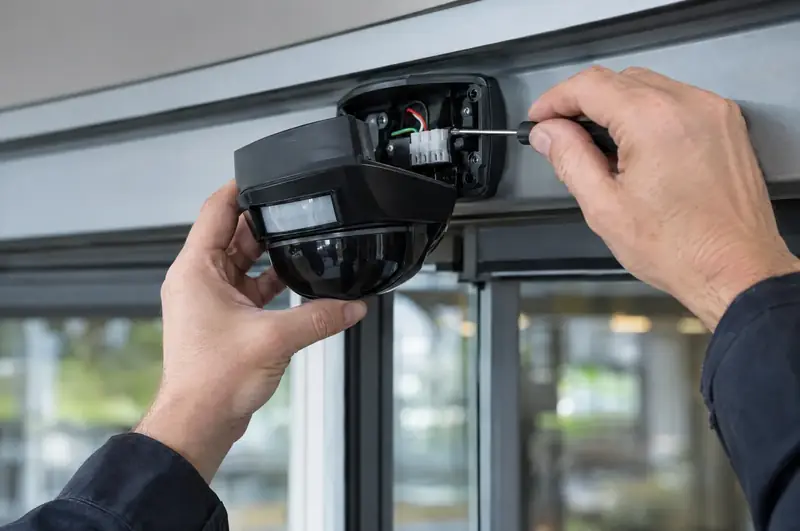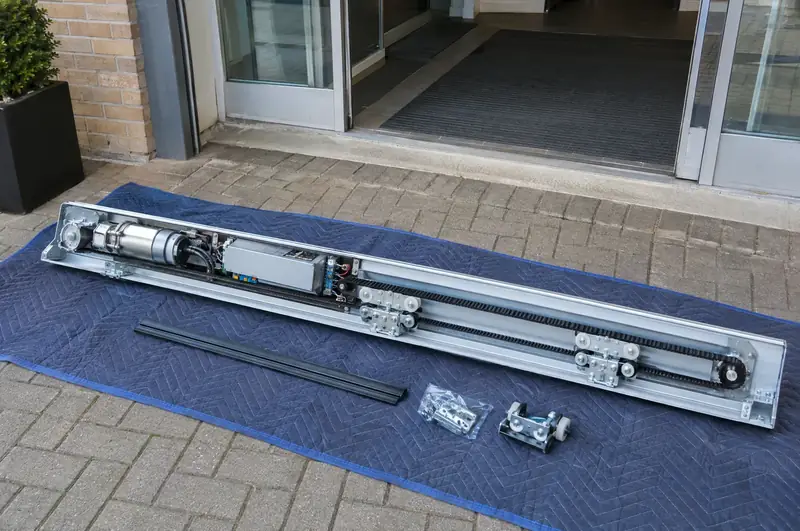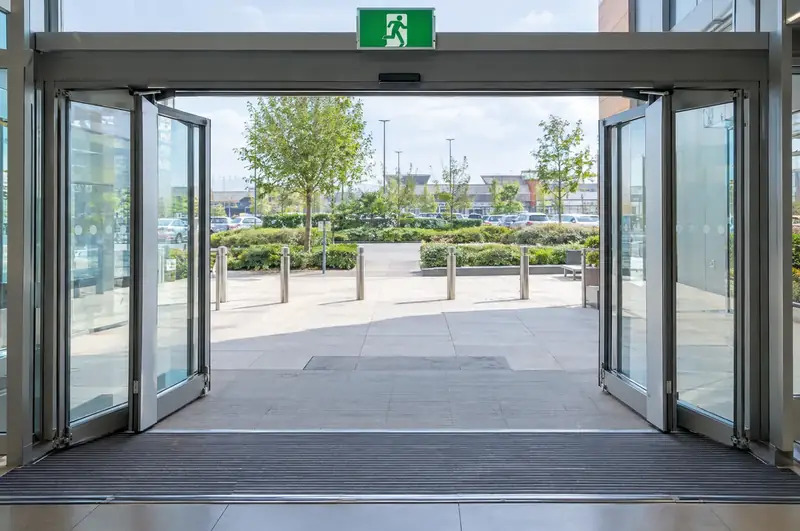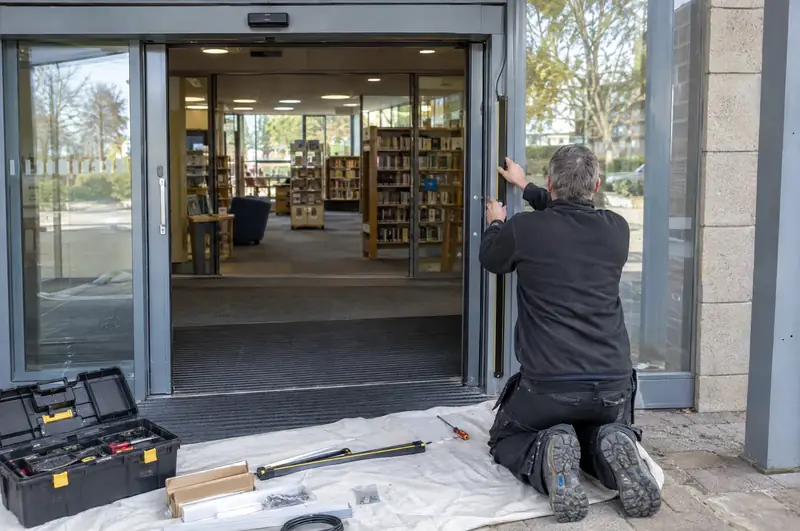
Many automatic doors in use today were fitted before the current version of BS EN 16005, or have been altered since. They still open and close, but a risk assessment may show closing edges with no sensors, unguarded gaps beside the leaves, no battery backup on an escape route or signs that peeled off years ago.
We carry out the upgrades that close those gaps, item by item, on sliding, swing, folding and revolving doors from most makers. We can work from your inspection report, whether it came from us or from another company, and we record each change so the report's actions can be closed off.
The survey is free. You receive a fixed, itemised written quote with each upgrade priced on its own, so the high-priority items can be done first and the rest planned for later. Warranty terms are set out in the quote.
- Typical upgrades
- Sensors, guarding, battery backup, signs
- Typical lead time
- typically 1 to 3 weeks
- Usually suits
- Older doors after a risk assessment
- Safety reference
- BS EN 16005
What are automatic door compliance upgrades?
Compliance upgrades are changes to an existing automatic door that reduce the risks found by a site-specific risk assessment. They bring the door's safety features closer to what BS EN 16005 and the BS 7036-0 code of practice describe, for the people who actually use it.
Standards are not law in themselves and are not retrospective, so an older door is not unlawful simply because the standard has moved on. Workplace law does, however, expect powered doors to have suitable and effective features that stop people being trapped and, where safety needs it, to be openable by hand if the power fails unless they open automatically. Upgrades are the practical way to get an older door there, and they usually cost far less than replacing a door that still works well.
Which upgrades are most common?
The most common upgrades deal with sensors, finger traps, power failure and visibility:
- Safety sensors: presence sensors or leaf-mounted sensors that stop the door closing on someone standing in its path;
- Side-screen protection: light curtains, guard screens or barriers that protect the gap between a sliding leaf and a fixed panel;
- Finger guards: hinge-side guards on swing doors, where the leaf meets the frame;
- Programme switch: a key-operated or code-protected switch, so only staff can change the door's mode;
- Battery backup and fail-safe opening: so a door on an escape route opens, or can be opened by hand, if the power fails;
- Signs and manifestation: door signs and markings on the glass so people can see it clearly;
- Documentation: updated settings, test results and user instructions for the altered door.
Do automatic doors on escape routes need special upgrades?
Doors on escape routes have to let people out safely during a fire or evacuation. Depending on the fire strategy for the building, an automatic door on an escape route is set up to open by itself, to break out when pushed, or to be openable by hand.
On older doors that often means adding a monitored battery so the door opens if the power fails, linking it to the fire alarm, or confirming that break-out leaves still swing out freely. The person responsible for fire safety in the building should confirm what the fire strategy requires, and the door is then set up and tested to match. Sliding doors that are not designed to break out, and revolving doors, usually need a separate escape door or special arrangements, which the fire strategy should cover.
Do I need an inspection before upgrades?
An inspection is the best starting point, because it tells you which gaps matter and how urgent each one is. If you already have a recent risk assessment, from us or another company, we can quote directly from it.
If you do not, we can carry out a safety inspection and risk assessment first, or survey the door for specific upgrades you already know you need, such as a key switch or new signs. The survey for upgrades is free; a documented inspection is a separate service, priced in writing before the visit.
How is the upgrade work carried out?
Most upgrades are completed in a single visit per door. The engineer fits the new devices, configures the controller to recognise them and then tests the door as a whole, using a test body on each hazard zone. The door is out of use for part of the visit, so work on busy entrances can be booked for a quieter time.
Upgrades can be phased. High-priority items are often done first, with lower-priority ones, such as signs or a programme switch, added at the next service visit. Where a door has several gaps and an old operator, the survey may show that a new drive unit with new sensors is better value than a series of separate upgrades, and the quote will set out both.
Some older controllers cannot monitor modern safety sensors at all. The survey checks this first, so you are not quoted for a sensor the door cannot use.
What records will I have afterwards?
After the upgrades you receive a record of each change: what was fitted, where, how it was set and the test results. Matching each change to the finding it addresses lets you close off the actions in the risk assessment one by one.
Keep the record with the inspection report and service history. Together they show the door has been assessed and the risks reduced, and they help the next engineer understand how the door is set up. Regular servicing then keeps the new features working as intended.
Upgrade options compared
| Option | What it is | Best for |
|---|---|---|
| Safety sensor upgrade | New presence or leaf-mounted sensors on closing edges and swing areas | Doors with motion-only sensors |
| Side-screen protection | Light curtains, guard screens or barriers beside sliding leaves | Gaps where hands could be drawn in |
| Battery backup | A monitored battery so the door opens or closes safely in a power cut | Escape routes and single entrances |
| Key programme switch | A lockable mode switch for staff only | Doors where the public can reach the switch |
| Signs and manifestation | Door signs and visible markings on the glass | Glass doors with faded or missing markings |
| Upgrade package | Several upgrades on one door in one visit | Older doors with a list of actions to close |
How much do automatic door safety upgrades cost?
Upgrading an existing automatic door is from £195 ex VAT as a guide; a single sensor sits at the lower end and a package of upgrades on an older door at the upper end. The table shows what moves the price; your written quote is the price you pay.
| Item | Guide price | Notes |
|---|---|---|
| Add or replace a safety or activation sensor | £195 – £495 | per sensor fitted, ex VAT |
| Side-screen protection or guarding | from £295 | per door, ex VAT |
| Battery backup for power-cut operation | £395 – £695 | per door, ex VAT |
| Programme switch with key | £145 – £345 | fitted, ex VAT |
| Upgrade package for an older door | £795 – £2,495 | typical, after an inspection, ex VAT |
Standards and the law
BS EN 16005 is the current standard for the safety in use of powered pedestrian doors, and BS 7036-0:2014 is the British code of practice for risk assessment and risk reduction used alongside it. Standards are not law in themselves, but they are the recognised benchmark for showing an automatic door is safe to use, and we set up, test and document doors with reference to them.
Whoever motorises a manual door, or builds an automatic door from separate parts, may take on the manufacturer’s legal duties for the finished door: a risk assessment, a technical file kept available for the authorities, a Declaration of Conformity, the conformity marking and instructions. You receive the Declaration of Conformity and the instructions at handover.
The law that applies also depends on the nation. The table shows the main differences; each county and town page carries the rules for its own nation.
| Nation | Accessibility | Building regulations guidance | Fire safety law |
|---|---|---|---|
| England | The Equality Act 2010 | Approved Document M (Volume 2): powered opening where opening force would exceed 30 N, or 22.5 N from 30° to 60°; 1000 mm clear width for public entrance doors in new buildings | Regulatory Reform (Fire Safety) Order 2005: the responsible person |
| Wales | The Equality Act 2010 | Approved Document M (Wales): powered opening where opening force would exceed 20 N; 1000 mm clear width for public entrance doors in new buildings | Regulatory Reform (Fire Safety) Order 2005: the responsible person |
| Scotland | The Equality Act 2010 | Building (Scotland) Regulations 2004, non-domestic Technical Handbook: accessible entrance with at least 800 mm clear opening; building warrant for building work | Fire (Scotland) Act 2005: whoever has control of the premises |
| Northern Ireland | The Disability Discrimination Act 1995 | Building Regulations (Northern Ireland) 2012: powered doors must not trap people and must open on power failure; access guidance in Technical Booklet R | Fire and Rescue Services (Northern Ireland) Order 2006 and Fire Safety Regulations (Northern Ireland) 2010 |
Questions about safety and compliance upgrades
Is my older automatic door illegal if it was fitted before the current standard?
No. Standards are not law in themselves and are not retrospective, so a door does not become unlawful when a standard is updated. What matters is whether the door is safe for the people using it now. A risk assessment shows that, and upgrades deal with any gaps it finds.
What is side-screen protection?
Side-screen protection stops hands and fingers being drawn into the gap between a sliding leaf and a fixed side screen or wall as the door opens. It can be a light curtain on the leaf edge, a guard screen, or a barrier that keeps people away from the gap. The right choice depends on the size of the gap and who uses the door.
Do all automatic doors need battery backup?
Not all of them, but doors on escape routes usually need to open, break out or be openable by hand if the power fails, as the fire strategy requires. Battery backup is the common way to make a sliding door open in a power cut. Doors that are not on escape routes may still benefit if they are the only accessible entrance.
Can you work from another company's inspection report?
Yes. Send us the report and we will quote each recommended action as a separate item. If anything in it is unclear, or the door has changed since it was written, the engineer checks on the free survey before the quote is finalised. You are under no obligation to use us for the work.
Why does the programme switch need a key?
The programme switch sets the door's mode, such as automatic, open, exit only or locked. If members of the public can change it, the door could be left in an unsafe mode. A key-operated or code-protected switch means only trained staff can change the mode, and the switch should be clearly labelled.
Do you need to upgrade every door at once?
No. Each upgrade is priced separately, so you can start with the high-priority items and plan others for later, often at the next service visit. Where several doors share the same gap, doing them together usually costs less per door and keeps the doors behaving consistently.
Will upgrades change how the door feels to use?
Mostly, users notice very little except that the door is safer, for example stopping when someone stands in the doorway. If sensor zones or speeds are changed to suit vulnerable users, the door may open a little earlier or close more gently. Any changes are explained at handover.
What paperwork do I get after upgrading?
You receive a record of each upgrade, its settings and the test results, linked to the inspection findings it addresses. If the work significantly changes the door, its documentation and user instructions are updated too. Keep everything together with the door's service history.