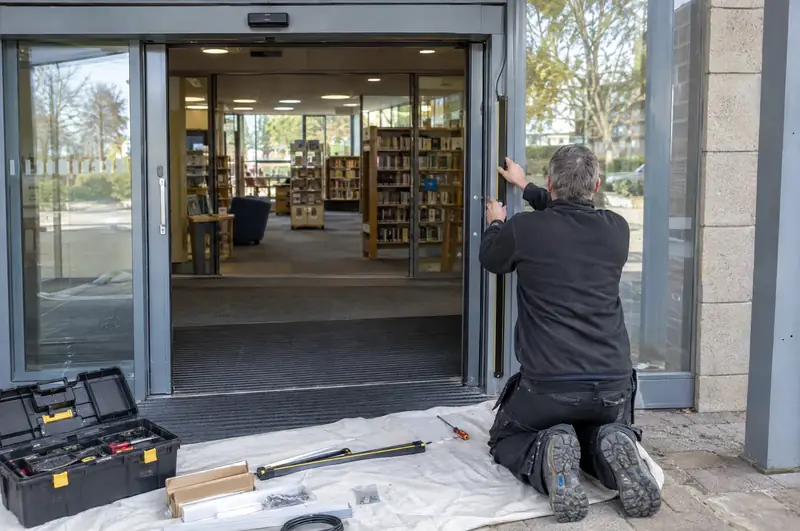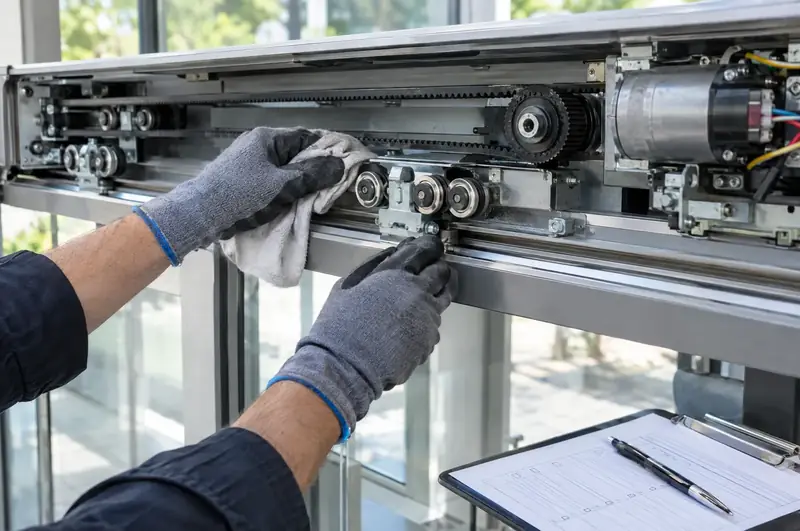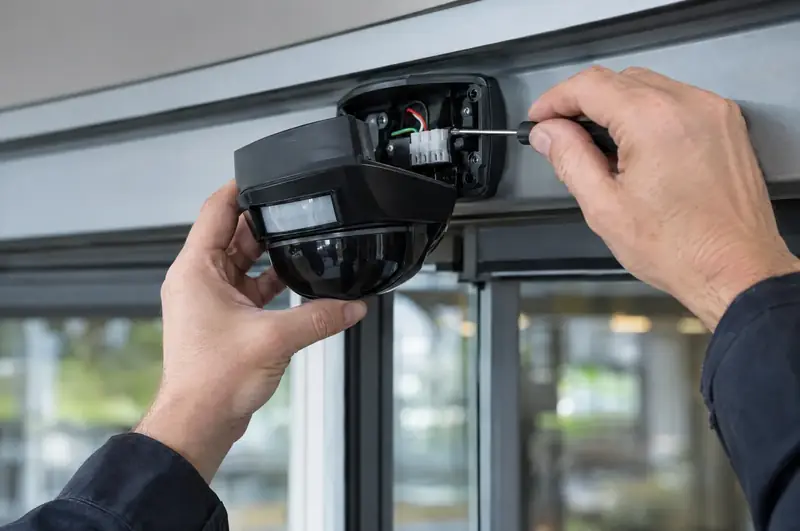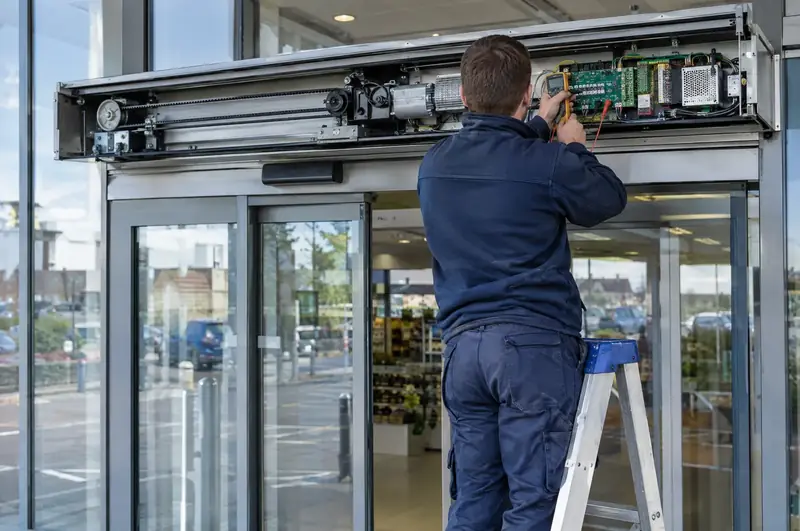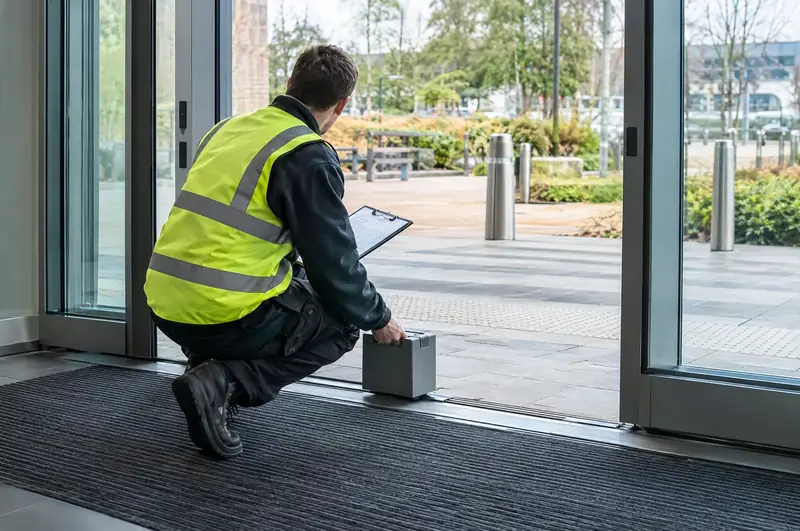
An automatic door can work perfectly and still put people at risk. Its sensors may not cover the full closing edge, a side screen may leave a finger trap, or the door may now move too quickly for the frail and elderly people who use it. A safety inspection looks at the door through the eyes of the people passing through it.
The engineers we send assess each door on site, test its safety devices and record the hazards with reference to BS EN 16005 and the BS 7036-0 code of practice. You receive a written report with each finding ranked by priority, and any upgrades are quoted separately so you can plan them.
The inspection fee is agreed in writing before the visit. Owners, landlords, insurers and facilities teams use the report as evidence that the door has been assessed by a competent person.
- Assesses
- Closing edges, opening areas, side screens
- You receive
- A written report with ranked priorities
- Usually suits
- Owners, landlords, insurers, facilities teams
- Safety reference
- BS EN 16005 and BS 7036-0
What is an automatic door risk assessment?
An automatic door risk assessment is a structured check of every place where the moving door could trap, crush, strike or cut someone, taking account of who uses the door and how. BS EN 16005 is the standard for the safety in use of powered pedestrian doors, and BS 7036-0 is the UK code of practice for risk assessment and risk reduction used alongside it.
The assessment is site-specific. The same door is a lower risk in a staff-only office corridor than at a care home entrance or a primary school, so the people using it shape what counts as acceptable protection.
Standards are not law in themselves and do not apply retrospectively. A door is not unlawful just because it was installed before the current version, but the assessment shows where it falls short and what is reasonable to put right.
Which hazard zones does the inspection cover?
The engineer checks each zone where the door's movement could hurt someone:
- Closing edges: where leaves meet each other or the frame, and whether safety sensors stop the door before it reaches a person.
- Opening area: the space a swing door sweeps through, and whether someone standing there is detected.
- Side screens and fixed panels: gaps between a sliding leaf and a fixed screen or wall, which can draw in hands and fingers.
- Hinge side of swing doors: the finger trap where the leaf meets the frame.
- Overhead and surroundings: the operator cover, canopy and any gap above the moving leaf.
- Glass: safety glazing and visible markings, so people do not walk into the leaves.
Each zone is tested in the door's normal modes, and on escape route doors the engineer also checks what happens when the fire alarm operates or the power fails.
What does the inspection report include?
The report records the door's details, how it is used, the tests carried out and each finding, with photos where they help. A typical report includes:
- The door location, type, make and model, and the people it serves;
- results of sensor tests on each hazard zone, carried out with a test body;
- a check of opening and closing speeds and how the door reacts to an obstruction;
- behaviour in a power failure and, on escape routes, when the fire alarm operates;
- signage, the programme switch and any manual release arrangements;
- each finding ranked by priority, with the recommended action.
How are findings prioritised?
Findings are ranked so you know what to act on first. We use three simple levels, often shown as red, amber and green:
| Priority | Meaning | Typical example |
|---|---|---|
| High | A hazard that could injure someone now; the door may need a safer mode until it is fixed | No safety sensor on a closing edge used by the public |
| Medium | A shortfall to plan for in the near term | Unprotected gap between a leaf and side screen on a busy door |
| Low | Good practice or a minor improvement | Faded signs or glass markings |
The report is yours to act on as you choose. Follow-up safety and compliance upgrades are quoted separately, item by item, and any competent installer can carry out the work if you prefer.
Who needs an automatic door safety inspection?
Anyone responsible for an automatic door used by staff or the public can benefit from one, and many are asked for it. Common reasons include:
- an insurer or landlord asking for evidence that the door has been assessed;
- taking over a building whose doors have an unknown history;
- a change in who uses the door, such as a shop unit becoming a clinic;
- a near miss or an incident involving the door;
- an older door that has never had a documented risk assessment;
- planning upgrades and needing a clear list of what is actually required.
Facilities teams with many doors often inspect every door once, then repeat the assessment whenever a door is altered or its users change.
How does an inspection fit with servicing?
An inspection and a service do different jobs. Servicing keeps the door working; the inspection tests whether its safety set-up suits the people who use it. Combining them in one visit saves an extra trip and usually reduces the combined cost.
In our view a trained engineer should check the safety functions at least once a year. How often the door is serviced then depends on the manufacturer's instructions and how hard the door works. Our guide to what an automatic door risk assessment covers explains the process in more depth.
Types of inspection
| Option | What it is | Best for |
|---|---|---|
| Single-door inspection | A risk assessment and report for one door | Shops, surgeries and small offices |
| Whole-site inspection | Every automatic door assessed, with one ranked report | Hospitals, campuses, councils and retail parks |
| Inspection with a service | A service and a risk assessment in the same visit | Doors due a service with no recent assessment |
| Post-incident assessment | A focused assessment after a near miss or injury | Doors where something has gone wrong |
| Acquisition or handover check | A condition and safety record when a building changes hands | Buyers, new tenants and managing agents |
How much does an automatic door safety inspection cost?
A safety inspection and written risk assessment for one existing door is typically £125 to £250 ex VAT as a guide, with a reduced rate when it is combined with a service. The table shows what moves the price; your written quote is the price you pay.
| Item | Guide price | Notes |
|---|---|---|
| Safety inspection and risk assessment, existing door | £125 – £250 | per door, written report, ex VAT |
| Inspection added to a service visit | reduced | quoted with the service |
| Upgrades found by the inspection | quoted separately | see safety and compliance upgrades |
The inspection price is agreed in writing before the visit. Any upgrades the report recommends are quoted separately so you can plan them.
Standards and the law
BS EN 16005 is the current standard for the safety in use of powered pedestrian doors, and BS 7036-0:2014 is the British code of practice for risk assessment and risk reduction used alongside it. Standards are not law in themselves, but they are the recognised benchmark for showing an automatic door is safe to use, and we set up, test and document doors with reference to them.
No law sets a fixed service interval. We recommend that a trained engineer checks the safety functions at least once a year, with service intervals set by the manufacturer’s instructions and how heavily the door is used, and that someone on site carries out simple regular checks and keeps a record.
The law that applies also depends on the nation. The table shows the main differences; each county and town page carries the rules for its own nation.
| Nation | Accessibility | Building regulations guidance | Fire safety law |
|---|---|---|---|
| England | The Equality Act 2010 | Approved Document M (Volume 2): powered opening where opening force would exceed 30 N, or 22.5 N from 30° to 60°; 1000 mm clear width for public entrance doors in new buildings | Regulatory Reform (Fire Safety) Order 2005: the responsible person |
| Wales | The Equality Act 2010 | Approved Document M (Wales): powered opening where opening force would exceed 20 N; 1000 mm clear width for public entrance doors in new buildings | Regulatory Reform (Fire Safety) Order 2005: the responsible person |
| Scotland | The Equality Act 2010 | Building (Scotland) Regulations 2004, non-domestic Technical Handbook: accessible entrance with at least 800 mm clear opening; building warrant for building work | Fire (Scotland) Act 2005: whoever has control of the premises |
| Northern Ireland | The Disability Discrimination Act 1995 | Building Regulations (Northern Ireland) 2012: powered doors must not trap people and must open on power failure; access guidance in Technical Booklet R | Fire and Rescue Services (Northern Ireland) Order 2006 and Fire Safety Regulations (Northern Ireland) 2010 |
Questions about safety inspections and risk assessments
Is an automatic door risk assessment a legal requirement?
Health and safety law expects risks from workplace equipment to be assessed and controlled, and workplace law expects powered doors to have features that prevent people being trapped. No law prescribes a particular inspection form, but a documented risk assessment with reference to BS EN 16005 is the recognised way to show a door has been assessed.
How long does an inspection take?
Most single doors take about an hour, including testing the sensors on each hazard zone and watching how the door is used. Revolving doors and complex entrances take longer. The door is out of use for short periods while it is tested, so we can plan the visit for a quieter time of day.
What is a test body?
A test body is a standard-sized object, often a box or cylinder, used to check that safety sensors detect a person in each hazard zone. The engineer places it at set points in the door's path and checks the door stops or reverses before contact. It gives repeatable results that can be recorded in the report.
Will the inspection make my door safe?
The inspection does not change the door; it shows how the door measures up against BS EN 16005 for the people who use it and what would reduce the risks. Carrying out the recommended upgrades, and keeping the door serviced, is what makes the difference. The report helps you decide what to do and in what order.
Do older doors have to meet the current standard?
Standards are not retrospective, so a door installed before the current version of BS EN 16005 is not automatically unsafe or unlawful. The risk assessment looks at whether the door is safe for the people using it now. Some older doors need sensors or guarding added, while others need little or nothing.
Can you inspect doors installed by another company?
Yes. We inspect doors whoever fitted them. The engineer records the door's make, model and set-up, tests it as found and reports any gaps. If you later want upgrades, we quote them separately, and you can use any competent installer for that work.
What happens if the inspection finds a serious hazard?
The engineer tells you before leaving and explains the risk. Where a hazard could injure someone, they may recommend switching the door to a safer mode, such as manual or locked open, until it is fixed. The report ranks the finding as high priority, and the fix can be quoted straight away if you want.
Who should keep the inspection report?
Whoever is responsible for the door, which may be the building owner, landlord, tenant or facilities manager depending on your lease or contract. Keep it with the service records. It is useful when an insurer asks, when the building changes hands and when planning upgrades or a replacement door.