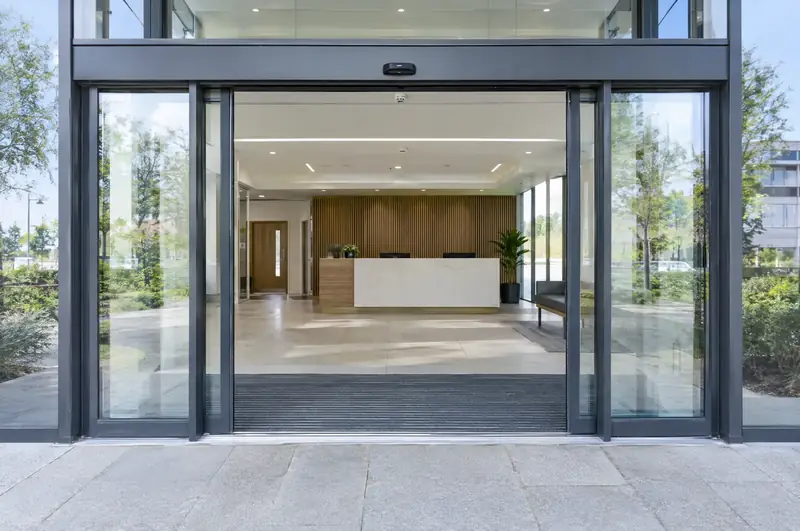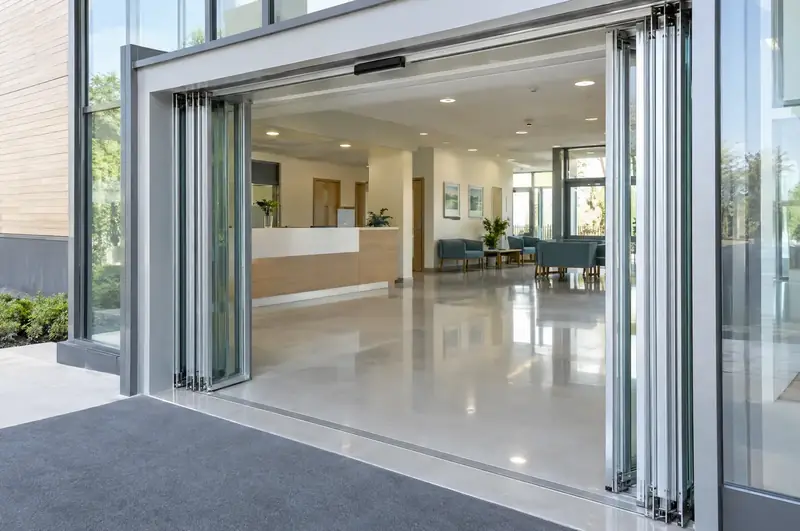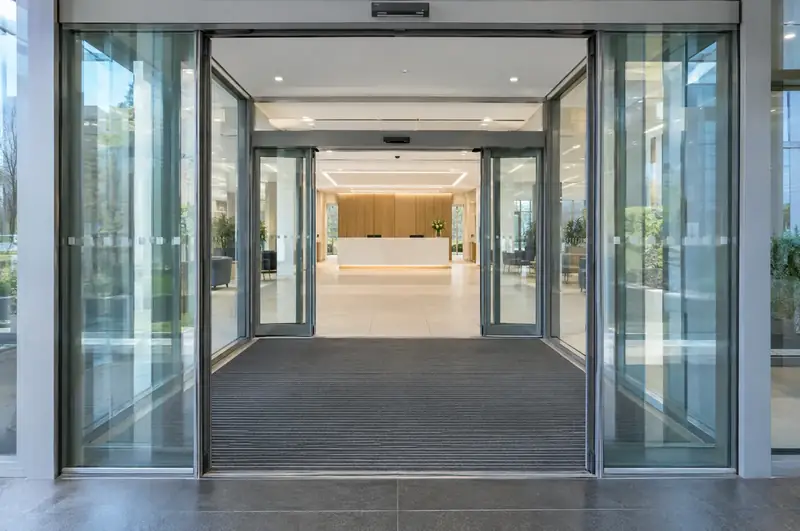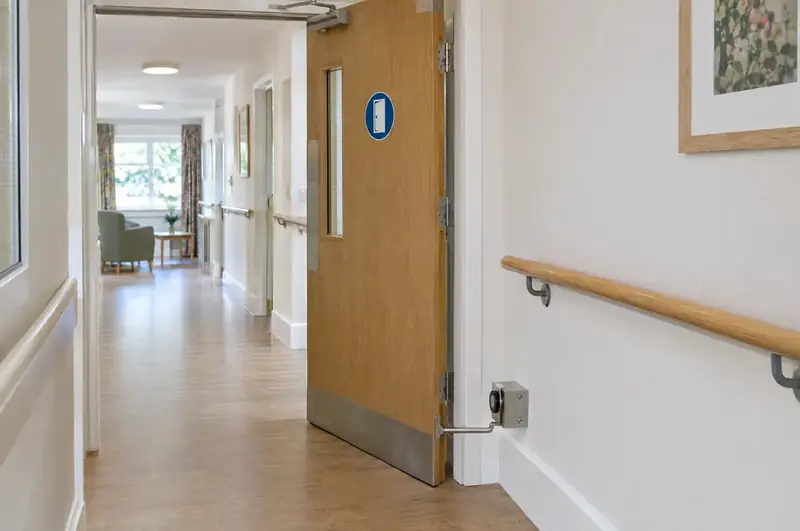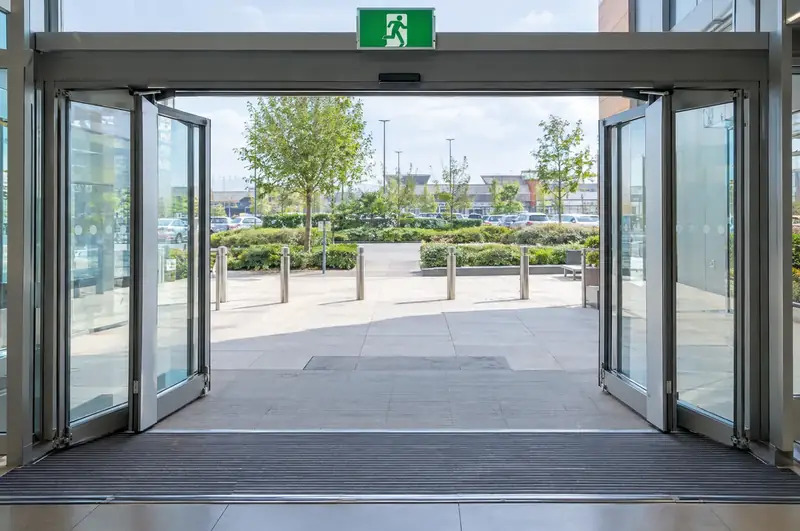
In everyday use a break-out door behaves like any other automatic sliding door: the leaves glide apart as someone approaches and close behind them. The difference shows in an emergency or a crush. Push firmly on a sliding leaf or a side screen and it swings outwards on a pivot, so people are not limited to the gap between the leaves.
That makes break-out doors a common choice for busy entrances that also serve as fire exits, such as shopping centres, supermarkets, hospitals, transport buildings and large offices. Whether an entrance needs break-out, and how it should behave on power loss or a fire alarm, is decided by the fire strategy for the building and your fire risk assessor, not by the door installer.
We supply and install complete break-out entrances, set them up to match the fire strategy you give us and document them with reference to BS EN 16005. The work is carried out by specialist automatic door engineers working under our management, after a free site survey and a fixed, itemised written quote.
- Typical clear opening
- About 1.2 m to 2.5 m between sliding leaves
- Typical lead time
- typically 6 to 10 weeks
- Usually suits
- Shopping centres, supermarkets, hospitals, public buildings
- Safety reference
- BS EN 16005
How does a break-out sliding door work?
A break-out sliding door is a sliding door with pivoting leaves and side screens that can be swung outwards by hand. Each leaf hangs from a carrier in the operator, with a break-out fitting that holds it in line until someone pushes it hard enough. When it breaks out, the leaf swings like a hinged door and the drive stops.
Side screens, the fixed panels either side of the opening, can usually break out too. With every panel swung open, most of the frame width becomes available for escape, which is why these doors are specified on busy exit routes. Once the emergency is over, the leaves are swung back, they latch into line and the door is reset.
- Sliding leaves only: the moving leaves break out while the side screens stay fixed.
- Full break-out: leaves and side screens all swing out to give the widest escape width.
- Monitored break-out: a switch tells the operator a leaf has been pushed out, so the drive stops and the door reports it.
When is a break-out door needed on an escape route?
A break-out door is needed when the fire strategy relies on the entrance as an escape route and a plain sliding door could not be counted on to give enough width, or to open, in every situation. The fire risk assessor or the designer who wrote the fire strategy makes that call. Our part is to supply a door that does what the strategy asks.
Doors on escape routes must let people out safely in an emergency. Automatic doors on escape routes are set up to open, break out or be openable by hand, as the fire strategy for the building requires. Fire safety rules restrict the use of sliding doors on exits intended specifically for emergencies, so an automatic sliding door on an escape route needs a special arrangement: opening fully when the alarm sounds or the power fails, break-out, or both.
If you are not sure what your strategy says, ask whoever holds it before asking for a quote. Our guide to automatic doors on escape routes lists the questions worth raising.
What happens to a break-out door in a power cut or fire alarm?
A break-out door is usually set up to fail safe, meaning it ends up open or openable when something goes wrong. The exact behaviour is a setting chosen to match the fire strategy, and it should be written down at handover so everyone knows what to expect.
| Event | Common set-up | Why |
|---|---|---|
| Mains power fails | A battery opens the leaves and holds them open, or the leaves stay free to push out | People can still leave without power |
| Fire alarm signal | The door opens fully and stays open until reset | Clears the route before people reach it |
| Leaf pushed out by hand | The drive stops and the door reports break-out | Stops the motor fighting the open leaf |
| Night locking set | The lock releases on alarm, as the fire strategy requires | Security without blocking escape |
Night locking needs the same care. A lock that stops a leaf breaking out while people are still inside the building is a problem to raise at survey, not after handover.
What do we check at a break-out door survey?
The survey confirms whether break-out will work in the opening you have, and what has to change to make it work. An engineer measures the structural opening, looks at the space outside the door where the leaves will swing, and checks the floor, the head and the fixing points for the frame.
- The swing zone outside: bollards, planters, steps, ramps and canopies that would stop a leaf opening fully.
- The floor: level, even and strong enough for the floor guides and bottom pivots.
- The fire strategy and alarm interface: what signal is available and what the door should do with it.
- Power: a suitable fused spur close to the operator, and whether battery back-up is needed.
- Traffic: footfall, trolleys, prams and wheelchairs, which set the opening width and speed.
We then send a fixed, itemised quote covering the door, the break-out fittings, safety sensors, the alarm link and any building or electrical work.
How is a break-out entrance installed and handed over?
Most break-out entrances replace an existing door, so the work is planned to keep the building usable. The old door comes out, the new frame and operator are fixed, the leaves and screens are hung, and the sensors and alarm link are connected. Lead time from order is typically 6 to 10 weeks, because leaves and screens are made to measure.
Before handover the door is tested in normal running, in break-out, on power loss and on an alarm signal, and the results are recorded. You receive the test record, settings, operating instructions and conformity paperwork. Staff are shown how to reset a leaf after break-out and how to switch the door between its modes.
How should a break-out door be looked after?
A break-out door needs regular servicing like any automatic door, with extra attention on the break-out fittings, which can stiffen or wear if they are never used. We recommend a trained engineer checks the safety functions at least once a year, with the service interval set by the manufacturer's instructions and how hard the door works. Busy entrances are often serviced more often than that.
Between visits, staff should check each day that nothing is stored in the swing zone, that the leaves are latched in line and that the door opens on approach, and note those checks in a log. Your fire risk assessment may also call for the alarm release to be tested alongside the routine fire alarm checks. Our servicing and safety inspections pages explain what a visit covers.
Which break-out arrangement suits your entrance?
| Option | What it is | Best for |
|---|---|---|
| Bi-parting with break-out leaves | Two sliding leaves that break out, with fixed side screens | Shop and office entrances where the leaves alone give enough escape width |
| Full break-out | Sliding leaves and side screens all break out | Shopping centres and large stores needing the widest escape route |
| Single-slide break-out | One sliding leaf and one screen, both breaking out | Narrower frontages with room for the leaf on one side |
| Telescopic break-out | Stacking leaves that break out together | Wide openings where side space is limited |
| Break-out within a lobby | Break-out sets on both the inner and outer screens | Lobbied entrances that are also on an escape route |
How much does a break-out escape route door cost?
A complete break-out sliding entrance, with operator, leaves, side screens and safety sensors, is from £7,995 ex VAT as a guide. The table shows what moves the price; your written quote is the price you pay.
| Item | Guide price | Notes |
|---|---|---|
| Break-out sliding door set for an escape route | from £7,995 | installed, ex VAT; typically up to £16,995 |
| Converting an existing sliding door to break-out | Priced on survey | depends on the frame, leaves and operator |
| Battery backup for power-cut operation | £395 – £695 | per door, ex VAT |
| Touch-free switch or push pad, fitted | £145 – £395 | per switch, ex VAT |
Standards and the law
BS EN 16005 is the current standard for the safety in use of powered pedestrian doors, and BS 7036-0:2014 is the British code of practice for risk assessment and risk reduction used alongside it. Standards are not law in themselves, but they are the recognised benchmark for showing an automatic door is safe to use, and we set up, test and document doors with reference to them.
Whoever motorises a manual door, or builds an automatic door from separate parts, may take on the manufacturer’s legal duties for the finished door: a risk assessment, a technical file kept available for the authorities, a Declaration of Conformity, the conformity marking and instructions. You receive the Declaration of Conformity and the instructions at handover.
Automatic doors on an escape route need special arrangements, such as failing safely to open, a monitored fail-safe opening system or a break-out facility, so they never block people leaving in an emergency. Fire doors that are held open must close when the fire alarm operates.
The law that applies also depends on the nation. The table shows the main differences; each county and town page carries the rules for its own nation.
| Nation | Accessibility | Building regulations guidance | Fire safety law |
|---|---|---|---|
| England | The Equality Act 2010 | Approved Document M (Volume 2): powered opening where opening force would exceed 30 N, or 22.5 N from 30° to 60°; 1000 mm clear width for public entrance doors in new buildings | Regulatory Reform (Fire Safety) Order 2005: the responsible person |
| Wales | The Equality Act 2010 | Approved Document M (Wales): powered opening where opening force would exceed 20 N; 1000 mm clear width for public entrance doors in new buildings | Regulatory Reform (Fire Safety) Order 2005: the responsible person |
| Scotland | The Equality Act 2010 | Building (Scotland) Regulations 2004, non-domestic Technical Handbook: accessible entrance with at least 800 mm clear opening; building warrant for building work | Fire (Scotland) Act 2005: whoever has control of the premises |
| Northern Ireland | The Disability Discrimination Act 1995 | Building Regulations (Northern Ireland) 2012: powered doors must not trap people and must open on power failure; access guidance in Technical Booklet R | Fire and Rescue Services (Northern Ireland) Order 2006 and Fire Safety Regulations (Northern Ireland) 2010 |
Questions about break-out escape route doors
Is a break-out door the same as a fire door?
No. A break-out door is an escape route door, designed to let people out quickly, not to hold back fire and smoke. Fire doors are tested for fire resistance and usually close when the alarm operates. If one entrance must do both jobs, the fire strategy needs to say so and the specification changes completely, so raise it before the survey.
Who decides whether our entrance needs break-out?
The fire strategy for the building and the fire risk assessment decide. That may be a fire engineer on a new building or your fire risk assessor on an existing one. We can explain what break-out does and what the options cost, but we follow the strategy you give us rather than deciding the escape provision ourselves.
How hard do you have to push to break out a leaf?
Hard enough that a leaf will not swing out when someone leans on it or brushes past, but not so hard that a person cannot push it open in an emergency. The break-out fittings are adjusted at installation and checked at each service. If a leaf seems too stiff or too loose, ask for it to be checked rather than adjusting it yourself.
Can an existing sliding door be converted to break-out?
Sometimes, if the operator and frame can take break-out leaves and a conversion exists for that model. Often it is more reliable to replace the leaves and screens together, or the whole door. The survey tells you which applies, and where both routes are possible the quote prices each so you can compare them.
What happens after a leaf has broken out?
The drive stops so the motor does not fight the open leaf. Once it is safe, a member of staff swings the leaf back until it latches, and the door returns to normal running, sometimes after a reset at the programme switch. Staff are shown how to do this at handover, and it is quick once you have seen it done.
Do break-out doors need more maintenance than standard sliding doors?
A little more. The pivots, latches and any break-out monitoring switches need checking and testing at each visit, along with the usual drive, track, sensor and safety checks. The extra time per visit is usually small, and keeping the break-out fittings free is what makes the door dependable on the day it is needed.
Can a break-out door be locked at night?
Yes. Most are locked out of hours with an electric lock or a mechanical lock built into the operator. The fire strategy decides whether the door must still be openable from inside while anyone is in the building, and the lock is chosen and wired to match, often releasing when the fire alarm operates.
How long does a break-out entrance take to install?
Made-to-measure leaves and screens mean a lead time of typically 6 to 10 weeks from order. On site, a typical entrance takes one to three days including removal of the old door. We plan the sequence to keep a usable entrance where we can, and any out-of-hours working is agreed in the quote.