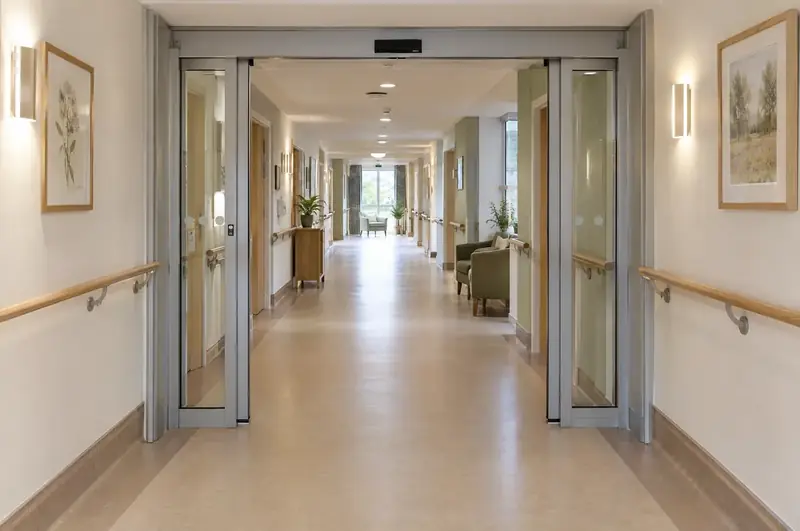
Inside a busy building, doors are opened far more often than the front entrance. Staff pushing beds, trolleys and wheelchairs, visitors with walking aids and people carrying trays all have to get through corridor and ward doors, many of them heavy fire doors. Automating the right internal doors saves time, cuts strain and reduces knocks to doors and frames.
Internal doors bring their own questions: fire ratings, smoke control, infection control, noise, and who should be allowed through. A cross-corridor fire door, a ward entrance and a meeting room door may all need different operators, controls and settings.
We supply and install automatic internal doors in hospitals, care homes, offices, schools and public buildings, as new sliding doors or as operators on existing swing doors. The work is carried out by specialist automatic door engineers working under our management. Every job starts with a free site survey and a fixed, itemised written quote.
- Door types
- Sliding, swing and fire-rated swing
- Typical lead time
- typically 3 to 6 weeks
- Usually suits
- Hospitals, care homes, offices, schools
- Safety reference
- BS EN 16005
Where are automatic internal doors most useful?
Automatic internal doors are most useful where people regularly pass through with their hands full or with limited mobility. In healthcare that means ward entrances, theatre corridors and day units. Elsewhere it means corridors, kitchens, stair lobbies and the doors between public and staff areas.
- Hospitals and clinics: ward entrances, corridor doors and treatment rooms, often with bed-width openings.
- Care homes and supported living: lounges, dining rooms and corridor doors used by residents with frames or wheelchairs.
- Offices: corridor and meeting room doors, kitchens and doors on accessible routes to toilets.
- Schools and colleges: corridor fire doors, dining halls and doors to accessible facilities.
- Back of house: kitchen, service and goods corridors where staff push trolleys all day.
Should an internal door be sliding or swing?
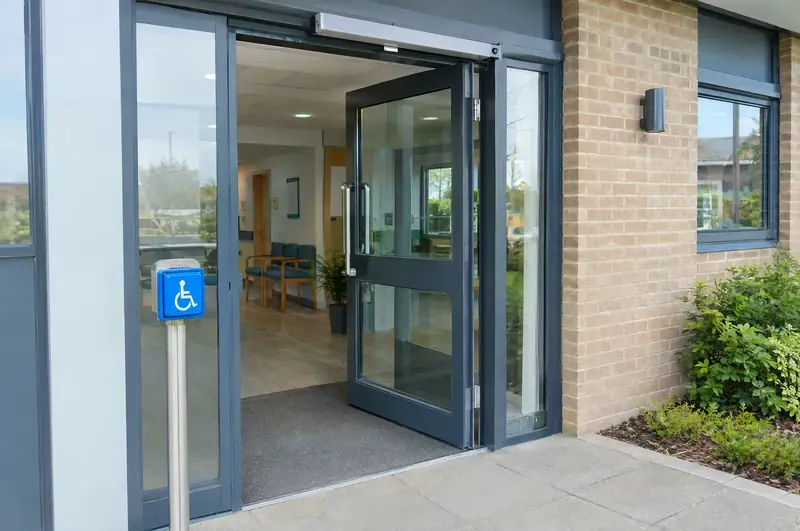
Sliding doors suit internal openings where there is wall space beside the opening for the leaves to park, while swing operators suit existing doors, fire doors and tight spaces. Sliding doors take up no floor space when they open and keep the corridor clear, which is why they are popular on wards. They also avoid a leaf swinging into someone on the other side, which matters on busy corridors with poor sight lines.
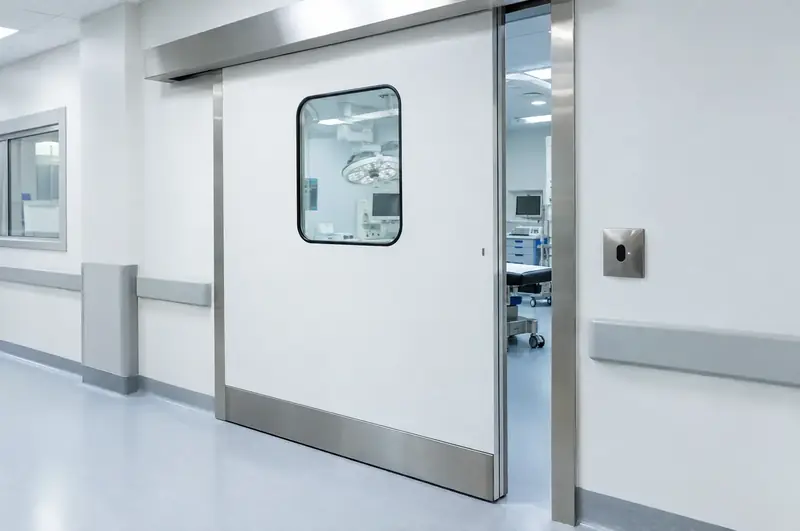
Swing operators can usually be fitted to the doors you already have, including fire doors, without changing the partition. For theatres, labs and other sealed rooms, hermetic sliding doors are the specialist option. The survey looks at wall space, partition strength and the traffic before recommending either.
How do automatic cross-corridor fire doors work?
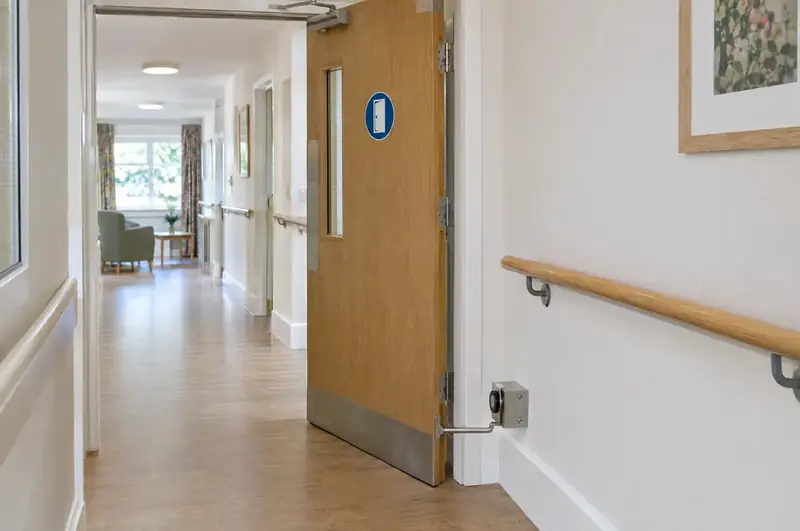
Cross-corridor fire doors can be automated or held open in everyday use, but they must close when the fire alarm operates. Fire doors that are held open must close automatically when the fire alarm operates. That means the operator or hold-open device is linked to the fire alarm system and releases the door on alarm.
- Fire-rated swing operators: open the doors on demand and let them close under control on alarm.
- Hold-open devices: hold doors open all day and release them on alarm. See fire door hold-open devices.
- Free-swing closers: let a door move freely like an unclosed door, then close it on alarm.
The fire door must keep its rating, so operator type, fixings and cable routes are checked against the door's labels or records. Any change to how fire doors behave should be agreed with whoever holds your fire risk assessment.
Do automatic doors help with infection control?
Automatic doors help with infection control because people do not have to touch handles, push plates or the door itself. In hospitals, clinics and care homes, fewer hands on the door means fewer surfaces to clean between users.
The choice of activation matters as much as the door. Motion sensors or touch-free switches avoid contact altogether, and push pads that can be pressed with an elbow are a fallback. Smooth, sealed leaves with few ledges are easier to wipe down, and controls should be chosen to stand up to the cleaning products used on site.
Can internal doors be quiet and control who goes through?
Yes. Internal operators can be set to open and close slowly and quietly, which matters on wards at night, in offices and in care homes. Many have a night mode with gentler settings or a switch that changes the door to manual during quieter hours.
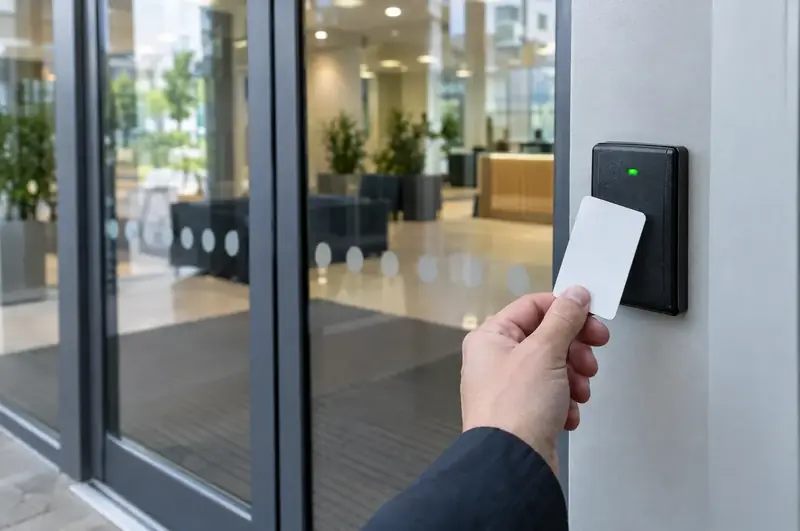
Internal doors can also be linked to access control, so a card, fob or keypad is needed to pass from public areas into staff-only zones. In care settings, any restriction on where residents can go is a care decision for the provider, and the fire strategy must still let everyone escape. Staff should be able to override a controlled door quickly, for example with a key switch or a release button at the nurses' station. See access control for automatic doors.
What does the survey check, and how are internal doors looked after?
The survey checks the partition or wall the door sits in, the ceiling void and head for fixing, the clear width needed for beds or equipment, the fire rating of the door, power supplies and any link to the fire alarm or access control. Lightweight stud partitions sometimes need extra support to carry an operator.
Lead time is typically 3 to 6 weeks from order. Work in occupied areas is planned around the building, often out of hours on wards. Afterwards, each door's safety functions should be checked by a trained engineer at least yearly, more often on busy wards, and staff should carry out simple checks and keep a record. Fire door releases are tested along with the routine fire alarm checks your fire risk assessment calls for.
Which internal door suits the space?
| Option | What it is | Best for |
|---|---|---|
| Internal sliding door | A new sliding door and screen in the partition | Ward entrances and corridors with wall space |
| Low-energy swing operator | A slow, gentle operator on an existing door | Meeting rooms, toilets and quiet corridors |
| Full-energy swing operator | A quicker operator protected by safety sensors | Busy corridor doors and heavy leaves |
| Fire-rated operator pair | Synchronised operators on double fire doors | Cross-corridor and stair lobby fire doors |
| Telescopic internal slider | Stacking leaves for a wider opening | Bed-width openings with limited wall space |
| Hermetic slider | A sealed sliding door for controlled rooms | Theatres, laboratories and isolation rooms |
How much do automatic internal doors cost?
An automatic internal door, from an operator on an existing swing door to a new sliding door and screen, is from £1,795 ex VAT as a guide. The table shows what moves the price; your written quote is the price you pay.
| Item | Guide price | Notes |
|---|---|---|
| Swing operator on an existing internal door | £1,795 – £3,995 | low-energy or full-energy, installed, ex VAT |
| Operators on a pair of cross-corridor doors | £3,795 – £6,495 | installed, ex VAT |
| Internal single-slide automatic door set | £4,495 – £7,995 | installed, ex VAT |
| Touch-free switch or push pad, fitted | £145 – £395 | per switch, ex VAT |
| Card or fob reader tied into the door | £795 – £2,495 | per door, ex VAT |
Standards and the law
BS EN 16005 is the current standard for the safety in use of powered pedestrian doors, and BS 7036-0:2014 is the British code of practice for risk assessment and risk reduction used alongside it. Standards are not law in themselves, but they are the recognised benchmark for showing an automatic door is safe to use, and we set up, test and document doors with reference to them.
Whoever motorises a manual door, or builds an automatic door from separate parts, may take on the manufacturer’s legal duties for the finished door: a risk assessment, a technical file kept available for the authorities, a Declaration of Conformity, the conformity marking and instructions. You receive the Declaration of Conformity and the instructions at handover.
The law that applies also depends on the nation. The table shows the main differences; each county and town page carries the rules for its own nation.
| Nation | Accessibility | Building regulations guidance | Fire safety law |
|---|---|---|---|
| England | The Equality Act 2010 | Approved Document M (Volume 2): powered opening where opening force would exceed 30 N, or 22.5 N from 30° to 60°; 1000 mm clear width for public entrance doors in new buildings | Regulatory Reform (Fire Safety) Order 2005: the responsible person |
| Wales | The Equality Act 2010 | Approved Document M (Wales): powered opening where opening force would exceed 20 N; 1000 mm clear width for public entrance doors in new buildings | Regulatory Reform (Fire Safety) Order 2005: the responsible person |
| Scotland | The Equality Act 2010 | Building (Scotland) Regulations 2004, non-domestic Technical Handbook: accessible entrance with at least 800 mm clear opening; building warrant for building work | Fire (Scotland) Act 2005: whoever has control of the premises |
| Northern Ireland | The Disability Discrimination Act 1995 | Building Regulations (Northern Ireland) 2012: powered doors must not trap people and must open on power failure; access guidance in Technical Booklet R | Fire and Rescue Services (Northern Ireland) Order 2006 and Fire Safety Regulations (Northern Ireland) 2010 |
Questions about automatic internal doors
Can you automate our existing corridor fire doors?
Usually, yes, with fire-rated operators wired to the fire alarm so the doors close when it operates. We check the doors' ratings, condition, hinges and frames first. Doors that do not close and latch properly need repairing before an operator goes on, as an operator will not fix a poor fire door.
Will automatic doors be noisy on a ward at night?
They should not be. Internal operators can be set to move slowly and quietly, and many have a night setting. If noise is a concern, we can suggest sliding doors with quieter drives, or a mode that leaves the door manual at night. We set this up with your staff at handover.
How wide do automatic ward doors need to be?
Wide enough for the beds, trolleys and equipment that pass through, plus room for the person pushing them. Hospital estates teams often have their own standard for this. We measure what currently passes through and confirm the clear opening at survey before recommending a door type.
Can internal automatic doors be linked to access control?
Yes. A card reader, fob reader or keypad can control who passes from public areas into staff zones. The door opens automatically once access is granted, and opens freely from the other side if needed. On alarm, locks release as the fire strategy requires.
Do internal automatic doors need sensors?
Most do. Full-energy operators need safety sensors to stop the door striking or trapping people. Low-energy operators set up within the low-energy limits may need fewer, but the site risk assessment decides. In care homes and hospitals, extra safety sensors are common because of vulnerable users.
Can you work in an occupied hospital or care home?
Yes. We plan the work around your routines, infection control rules and fire safety arrangements, and agree out-of-hours working where it helps. Dust control, temporary fire precautions and keeping routes open are covered in the method statement we send before work starts.
Is a hold-open device better than an operator for a corridor fire door?
It depends on how the door is used. A hold-open device keeps the door open all day and releases it on alarm, which suits doors that are rarely closed. An operator opens the door on demand and suits doors that should stay closed most of the time. Some corridors use both.
How often should internal automatic doors be serviced?
No law sets a fixed interval. We recommend a trained engineer checks the safety functions of every automatic door at least once a year, with busy ward and corridor doors usually serviced more often, following the manufacturer's instructions. Fire door releases should also be checked alongside your routine fire alarm tests.