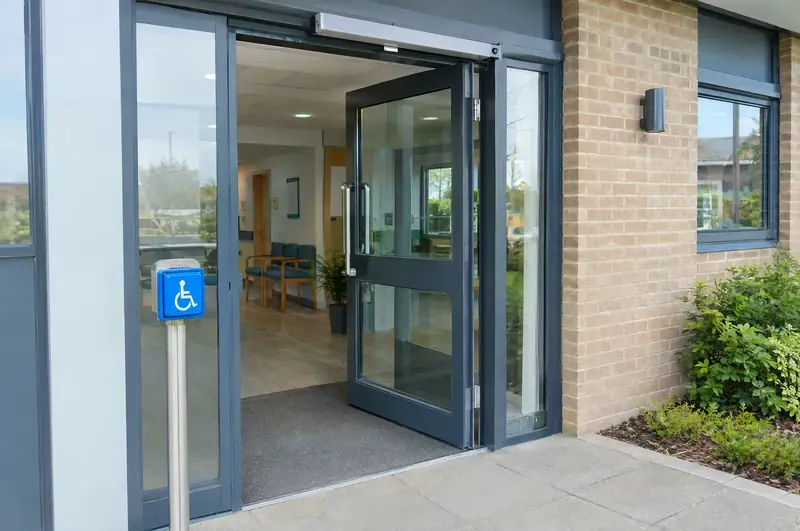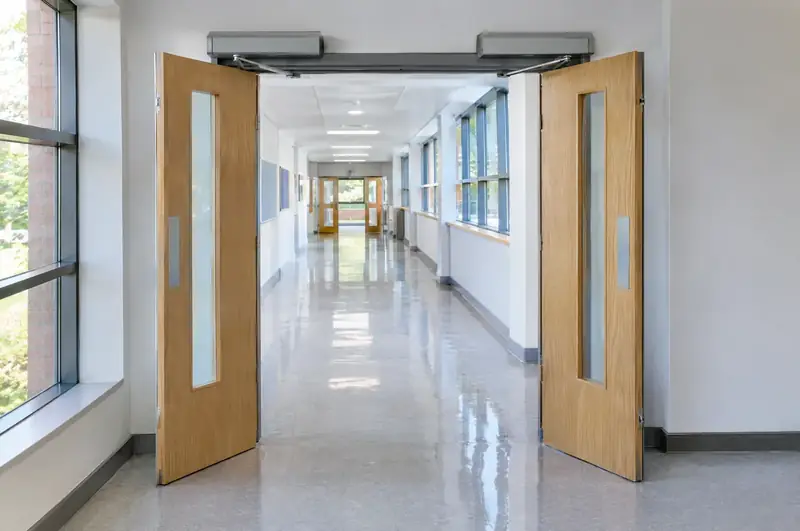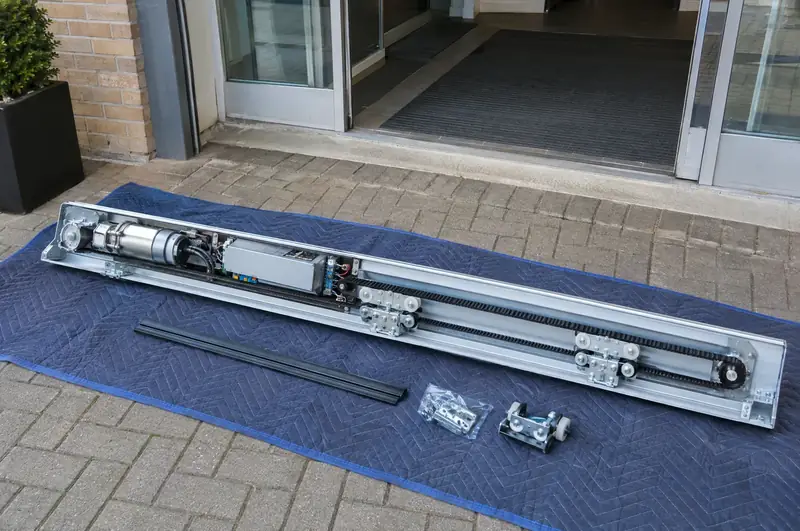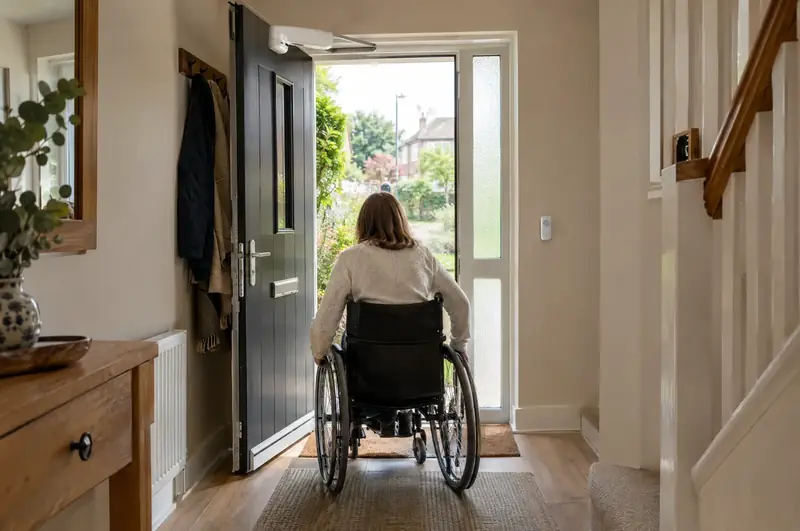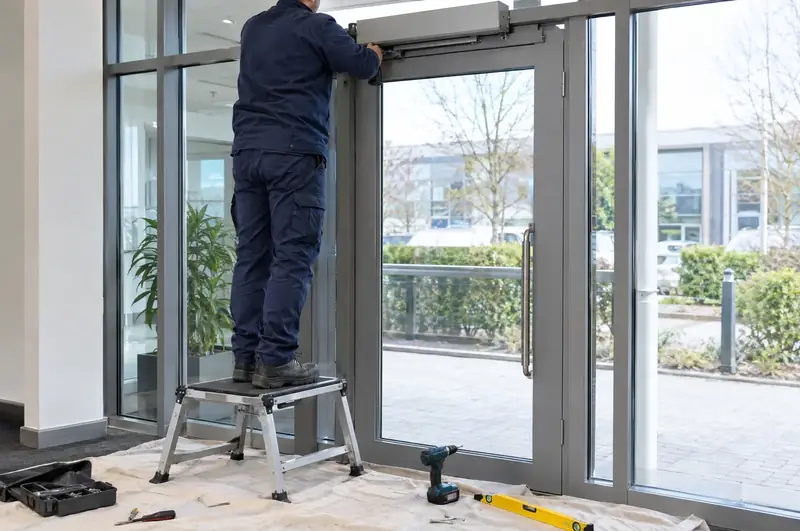
Plenty of doors are perfectly sound but hard to use: a heavy timber entrance, an aluminium shop door with a strong closer, or a manual sliding door in a reception. Adding an operator to the existing door is often quicker and cheaper than replacing it, and it keeps the look of the building as it is.
Not every door is a good candidate. The door has to hang properly, the frame and the wall or head above it must carry the operator, and the glass, locks and hinges must suit powered use. A door that is already failing will not be improved by a motor, and sometimes replacement is the better value.
We survey each door for free, tell you plainly whether automation will work, and give a fixed, itemised written quote for the operator, any work the door needs first, safety devices and controls. The work is carried out by specialist automatic door engineers working under our management, for businesses and homes.
- Doors it suits
- Sound swing and manual sliding doors
- Typical lead time
- typically 2 to 5 weeks
- Usually suits
- Offices, shops, schools, public buildings, homes
- Safety reference
- BS EN 16005
Can my existing door be automated?
Most existing doors can be automated if they are in good condition, hang square in their frame and have something solid above them to fix an operator to. Timber, aluminium, steel, uPVC and composite doors can all be done. The survey looks at the door as a whole, not just at where the operator will go.
- Weight and size: the operator is chosen for the leaf, and very large or heavy leaves may need a full-energy unit.
- Hinges or pivots: worn or undersized hinges are replaced, as an operator will wear them faster.
- Frame and fixings: the head, transom or wall above must take the operator without flexing.
- Glazing: glass in a powered door should be safety glass, and older panes may need replacing.
- Thresholds and floor: raised sills, door stops and uneven floors can stop a leaf moving freely.
What happens to the closer, hinges and locks?
An existing overhead closer is normally removed, because the operator closes the door itself and acts as a closer when the power is off. Floor springs are harder: some can be adapted or set to run freely, while others are taken out and replaced with hinges or pivots. The survey tells you which applies to your door.
Locks need planning. A mechanical lock that is left locked stops the operator opening the door, so many retrofits add an electric lock or electric keep that releases when the door is triggered. Panic and emergency exit hardware on escape doors stays in place and keeps working as before.
Can a manual sliding door be made automatic?
A manual sliding door can sometimes be automated by fitting an operator above it and new carriers to the existing leaves. It depends on the leaves being straight, light enough and in safety glass, and on there being room above the opening for the drive. Where those conditions are met, the frame and leaves can stay.
Often the old track and runners are worn, or the leaves are too heavy for a retrofit drive. In that case, keeping the frame and fitting a complete new sliding operator with new leaves is usually the more reliable route. See automatic sliding doors for what a full replacement involves.
Who is responsible for a door once it has been automated?
Whoever automates the door takes responsibility for it as a powered door. A powered door is treated as machinery. Whoever motorises a manual door, or assembles an automatic door from separate parts, takes on the manufacturer's duties for it, including the conformity paperwork and marking.
When we automate a door, those duties are part of our job. Before the door is first used, it is risk assessed, set up and tested with reference to BS EN 16005, and the completed door gets its declaration of conformity, technical file, instructions and conformity marking, UKCA or CE depending on where in the UK it is. You receive the test record, settings and paperwork at handover. That is one strong reason not to have an operator kit fitted by someone who will not produce it.
When is it better to replace the door instead?
Replacing the door is usually better when the leaf or frame is in poor condition, or when the work needed to make it safe would cost close to a new door. The survey compares the two honestly, and where both are possible the quote prices each so you can decide.
| Situation | Usually | Why |
|---|---|---|
| Sound door, worn hinges | Retrofit | New hinges are a small part of the job |
| Door drops, binds or is twisted | Replace | An operator will strain and wear quickly |
| Old glass that is not safety glass | Retrofit with reglazing, or replace | Depends on the condition of the rest of the door |
| Frame too weak to fix to | Replace or reinforce | The operator needs a rigid fixing |
| Busy entrance needing a wide opening | Replace with a sliding door | A swing retrofit may not handle the traffic |
What does a retrofit involve on the day, and afterwards?
Once you accept the quote, lead time is typically 2 to 5 weeks, depending on the operator and any parts for the door. Fitting usually takes half a day to a day per door, longer if hinges, locks or glass are being changed at the same time.
The engineer fits the operator, safety sensors and controls, sets the speed, force and hold-open time, and tests the door before handover. Afterwards, we recommend a trained engineer checks the door's safety functions at least once a year, with the manufacturer's instructions and the amount of use setting whether it needs more. A busy shop door will usually be serviced more often than a quiet office or home door. Our guide to automating an existing door covers the checks in more detail.
Which retrofit suits your door?
| Option | What it is | Best for |
|---|---|---|
| Low-energy swing operator | A slow, gentle operator above a single swing door | Accessible entrances, toilets and home doors |
| Full-energy swing operator | A faster operator with safety sensors | Heavy doors and busier entrances |
| Paired swing operators | Two operators working together on double doors | Corridors and wide entrances |
| Sliding drive on existing leaves | A new operator and carriers above existing sliding leaves | Sound manual sliding doors in safety glass |
| Power assist | The operator reduces the effort to push the door by hand | Staff doors where most users can manage a lighter door |
How much does it cost to automate an existing door?
Automating a sound existing door, with the operator, safety devices and controls, is from £1,795 ex VAT (£2,154 inc VAT) as a guide, depending on the door and the work it needs first. The table shows what moves the price; your written quote is the price you pay.
| Item | Guide price | Notes |
|---|---|---|
| Low-energy operator on an existing swing door | £1,795 – £2,995 | installed, ex VAT; homes £2,154 – £3,594 inc VAT |
| Full-energy operator on an existing swing door, with safety sensors | £2,495 – £3,995 | installed, ex VAT; homes £2,994 – £4,794 inc VAT |
| Operators on an existing pair of swing doors | £3,795 – £6,495 | installed, ex VAT; homes £4,554 – £7,794 inc VAT |
| Automating an existing manual sliding door or screen | £2,995 – £5,495 | installed, ex VAT; homes £3,594 – £6,594 inc VAT |
Standards and the law
BS EN 16005 is the current standard for the safety in use of powered pedestrian doors, and BS 7036-0:2014 is the British code of practice for risk assessment and risk reduction used alongside it. Standards are not law in themselves, but they are the recognised benchmark for showing an automatic door is safe to use, and we set up, test and document doors with reference to them.
Whoever motorises a manual door, or builds an automatic door from separate parts, may take on the manufacturer’s legal duties for the finished door: a risk assessment, a technical file kept available for the authorities, a Declaration of Conformity, the conformity marking and instructions. You receive the Declaration of Conformity and the instructions at handover.
The law that applies also depends on the nation. The table shows the main differences; each county and town page carries the rules for its own nation.
| Nation | Accessibility | Building regulations guidance | Fire safety law |
|---|---|---|---|
| England | The Equality Act 2010 | Approved Document M (Volume 2): powered opening where opening force would exceed 30 N, or 22.5 N from 30° to 60°; 1000 mm clear width for public entrance doors in new buildings | Regulatory Reform (Fire Safety) Order 2005: the responsible person |
| Wales | The Equality Act 2010 | Approved Document M (Wales): powered opening where opening force would exceed 20 N; 1000 mm clear width for public entrance doors in new buildings | Regulatory Reform (Fire Safety) Order 2005: the responsible person |
| Scotland | The Equality Act 2010 | Building (Scotland) Regulations 2004, non-domestic Technical Handbook: accessible entrance with at least 800 mm clear opening; building warrant for building work | Fire (Scotland) Act 2005: whoever has control of the premises |
| Northern Ireland | The Disability Discrimination Act 1995 | Building Regulations (Northern Ireland) 2012: powered doors must not trap people and must open on power failure; access guidance in Technical Booklet R | Fire and Rescue Services (Northern Ireland) Order 2006 and Fire Safety Regulations (Northern Ireland) 2010 |
Questions about automating an existing door
Is it cheaper to automate a door than to replace it?
Usually, if the door and frame are in good condition. You are paying for the operator, safety devices, controls and fitting, not a new leaf and frame. If the door needs new hinges, glass or a lock as well, the gap narrows, so where both options make sense the quote prices each.
Can you automate a fire door?
Yes, with an operator designed for fire doors, wired to the fire alarm so the door closes when the alarm operates. The fixings and cabling must not weaken the door's fire rating, so we check its labels or records first. A fire door in poor condition needs putting right before an operator goes on.
Will the door still work by hand?
Yes. A swing door with an operator can still be pushed open by hand, and when the power is off the operator acts like a door closer. A sliding door can usually be pushed open by hand without power, or a battery can open it, depending on how it is set up.
Do I need to change my lock?
Not always, but often. If the door is normally kept locked, an electric lock or electric keep lets the operator release it before opening. If the door is only key-locked at night, the existing lock can stay, with the operator switched off while it is locked.
Can you automate a uPVC or composite door?
Usually, yes. Domestic uPVC and composite doors are commonly automated for home use, often with an electric keep added to the multipoint lock. Commercial uPVC doors can also take an operator if the frame is reinforced enough to carry it. The survey checks the frame and fixing points.
Who provides the paperwork for an automated door?
We do, for doors we automate. Motorising a manual door brings manufacturer's duties for the completed powered door, including a risk assessment, testing, conformity paperwork and marking. You receive those documents at handover, together with the settings and operating instructions, and you should keep them with the building's records.
How long does it take to automate a door?
Lead time is typically 2 to 5 weeks after you accept the quote. On site, most single doors take half a day to a day. Double doors, or doors that need hinges, locks or glass changed, can take longer, and we give you the expected time on site with the quote.
What if the survey finds the door is not suitable?
We will tell you why, for example a twisted leaf, a weak frame or glass that is not safety glass, and what it would take to fix it. If replacing the door makes more sense, we can quote a new automatic door instead, and there is no charge for the survey either way.