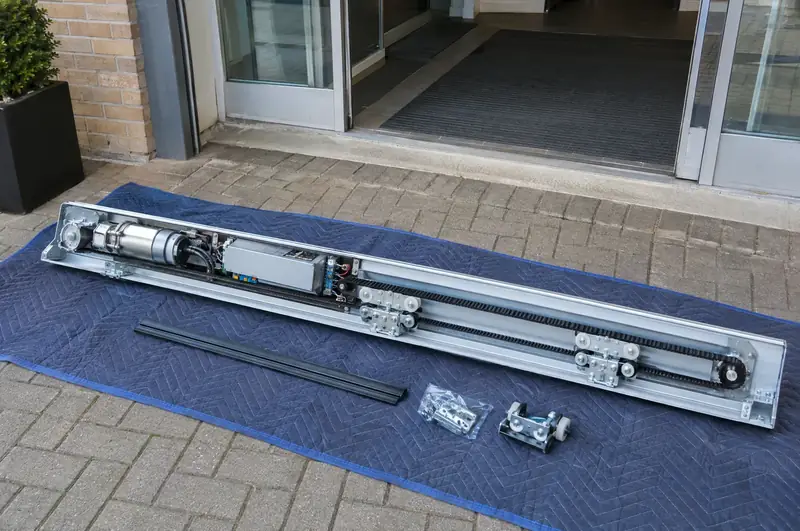
The frame and glass of an automatic door often outlast its drive unit by many years. When the operator becomes unreliable, or spare parts for it are no longer made, a new drive unit gives you a supported, dependable door without the cost and disruption of replacing the whole entrance.
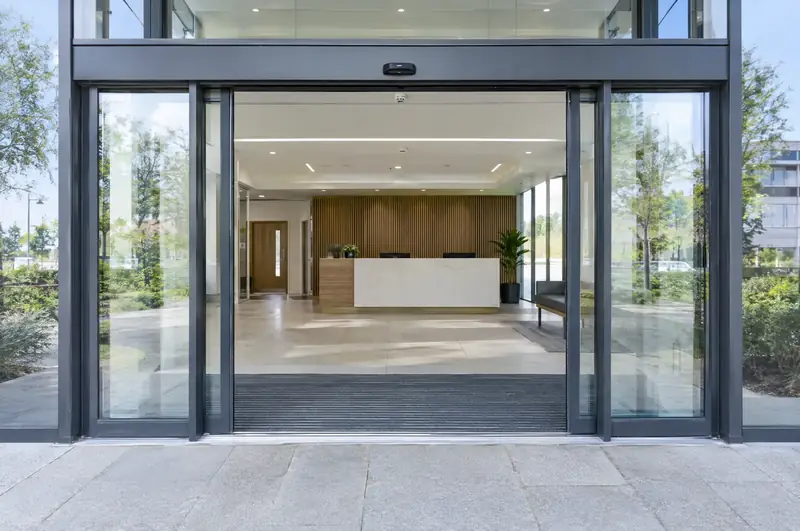
We remove the old operator, fit a new drive unit to the existing transom and leaves, add new sensors where they are needed and set the door up for the people who use it. On a standard sliding door the changeover typically takes a day, so the entrance is back in use with little disruption.
The survey is free and checks that the frame, leaves and fixings are worth keeping. You receive a fixed, itemised written quote before any work is booked, and warranty terms are set out in that quote.
- Keeps
- Existing frame, transom and glass leaves
- Typical lead time
- typically 2 to 4 weeks
- Usually suits
- Worn, obsolete or unreliable operators
- Safety reference
- BS EN 16005
What is an automatic door drive unit?
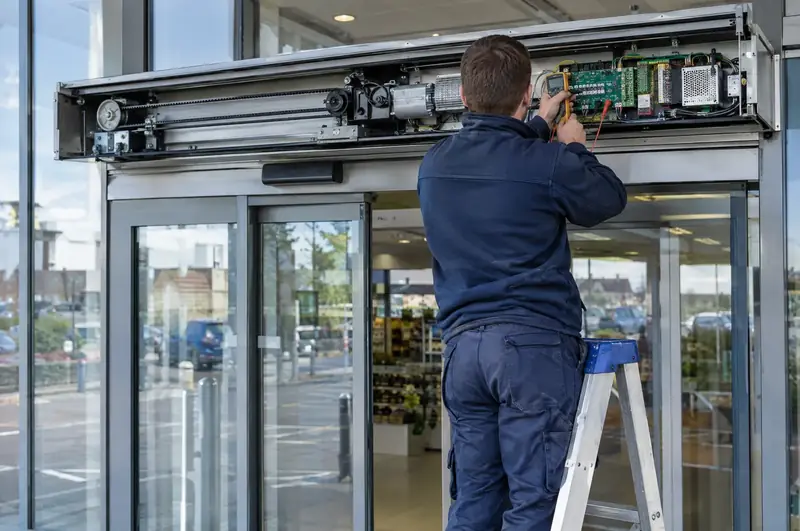
The drive unit, or operator, is the powered part of an automatic door. On a sliding door it sits in the header above the opening and includes the motor and gearbox, the control board, the belt and pulleys, the track and the carriages the leaves hang from. On a swing door it is the arm and motor unit fixed above the door.
Sensors, the programme switch, locking and battery backup all connect to it. Replacing the drive unit usually means refreshing those too, so the whole door works together as one system. A new controller also brings current safety monitoring, adjustable speeds and clearer fault codes, which older boards often lack.
When does replacing the drive unit make sense?
Replacing the drive unit makes sense when the frame and leaves are sound but the operator is the problem. Typical reasons are:
- repeated breakdowns, with one major part after another failing;
- spare parts that are obsolete, or a maker that no longer supports the model;
- a quote for a motor, gearbox or controller that approaches the cost of a new operator;
- a noisy, slow or jerky door that adjustment can no longer improve;
- an older controller that cannot work with modern safety sensors or battery backup.
It does not make sense when the frame is damaged or corroded, the glass is not safety glass, the opening needs to be wider or the entrance needs better insulation. In those cases a new automatic sliding door or automatic swing door is usually the better buy, and we will say so.
Which doors can take a new drive unit?
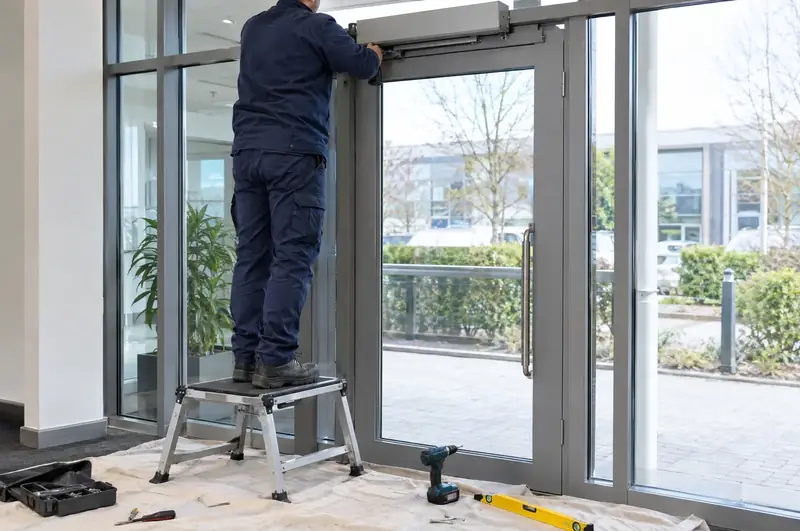
Most sliding doors and swing doors can take a new operator. Sliding drive units from the major European operator brands come in lengths and weight ratings to suit most leaves, and adapter plates can match the fixings of the old header. Swing operators can usually be fitted to existing timber, aluminium or steel doors.
Telescopic, curved, folding and revolving doors are more specialised, with more moving parts and tighter tolerances. Their drive units are often specific to the door system, so we check what is available on survey and tell you plainly if a complete replacement is the only sensible option.
What does the survey look at before a drive unit is replaced?
The survey, which is free, checks that the parts you keep are worth keeping and that the new operator will fit. The engineer looks at:
- The transom or header, its fixings and the space available for the new drive;
- The weight and size of each leaf and the condition of the glass and leaf frames;
- floor guides, the threshold and how the leaves run at the bottom;
- The power supply, isolator and any links to the fire alarm or access control;
- how the door is used, so speeds, sensors and modes suit the people passing through.
If something else needs attention, such as a cracked leaf or a worn floor guide, it is listed separately in the quote so you can decide whether to include it.
What happens on the changeover day?
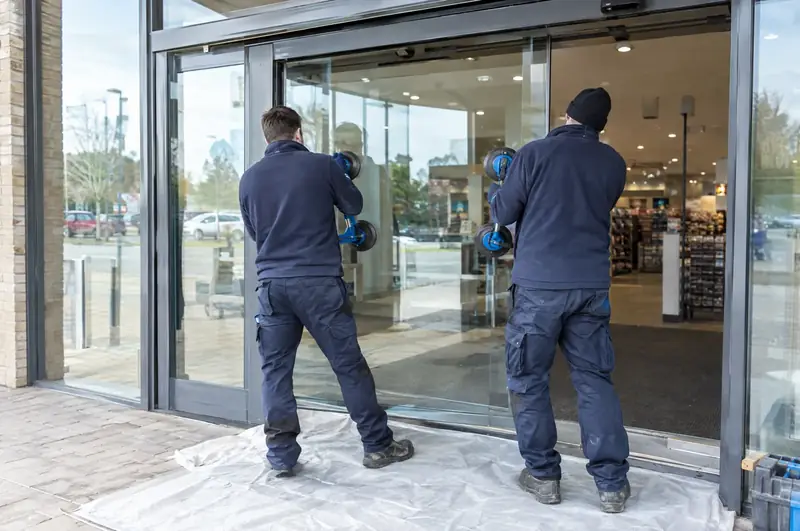
On a standard sliding door the changeover typically takes a day. The engineer isolates the door, removes the old operator, fits the new drive and track, rehangs and adjusts the leaves, then wires in the sensors, programme switch, locking and battery backup.
Before handover the door is set up and tested with reference to BS EN 16005, covering sensor coverage, speeds, how it reacts to an obstruction and how it behaves in a power failure. The entrance is out of use while the work is done, so changeovers are often booked early in the morning, after closing or at a weekend.
Doors on escape routes are set up to open, break out or be openable by hand, as the fire strategy for the building requires, and that behaviour is tested before the door goes back into use.
What paperwork comes with a new drive unit?
Machinery law treats a powered door as a machine. Whoever puts a new drive unit on an existing door may take on the manufacturer's duties for the finished door, including the risk assessment, technical file, Declaration of Conformity, conformity marking and user instructions.
We prepare that paperwork for the new assembly and hand it over with the door, along with the test results, settings and a recommended service interval. Keep it with the building's records, because it shows the converted door was set up and documented properly and it gives future engineers a reliable starting point.
Repair, new operator or new door?
| Option | What it is | Best for |
|---|---|---|
| Repair the existing drive | Replace the failed part only | Supported operators with one worn part |
| New sliding drive unit | New operator, track and carriages on the existing frame and leaves | Sound sliding doors with worn or obsolete operators |
| New swing door operator | New arm and motor unit on the existing door | Swing doors whose operator has become unreliable |
| Drive unit plus refurbishment | New operator with new rollers, guides, seals and brushes | Older doors that need a full refresh |
| Complete new door | New frame, leaves and operator | Damaged frames, unsafe glass or a wider opening |
How much does a replacement drive unit cost?
A new drive unit fitted to an existing automatic door, with the frame and leaves kept, is typically £1,995 to £3,995 ex VAT as a guide. The table shows what moves the price; your written quote is the price you pay.
| Item | Guide price | Notes |
|---|---|---|
| New drive unit on an existing automatic sliding door | £1,995 – £3,995 | existing leaves kept, installed, ex VAT |
| New operator on an existing automatic swing door | £1,795 – £3,995 | installed, ex VAT |
| Sensors replaced at the same time | £195 – £495 | per sensor, ex VAT |
Standards and the law
BS EN 16005 is the current standard for the safety in use of powered pedestrian doors, and BS 7036-0:2014 is the British code of practice for risk assessment and risk reduction used alongside it. Standards are not law in themselves, but they are the recognised benchmark for showing an automatic door is safe to use, and we set up, test and document doors with reference to them.
Whoever motorises a manual door, or builds an automatic door from separate parts, may take on the manufacturer’s legal duties for the finished door: a risk assessment, a technical file kept available for the authorities, a Declaration of Conformity, the conformity marking and instructions. You receive the Declaration of Conformity and the instructions at handover.
The law that applies also depends on the nation. The table shows the main differences; each county and town page carries the rules for its own nation.
| Nation | Accessibility | Building regulations guidance | Fire safety law |
|---|---|---|---|
| England | The Equality Act 2010 | Approved Document M (Volume 2): powered opening where opening force would exceed 30 N, or 22.5 N from 30° to 60°; 1000 mm clear width for public entrance doors in new buildings | Regulatory Reform (Fire Safety) Order 2005: the responsible person |
| Wales | The Equality Act 2010 | Approved Document M (Wales): powered opening where opening force would exceed 20 N; 1000 mm clear width for public entrance doors in new buildings | Regulatory Reform (Fire Safety) Order 2005: the responsible person |
| Scotland | The Equality Act 2010 | Building (Scotland) Regulations 2004, non-domestic Technical Handbook: accessible entrance with at least 800 mm clear opening; building warrant for building work | Fire (Scotland) Act 2005: whoever has control of the premises |
| Northern Ireland | The Disability Discrimination Act 1995 | Building Regulations (Northern Ireland) 2012: powered doors must not trap people and must open on power failure; access guidance in Technical Booklet R | Fire and Rescue Services (Northern Ireland) Order 2006 and Fire Safety Regulations (Northern Ireland) 2010 |
Questions about drive unit replacement
Is it cheaper to replace the drive unit than the whole door?
Usually, yes, by a wide margin. The frame, glass and side screens are a large share of the cost of a new entrance, and a sound frame can last many years longer than its operator. Replacing only the drive unit also avoids building work around the opening. The survey confirms whether the parts you keep are worth keeping.
Can a drive unit from a different maker fit my old door?
In most cases, yes. Modern sliding operators from the major European operator brands are made in a range of lengths and weight ratings, and adapter plates match most existing headers. The engineer measures the header and leaves on survey and confirms the fit before quoting.
How long will the entrance be out of use?
A standard sliding door changeover typically takes a day, and a swing door operator often less. The door is out of use while the work is done. Changeovers can be booked early, after closing or at a weekend to reduce disruption, and the quote states the planned programme.
Will I get new sensors with the drive unit?
Usually, yes. Old sensors may not work with a new controller, or may not cover the door's hazard zones properly. The quote lists the sensors needed, and the engineer sets them up and tests them with a test body as part of the changeover, so the door leaves with a complete safety set-up.
Who is responsible for the paperwork on a converted door?
Whoever fits the new drive unit may take on the manufacturer's duties for the finished door, including the conformity paperwork and marking. When we replace an operator, we prepare the paperwork for the new assembly and hand it over with the door, together with the test results and settings.
My door's parts are obsolete. Do I have to replace the whole door?
Not necessarily. If the frame, track fixings and leaves are in good condition, a new drive unit solves the obsolete parts problem for far less than a new door. If the frame or glass is damaged, unsafe or too narrow for the people using it, a complete door may be better value, and we will tell you so.
Is a new drive unit as reliable as a new door?
The drive unit is the part that wears, so a new one brings back the reliability most owners notice. Long-term running also depends on the leaves, floor guides and seals, which is why worn running parts are often replaced at the same time. Regular servicing keeps it that way.
Can you add battery backup or access control when replacing the drive?
Yes, and it is a good moment to do it. Battery backup, a key-operated programme switch, card readers, timers and fire alarm links can all be wired into the new controller during the changeover. Each item is listed separately in the quote, so you can choose what to include.