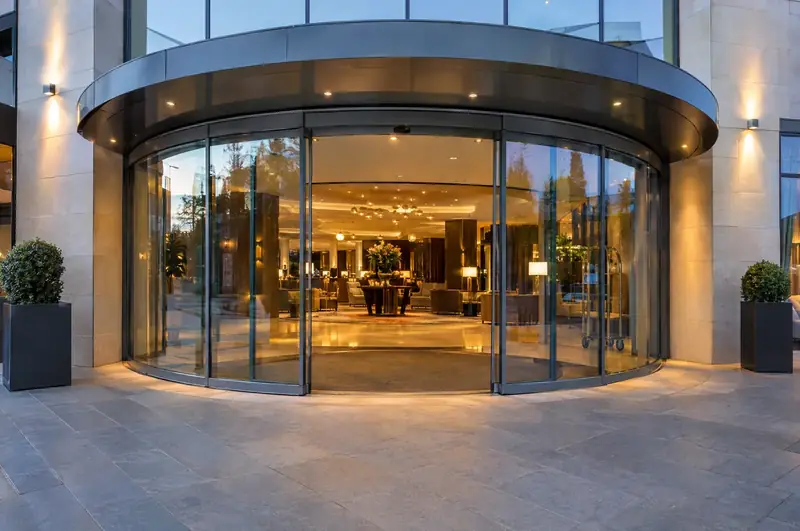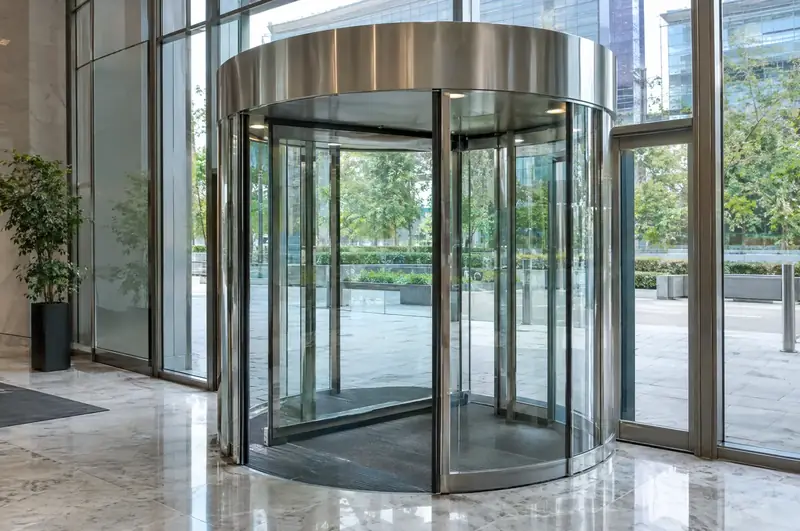
Revolving doors keep wind, rain, noise and cold air out of busy buildings while letting people in and out continuously. Because the wings always seal against the drum, the inside of the building is never open straight to the street, which makes them a common choice for office towers, hotels, banks and large public buildings.
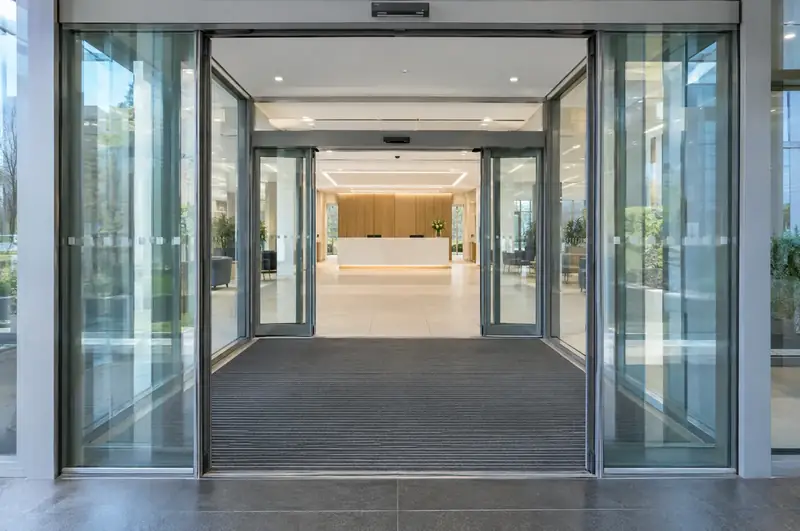
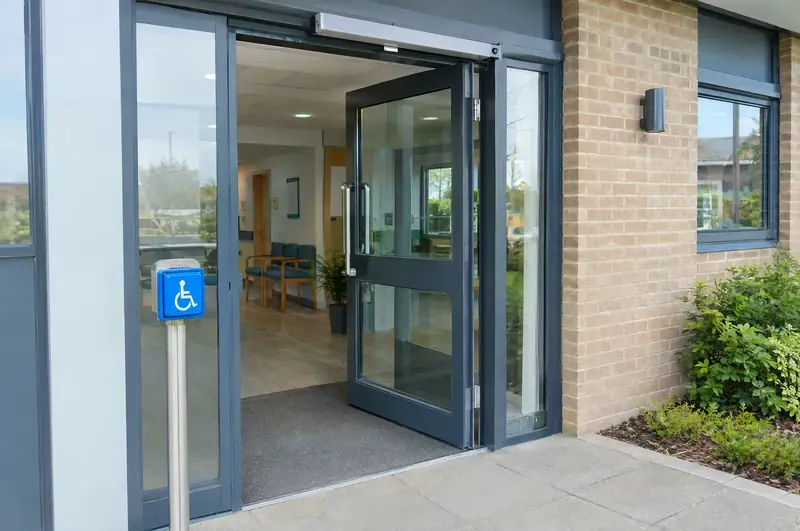
They also come with clear limits. A revolving door is not an accessible entrance on its own, so it is normally installed alongside an accessible powered swing or sliding pass door for wheelchair users, pushchairs, deliveries and anyone who needs more time. The fire strategy for the building decides how people escape in an emergency.
We supply and install manual and automatic revolving doors in three- and four-wing designs, together with the pass door beside them. Specialist automatic door engineers working under our management carry out the survey, installation and commissioning, and automatic doors are set up and documented with reference to BS EN 16005. The survey is free and the quote is fixed and itemised.
- Typical diameter
- 1,800 mm to 3,600 mm
- Typical lead time
- Typically 8 to 14 weeks from order
- Usually suits
- Office towers, hotels, large public buildings
- Safety reference
- BS EN 16005 for automatic doors
Manual or automatic: how does a revolving door work?
A revolving door works by turning a set of wings around a central shaft inside a drum with curved glass walls. As the wings turn, each compartment carries people from outside to inside, and the wings seal against the drum walls so air cannot rush straight through.
A manual revolving door is pushed round by the people using it, with a speed governor that stops it spinning too fast and a mechanism that brings the wings back to a set position. It suits smaller diameters and steady, moderate traffic. An automatic revolving door has a drive in the canopy that turns the wings at a set speed when sensors detect someone approaching, slowing or stopping if anyone gets too close to a moving edge. It suits larger diameters, heavier traffic and buildings where visitors carry bags or luggage.
Many automatic doors also offer a push-assist mode, where the drive helps a gentle push, and a slow-speed button for anyone who needs extra time.
Three wings or four, and what diameter do I need?
The number of wings and the diameter together decide how much room each person gets and how many people can pass in a minute.
- Three wings give larger compartments for the same diameter. They are the usual choice for automatic doors, where people walk in with cases, shopping or a colleague.
- Four wings give smaller compartments and a traditional look, and are common on manual doors and smaller diameters.
- Larger diameters give more room per compartment and more people per turn, but need more floor space and cost more.
As a rough guide, manual doors often sit between about 1,800 and 2,400 mm in diameter, and automatic doors between about 2,000 and 3,600 mm. The survey looks at peak traffic, such as the morning arrival at an office or check-out time at a hotel, and recommends a size that copes without queues forming outside.
Does a revolving door need a pass door alongside it?
Yes, in almost every case. A revolving door is not accessible on its own: wheelchair users, people with assistance dogs, parents with pushchairs and anyone who cannot keep pace with the wings need a door they can pass through without turning. Building regulations guidance expects an accessible powered swing or sliding door alongside, and service providers have duties to make reasonable adjustments for disabled people under equality and accessibility law.
The pass door also takes deliveries, furniture moves and cleaning equipment, and it often forms part of the escape route. In England and Wales, fire safety law says revolving doors must not be used for exits specifically intended as emergency exits, so the fire strategy will normally rely on the pass door or another exit. Some automatic revolving doors have wings that fold flat when pushed, but whether that counts for anything is decided by the fire strategy, not assumed.
We design the revolving door and the pass door together, so they share the same framing, finish and controls. See accessible door operators and automatic sliding doors.
How much energy does a revolving door save?
A revolving door saves energy because the building is never fully open to the outside. With a sliding or swing door, every opening lets warm air out and cold air in, and in tall buildings the stack effect can pull a strong draught through an open entrance. A revolving door keeps that airflow closed off however many people pass through.
The saving is largest at busy, exposed entrances in winter and at air-conditioned buildings in summer. It also improves comfort for reception staff, who no longer sit in a draught each time someone arrives. Insulated glass in the drum walls and good brush seals on the wings add to the effect. To compare the alternatives, see automatic entrance lobbies.
What does the survey check for a revolving door?
- The floor area available for the drum and the pass door, inside and outside the building line
- The ceiling height and the structure above, which must carry the canopy and, for automatic doors, the drive
- floor construction and levels, since the drum needs a flat, level floor and often a recess for the bottom bearing and drum mat
- peak and average traffic, the type of visitors and what they carry
- The fire strategy, the escape routes and where the pass door should sit
- power supply, fire alarm and access control links, and night security
- planning or listed building questions where the entrance changes the look of the façade
The survey produces drawings for both doors and a fixed, itemised written quote.
How is a revolving door installed and looked after?
Installing an automatic revolving door usually takes several days on site. The floor is prepared, the drum walls and canopy are erected, the curved glass is fitted, and then the wing assembly and drive are installed and aligned. The engineer sets the rotation speed, safety sensors, emergency stop buttons and slow-speed function, tests every safety feature and completes the risk assessment.
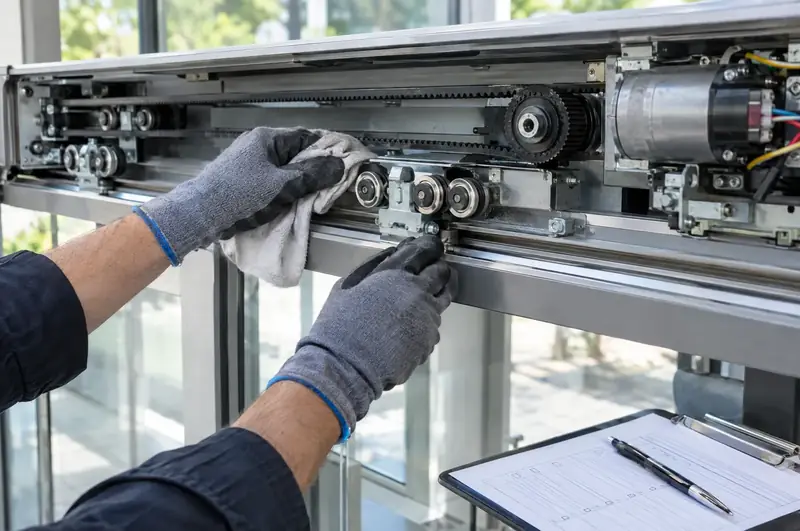
Revolving doors work hard, so planned servicing matters. An engineer should test the safety sensors, stop buttons and wing edge protection at least once a year, with the interval set by the manufacturer's instructions and how busy the entrance is, which for an office tower usually means more frequent visits. Staff should check daily that the door turns smoothly and the stop buttons are unobstructed. See automatic door servicing.
Which revolving door suits your entrance?
| Option | What it is | Best for |
|---|---|---|
| Manual four-wing | Pushed round by users, with a speed governor | Smaller entrances with steady, moderate traffic |
| Manual three-wing | Pushed round, with larger compartments | Hotels and offices wanting more room per person |
| Automatic three-wing | Drive-turned wings with sensors and a slow-speed button | Busy offices, hotels and public buildings |
| Automatic four-wing | Drive-turned wings in a traditional layout | Prestige entrances with moderate diameters |
| Fold-flat wings | Wings that fold when pushed in an emergency, where the fire strategy permits | Entrances where the strategy relies on it |
| Pass door | Accessible powered swing or sliding door beside the drum | Wheelchair users, pushchairs, deliveries and escape |
How much does a revolving door cost?
An automatic revolving door is typically £29,995 to £59,995 ex VAT as a guide, with manual doors usually costing less and the diameter, glass, finish and pass door all changing the figure. The table shows what moves the price; your written quote is the price you pay.
| Item | Guide price | Notes |
|---|---|---|
| Manual revolving door | from £14,995 | installed, ex VAT; priced on survey |
| Automatic revolving door, three or four wings, about 2.1 m diameter | £29,995 – £59,995 | installed, ex VAT |
| Large-diameter or high-capacity revolving doors | Priced on survey | often with a side swing or sliding door alongside |
| Side door for wheelchair users, prams and escape | see sliding and swing doors | usually needed alongside a revolving door |
Standards and the law
BS EN 16005 is the current standard for the safety in use of powered pedestrian doors, and BS 7036-0:2014 is the British code of practice for risk assessment and risk reduction used alongside it. Standards are not law in themselves, but they are the recognised benchmark for showing an automatic door is safe to use, and we set up, test and document doors with reference to them.
Whoever motorises a manual door, or builds an automatic door from separate parts, may take on the manufacturer’s legal duties for the finished door: a risk assessment, a technical file kept available for the authorities, a Declaration of Conformity, the conformity marking and instructions. You receive the Declaration of Conformity and the instructions at handover.
Building regulations guidance treats revolving doors as not accessible on their own, so an accessible powered swing or sliding door should be provided alongside. Fire safety law in every UK nation says sliding or revolving doors must not be used for exits specifically intended as emergency exits.
The law that applies also depends on the nation. The table shows the main differences; each county and town page carries the rules for its own nation.
| Nation | Accessibility | Building regulations guidance | Fire safety law |
|---|---|---|---|
| England | The Equality Act 2010 | Approved Document M (Volume 2): powered opening where opening force would exceed 30 N, or 22.5 N from 30° to 60°; 1000 mm clear width for public entrance doors in new buildings | Regulatory Reform (Fire Safety) Order 2005: the responsible person |
| Wales | The Equality Act 2010 | Approved Document M (Wales): powered opening where opening force would exceed 20 N; 1000 mm clear width for public entrance doors in new buildings | Regulatory Reform (Fire Safety) Order 2005: the responsible person |
| Scotland | The Equality Act 2010 | Building (Scotland) Regulations 2004, non-domestic Technical Handbook: accessible entrance with at least 800 mm clear opening; building warrant for building work | Fire (Scotland) Act 2005: whoever has control of the premises |
| Northern Ireland | The Disability Discrimination Act 1995 | Building Regulations (Northern Ireland) 2012: powered doors must not trap people and must open on power failure; access guidance in Technical Booklet R | Fire and Rescue Services (Northern Ireland) Order 2006 and Fire Safety Regulations (Northern Ireland) 2010 |
Questions about revolving doors
Can wheelchair users use a revolving door?
Not reliably, which is why a revolving door should never be the only way in. Even large automatic doors can be difficult for wheelchair users, people with assistance dogs and anyone who needs more time. An accessible powered swing or sliding door should be provided alongside, clearly signed and available whenever the building is open.
Can a revolving door be a fire exit?
It should not be relied on as an emergency exit. In England and Wales, fire safety law says revolving doors must not be used for exits specifically intended as emergency exits, and elsewhere the fire strategy sets strict conditions for any revolving door on an escape route. Escape is normally through a pass door or other exits. Fold-flat wings exist on some doors, but only count where the fire strategy allows.
Is a manual or automatic revolving door better?
It depends on traffic and users. Manual doors suit smaller entrances with steady traffic and cost less to buy and maintain, but some people find them heavy to start. Automatic doors suit busy entrances, larger diameters and visitors with luggage, and they include sensors, stop buttons and a slow-speed mode. The survey looks at your entrance and recommends one.
How many people can a revolving door handle?
That depends on the diameter, the number of wings and the rotation speed. A larger three-wing automatic door lets two or three people share a compartment and copes well with a morning rush, while a small manual door suits one person at a time. We look at your busiest periods at survey and size the door to match.
Do revolving doors really save energy?
At busy and exposed entrances, yes. Because the drum always seals, the building is never open straight through, so less warm air escapes each time someone enters and draughts caused by the stack effect in tall buildings are kept in check. The size of the saving depends on traffic, weather and building height, and comfort for staff near the entrance improves too.
What happens to an automatic revolving door in a power cut?
Depending on the specification, the wings can be pushed round by hand, or a battery keeps the door turning for a period. Powered doors must be safe if the power fails, so this behaviour is agreed with you and set at commissioning. The pass door is usually set up to open, or to be openable by hand, as well.
How is a revolving door secured at night?
The wings stop in a locked position across the drum, with locks in the wings or the floor. Some automatic doors add a night shield or sliding night door that closes across the drum opening. The pass door is locked separately, and both can be linked to timers, access control and the intruder alarm.
Can an old revolving door be refurbished rather than replaced?
Sometimes. Where the drum, canopy and glass are sound, a revolving door can be overhauled or have a new drive and safety sensors fitted. Where parts are no longer supported or the door no longer suits the building, replacement is usually better value. The survey looks at the existing door and gives you both options where they make sense.