An automatic door is only as easy to use as the thing that opens it. A push pad in the wrong place, a sensor that opens the door for every passer-by, or a fob that a person cannot grip can make a good door frustrating. Choosing the right activation for each side of each door fixes that.
We supply, fit and set up activation devices for automatic doors in businesses, public buildings and homes. That includes no-touch wave switches, large push pads, radio buttons and fobs, key switches and motion sensors, on their own or linked to access control.
Activation can be added to an existing automatic door or specified as part of a new one, and changing it is often the cheapest way to make a frustrating door easy to use. Every job starts with a free survey and a fixed, itemised written quote, with home prices quoted including VAT.
- Devices
- Wave switches, push pads, radio, key switches, sensors
- Typical lead time
- typically 1 to 3 weeks
- Usually suits
- Healthcare, washrooms, offices, homes
- Safety reference
- BS EN 16005
What are the ways to open an automatic door?
An automatic door can be opened by something the user does, such as pressing or waving, or by something that detects them, such as a motion sensor. Most doors use one method on each side, and many combine two.
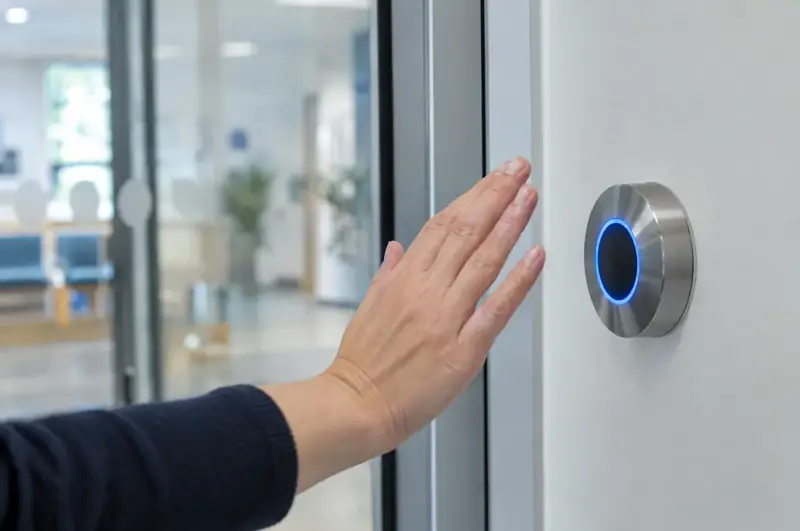
- Wave or no-touch switch: a small infrared sensor that opens the door when a hand passes in front of it.
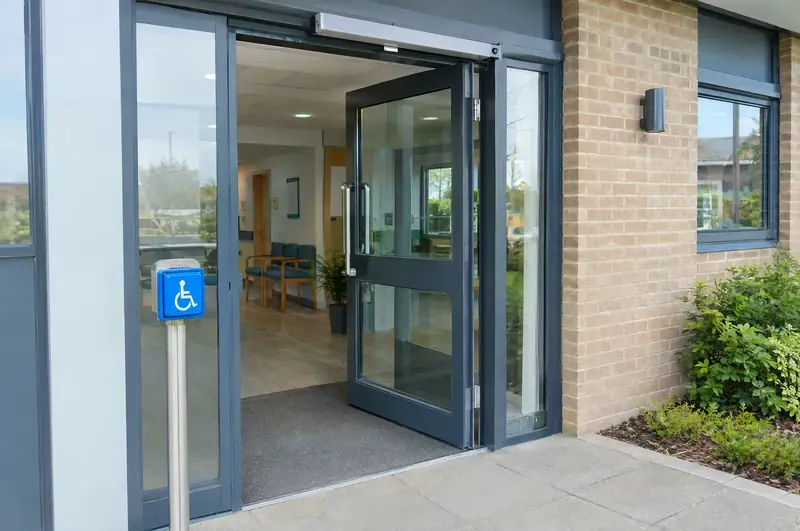
- Push pad: a large button, often with a wheelchair symbol, pressed with a hand, elbow or forearm.
- Radio button or fob: a wireless transmitter on a keyring, wristband, wheelchair or wall.
- Key switch: a lock-and-key switch that opens the door or changes its mode for staff.
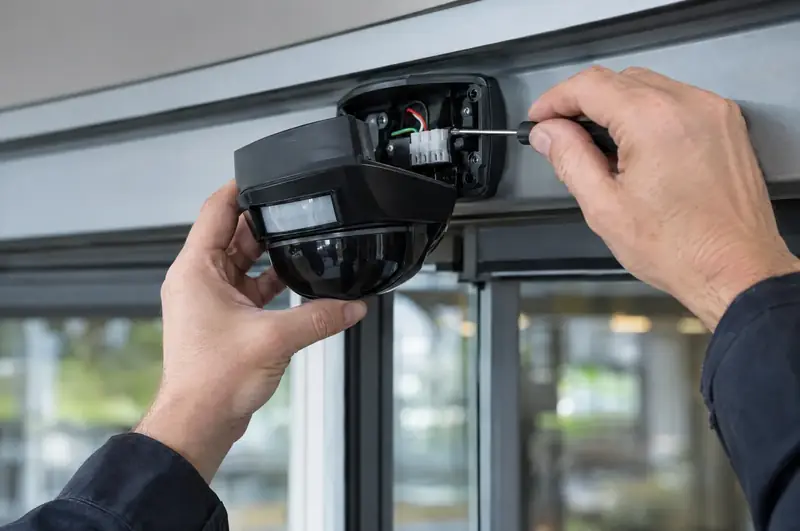
- Motion sensor: a radar sensor above the door that opens it as people approach.
Presence sensors, which watch the doorway itself, are mainly safety devices that stop the door closing on someone. Some combined sensors handle both jobs, and our guide to door sensors explains the difference.
Should a door open on a sensor or on a switch?
A door should open on a sensor when everyone who approaches it needs to go through, and on a switch when only some people do. A busy shop entrance suits a motion sensor. A corridor door that people walk past, or a door into a quiet room, suits a switch so it does not open every time someone goes by.
Switches also help with heating and security. A door that opens only when asked loses less heat and stays closed against people who have no reason to pass. Low-energy accessible doors are usually push-pad operated for this reason, and a sensor can still be added on the exit side so people leave hands-free.
Where should switches and push pads be placed?
Switches should be placed where users reach them naturally, before they arrive at the door and out of the path of a swinging leaf. On a swing door, that usually means a side wall or a post set back from the door, so a wheelchair user does not have to reverse once the door starts to open.
- Mount at a height a seated person can reach, and keep the same height across the building.
- Fit a switch on both sides of the door unless one side is exit-only.
- Use a colour that contrasts with the wall, with a clear symbol for people with sight loss.
- Set the distance so the door is open by the time the user reaches it.
- In car parks and drop-off points, a switch on a post lets drivers open the door before leaving the car.
- Keep switches clear of door handles, signs and fire alarm call points so nobody mistakes one for another.
Do touch-free switches help with hygiene and infection control?
Yes. A wave switch lets people open a door without touching anything, which reduces the surfaces that need cleaning and the hand contact between users. That matters in hospitals, clinics, care homes, food preparation areas and washrooms.
Detection range is adjustable, so the switch reacts to a deliberate wave and not to someone walking past. Sealed switch faces that can be wiped down with the cleaning products used on site are worth specifying. Where a push pad is still needed, a large pad can be pressed with an elbow or forearm instead of a fingertip.
Can activation work with access control and night modes?
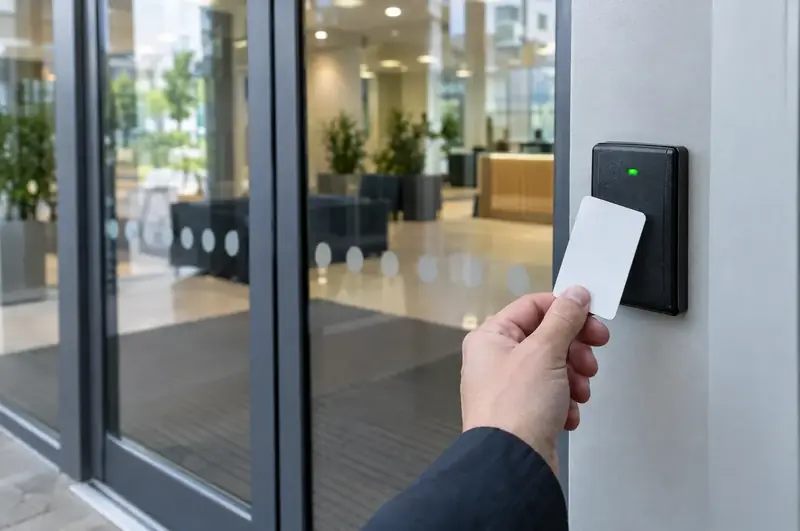
Yes. Activation devices can be linked to access control so the switch only works while the access control system has released the lock, or so a card reader opens the door in place of a switch. A wave switch or motion sensor on the inside can still let people out freely.
Key switches are often used to change the door's mode, for example from automatic to exit-only or locked at night. Timers can switch modes on a schedule. See access control for automatic doors for readers, keypads and intercoms.
What about activation for doors at home?
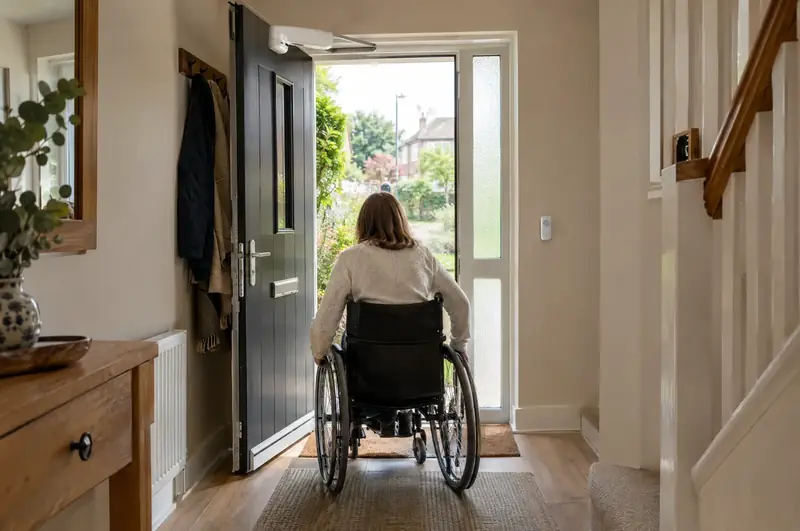
At home, activation is chosen around the person using the door. A wheelchair user might have a switch on the chair, while someone with limited grip may find a wristband easier than a small fob. Large wall buttons suit internal doors, and a fob lets someone open the front door from the car or garden.
Wireless devices make it easier to add controls without cutting into walls, though batteries need changing from time to time. Before handover, every device is tested and the settings recorded, and new or lost fobs can be added or removed later. See home automatic door openers.
Which activation device suits each door?
| Option | What it is | Best for |
|---|---|---|
| No-touch wave switch | Infrared switch triggered by a hand wave | Hospitals, clinics, washrooms and food areas |
| Large push pad | Wall or post-mounted button with a symbol | Accessible entrances and toilets |
| Radio fob or wristband | Wireless transmitter carried by the user | Homes and staff who need the door from a distance |
| Wheelchair-mounted switch | Transmitter fixed to the chair | Power chair users at home or work |
| Key switch | Keyed switch for opening or changing mode | Staff-only doors and out-of-hours control |
| Motion sensor | Radar sensor that opens the door on approach | Busy entrances where everyone goes through |
How much does touch-free door activation cost?
A new activation device, supplied, fitted and set up on an existing automatic door, is from £145 ex VAT (£174 inc VAT) per switch as a guide. The table shows what moves the price; your written quote is the price you pay.
| Item | Guide price | Notes |
|---|---|---|
| Touch-free switch or push pad, fitted | £145 – £395 | per switch, ex VAT; homes £174 – £474 inc VAT |
| Radio push-button kit | £195 – £495 | buttons and receiver, ex VAT; homes £234 – £594 inc VAT |
| Key switch or programme switch | £145 – £345 | fitted, ex VAT; homes £174 – £414 inc VAT |
| Replacement motion (activation) sensor | £195 – £495 | fitted, ex VAT; homes £234 – £594 inc VAT |
Standards and the law
BS EN 16005 is the current standard for the safety in use of powered pedestrian doors, and BS 7036-0:2014 is the British code of practice for risk assessment and risk reduction used alongside it. Standards are not law in themselves, but they are the recognised benchmark for showing an automatic door is safe to use, and we set up, test and document doors with reference to them.
Whoever motorises a manual door, or builds an automatic door from separate parts, may take on the manufacturer’s legal duties for the finished door: a risk assessment, a technical file kept available for the authorities, a Declaration of Conformity, the conformity marking and instructions. You receive the Declaration of Conformity and the instructions at handover.
The law that applies also depends on the nation. The table shows the main differences; each county and town page carries the rules for its own nation.
| Nation | Accessibility | Building regulations guidance | Fire safety law |
|---|---|---|---|
| England | The Equality Act 2010 | Approved Document M (Volume 2): powered opening where opening force would exceed 30 N, or 22.5 N from 30° to 60°; 1000 mm clear width for public entrance doors in new buildings | Regulatory Reform (Fire Safety) Order 2005: the responsible person |
| Wales | The Equality Act 2010 | Approved Document M (Wales): powered opening where opening force would exceed 20 N; 1000 mm clear width for public entrance doors in new buildings | Regulatory Reform (Fire Safety) Order 2005: the responsible person |
| Scotland | The Equality Act 2010 | Building (Scotland) Regulations 2004, non-domestic Technical Handbook: accessible entrance with at least 800 mm clear opening; building warrant for building work | Fire (Scotland) Act 2005: whoever has control of the premises |
| Northern Ireland | The Disability Discrimination Act 1995 | Building Regulations (Northern Ireland) 2012: powered doors must not trap people and must open on power failure; access guidance in Technical Booklet R | Fire and Rescue Services (Northern Ireland) Order 2006 and Fire Safety Regulations (Northern Ireland) 2010 |
Questions about touch-free and push-button activation
Can a wave switch be added to our existing automatic door?
Usually, yes. Most automatic door operators have inputs for extra activation devices, and wave switches can be wired or wireless. We check the operator, the wiring route and where the switch should go at the survey, then quote a fixed price for the device and fitting.
Will a wave switch open the door if someone walks past?
It should not, once set up properly. The detection range is adjusted so the switch reacts to a hand held close to it, not to people passing. If a switch is placed beside a busy walkway, we may suggest moving it or shortening the range to stop false openings.
Do push pads need wiring?
Not always. Wired push pads are the most reliable for busy public doors, but wireless pads with a battery are useful where running cables would be difficult or unsightly, such as on glazed screens or listed walls. Batteries need changing from time to time, and we explain how at handover.
What height should a push pad be fitted at?
At a height a seated person can reach comfortably, and kept consistent across the building. The exact height depends on the guidance that applies and the layout of the door. We also check the pad is far enough from the door that the leaf does not swing towards the user once it starts opening.
Can we stop the door opening at night?
Yes. A key switch, timer or access control link can change the door to exit-only or locked out of hours, while still letting people leave if the fire strategy requires it. During opening hours the door can go back to opening on a sensor or switch automatically.
Are touch-free switches suitable for washrooms?
Yes, and they are common there. Wave switches reduce hand contact on washroom and accessible toilet doors, and sealed switch faces cope with regular cleaning. In an accessible toilet, the inside switch is usually paired with a lock button and an emergency release for staff.
Can a fob open several doors?
Yes. One fob or wristband can usually be set up to open several doors, such as the front door and an internal door at home, or a set of staff doors at work. Each door's receiver is programmed with the fob, and a lost fob can be removed from all of them.
Does a motion sensor count as touch-free activation?
Yes. A motion sensor above the door opens it as people approach, so nobody touches anything. It suits entrances where everyone goes through. Where people walk past without needing the door, a wave switch or push pad avoids the door opening unnecessarily.