What do automatic door sensors actually do?
Automatic door sensors are the detectors that open a powered door when someone approaches and stop it closing or moving onto anyone in its path. Most doors use two kinds: an activation sensor that starts the opening cycle, and one or more safety sensors that watch the areas where the door moves.
The operator, meaning the motor and control unit above or beside the door, acts on these signals. Activation tells it to open. Safety tells it to stop, slow, reverse or stay open. A door can have a perfect drive and still be unsafe if its sensors are set up badly, which is why sensor set-up is a large part of any installation or safety inspection.
BS EN 16005 is the standard for the safety in use of power-operated pedestrian doors. It sets out how the hazard zones around a door should be protected, and sensors are one of the main ways of doing that. We set up, test and document doors with reference to it. See BS EN 16005 explained for an overview of the standard.
What types of activation sensor are there?
An activation sensor is any device that tells the door to open: a motion detector, a push pad, a touch-free switch, a key switch, a card reader or a remote button. The right choice depends on who uses the door and whether it should open for everyone or only on request.
| Activation method | How it works | Typical use |
|---|---|---|
| Microwave (radar) motion sensor | Detects movement towards the door in a zone in front of it | Shop, office and public entrances with steady footfall |
| Direction-sensitive motion sensor | Opens for people approaching and ignores people walking past or away | High streets, pavements and corridors with cross traffic |
| Push pad or push button | The user presses to open, often marked with the wheelchair symbol | Accessible swing doors, toilets, doors that should not open for passers-by |
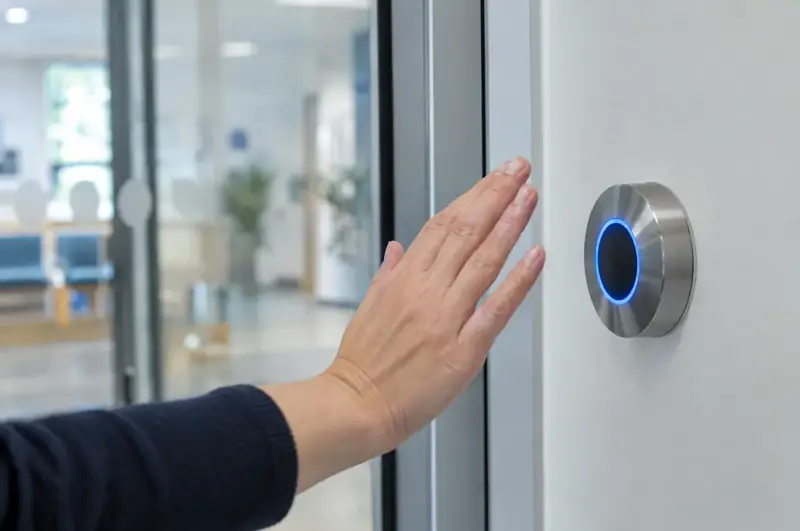
| Touch-free (wave) switch | A short-range sensor that opens the door when a hand passes in front of it | Healthcare, food areas, washrooms |
| Key switch, keypad or card reader | Opens only for authorised users | Staff doors, out-of-hours access, secure areas |
| Radio button or fob | A wireless transmitter, carried or fixed to a wall or desk | Homes, carers, reception staff opening the door remotely |
Motion sensors suit doors that should open for everyone. Push pads and touch-free switches suit doors that should stay shut unless someone wants to use them, such as an accessible door off a busy corridor. See touch-free and push-button activation for the options we fit.
How do safety sensors protect people?
A safety sensor is a detector that watches the area a door moves through and stops the door closing on, or striking, anyone standing there. On most modern doors this is an active infrared presence sensor, which projects invisible infrared spots onto the floor or across the opening and notices when something interrupts them.
Different door types need protection in different places:
- Sliding doors: presence detection across the threshold, so the leaves do not close on someone standing in the opening, plus protection where the leaves slide past side screens or walls.
- Swing doors: door-mounted sensors on both faces of the leaf. One watches the swing path so the door stops before it strikes someone. The other watches the closing side so the door does not close on a person behind it.
- Revolving doors: sensors and safety edges at the wing edges, the canopy and the posts, where the turning wings could trap or strike.
- Light curtains: a row of infrared beams in the door posts that forms a vertical detection plane, used where a threshold needs protection from low down to head height.
Workplace health and safety law expects powered doors to have safety features that prevent people being trapped or struck. Safety sensors are one of the main ways an installer meets that expectation, along with limits on the drive's force and speed, guards over gaps and the shape of the door itself.
What is a combined sensor?
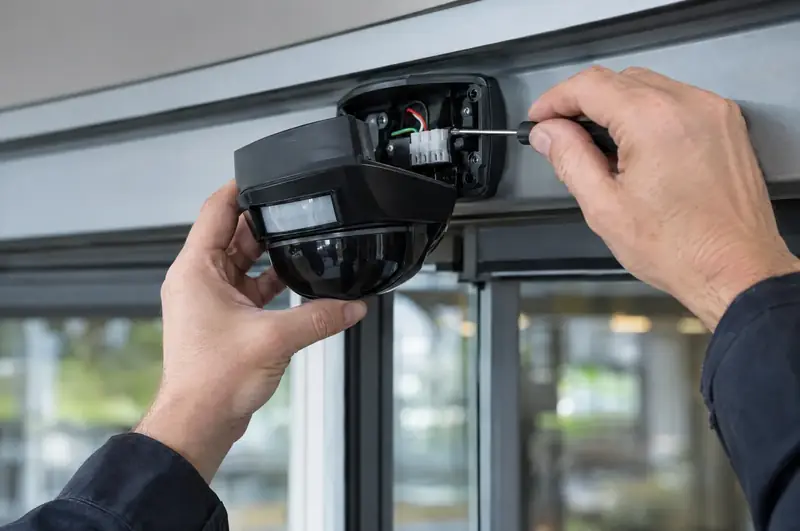
A combined sensor is a single unit that does both jobs: a microwave motion detector for activation and an active infrared presence field for safety, in one housing above the door. Most new sliding doors use one on each side.
Combined units save space and wiring, and set-up is simpler because one device covers both functions. The catch is that a fault in the unit can affect both. When a combined sensor fails, the door may stop opening, or it may refuse to close because the controller can no longer confirm the threshold is clear.
Many safety sensors are monitored. Before each closing movement the door's controller checks that the sensor is responding, and if it gets no answer the door stays open or moves slowly instead of closing normally. That is a safety feature rather than a fault in itself, although it often looks like one to the people using the door.
How are detection zones set up?
A detection zone is the area of floor or opening in which a sensor responds. Setting it up means placing and sizing that zone so the door opens in time for people approaching, ignores people who are not, and protects everyone standing where the door moves.
The engineer adjusts the sensor's angle, field width and depth, sensitivity and any direction filtering on site. The right set-up depends on:
- how fast and how many people approach, and whether they include wheelchair users, people with walking aids, children or people pushing trolleys and buggies
- cross traffic past the door, such as pavements, corridors or till queues
- weather, because rain, snow, blowing leaves and moving shadows can trigger some sensors if the field reaches outside
- the floor finish, because glossy, wet or very dark floors and entrance mats affect how infrared sensors see the floor
- nearby objects such as A-boards, plants, displays, hanging signs and other doors
A zone that is too small makes the door open late, so people slow down or walk into the glass. A zone that is too large makes the door open for passers-by, which wastes heat and wears the drive. Getting the balance right is usually a matter of careful adjustment rather than new hardware.
How are door sensors tested?
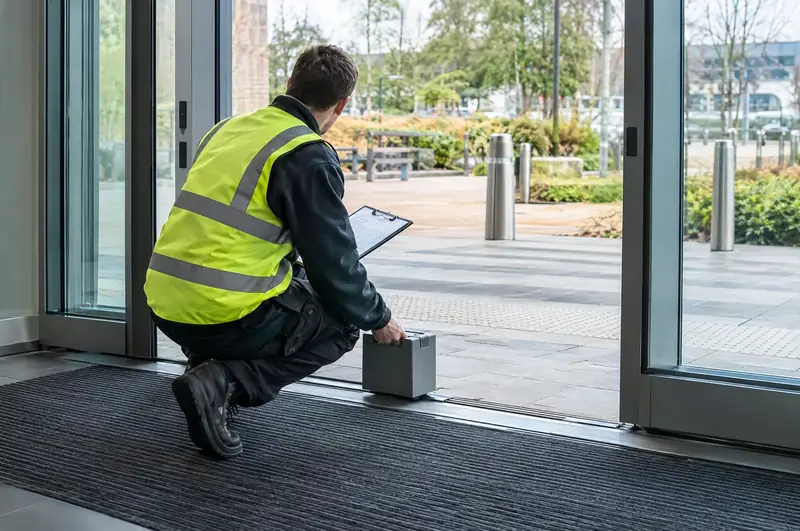
Sensors are tested by checking that the door responds correctly with a person or a test object in each hazard zone, and recording the results. A safety inspection or service visit should test every activation and safety device the door relies on, not just watch the door open and close.
For safety sensors, the engineer places a test object of a set size and shape, of the kind described in BS EN 16005, at points across the threshold and in the slide or swing path. They check the door stops, reverses or stays open as it should at each point. For activation, they check the approach zone and any direction filtering. The results go in the written service or inspection record.
Day to day, a site manager can watch for warning signs: a door that closes while someone is standing in the opening, opens late, or behaves differently in rain. Those are reasons to take the door out of automatic use and ask for a check. Our safety inspections are typically £125 to £250 ex VAT per door as a guide, with the visit price agreed in writing before we attend.
What are the most common sensor faults?
The most common sensor faults are dirty or misaligned sensor faces, detection fields knocked out of position, interference from weather or nearby objects, and failed units on older doors. Many show up as a door that will not close or one that opens by itself.
| Symptom | Likely sensor cause |
|---|---|
| Door stays open or will not close | Something in the presence field, a dirty or misaligned safety sensor, or a failed monitored sensor |
| Door opens by itself (ghosting) | The activation field is picking up rain, passing traffic, flags, displays or vibration |
| Door opens late or people walk into it | The activation zone is too small or angled too steeply |
| Door closes while someone is in the opening | The safety field is misaligned, too narrow or not working. Take the door out of use. |
| Door works on dry days but not wet ones | Wet floors are affecting the infrared field, or the motion field reaches outside |
| Swing door stops part way for no reason | A door-mounted sensor is seeing a wall, radiator or handrail in its field |
A sensor that has been knocked by a ladder or a trolley can often be realigned. Older units that are no longer made, or that cannot protect the hazard zones on their own, are better replaced. Sensor upgrades and replacement are typically £195 to £495 ex VAT per sensor fitted as a guide, and we quote parts and work before doing them.
Never cover, tape over or disconnect a safety sensor to stop a door misbehaving. That removes the protection the door relies on. Switch the door to a safe setting and ask for a check instead.
Questions
Can I clean automatic door sensors myself?
Usually, yes, with care. Wipe the sensor face gently with a soft, dry or slightly damp cloth, without solvents, and do not move or open the housing. Check the manufacturer's instructions for the door first if you have them. If the door still behaves oddly after cleaning, the sensor may be misaligned or failing and needs an engineer to test it.
Why does my automatic door open when nobody is there?
This is often called ghosting. The motion sensor is picking up something in its field, such as rain, traffic, a flag, a moving display or reflections. An engineer can narrow the field, change its angle, add direction filtering or adjust the sensitivity. On older doors, a newer sensor with better filtering often solves it.
Do push-button doors still need safety sensors?
A push pad only starts the door. Whether the door also needs safety sensors depends on the door type, its speed and force, and the people using it, which is what a risk assessment decides. Full-energy doors normally need them. Low-energy swing operators move slowly and gently, so some can rely more on limited force, but that is judged door by door.
How often should door sensors be checked?
No law sets a fixed interval. We recommend a trained engineer checks the safety functions at least once a year, with service intervals set by the manufacturer's instructions and how heavily the door is used, so busy doors are often checked more often. Site staff should make simple regular checks and keep a record, and ask for a check if the door is knocked or the floor or mats change. See how often automatic doors should be serviced.
Can new sensors be fitted to an old automatic door?
Often, yes. Many older doors can take modern activation and safety sensors, as long as the control unit can accept and monitor them. If the controller is too old to do that, a new drive unit may be the better option. An engineer's check of the door tells you which applies, and any work is quoted before it is done.