Can any door be made automatic?
Most sound, well-hung doors can be made automatic, as long as the door, frame, hinges and surrounding wall are strong enough to take an operator and the forces of daily automatic use. Swing doors in timber, aluminium, steel and some reinforced uPVC can all be suitable.
Some doors are not worth automating. Typical reasons are:
- a leaf that is warped, rotten, damaged or badly hung
- a weak frame or wall with nothing solid to fix the operator to
- a leaf too heavy or too wide for the operators that would fit the space
- no room above or beside the door for the operator or arm
- a fire door where a suitable operator cannot be fitted without affecting its fire performance
- an opening that is too narrow for the people who need to use it
In those cases a new automatic door set is usually the better answer, and the survey will say so.
What makes a door suitable for an operator?
A door is suitable for an operator when its condition, weight, hinges, fixings, space and power supply all allow an operator to be fitted and set up safely. The survey checks each of these before we quote.
| What the survey checks | Why it matters |
|---|---|
| Condition and weight of the leaf | The operator must be matched to the door, and a poor leaf will not stay aligned |
| Hinges or pivots | Automatic use puts more cycles on the hinges, so they may need upgrading |
| Frame and head fixing | The operator is fixed above the door, so the head must be solid |
| Space above and around the door | There must be room for the operator, the arm and the swing |
| Which way the door opens | Push or pull side affects the arm type and the sensor layout |
| Glass | Glazed leaves need safety glass and markings where people could walk into them |
| Locks and handles | Locks must release before the door opens, or be swapped for an electric lock |
| Fire rating | Fire doors need an operator suitable for fire doors, linked to the alarm |
| Power supply | A supply near the door head is needed, and adding one is shown in the quote |
Which type of operator does an existing door need?
An existing swing door is automated with an overhead swing operator, either low-energy or full-energy, while a manual sliding door needs a sliding operator and track fitted above it. The choice depends mainly on how busy the door is and who uses it.
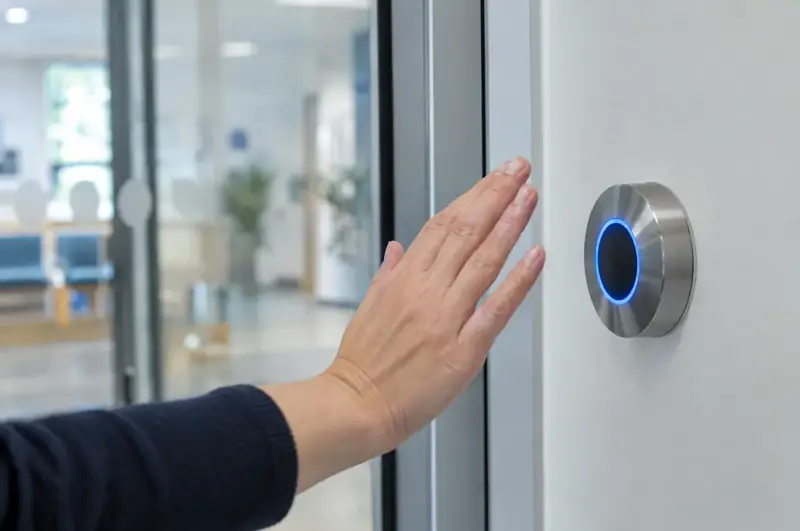
- Low-energy swing operator. Opens the door slowly and gently, usually from a push pad or touch-free switch. It suits accessible toilets, offices, consulting rooms, flat entrances and other doors with lighter traffic.
- Full-energy swing operator. Moves the door at normal speed for busy doors, usually opened by motion sensors, and protected by safety sensors on the leaf.
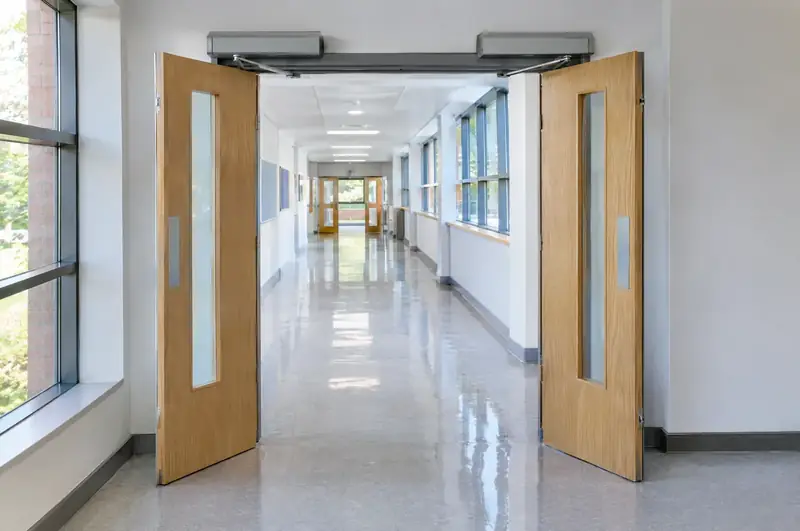
- Operators for pairs of doors. A double door can take two operators or a single unit that drives both leaves, set up so the leaves open and close in the right order.
- Sliding operator. A manual sliding door or screen can sometimes be motorised with a new operator, track, carriers and sensors, if the leaves and frame are suitable.
Our guide to low-energy or full-energy operators explains the choice in detail.
What safety devices does an automated door need?
An automated door needs the safety devices that its site-specific risk assessment shows are necessary to stop it trapping or striking anyone. For a full-energy swing door that usually means safety sensors on both faces of the leaf and a finger guard on the hinge side. A low-energy door may need fewer, but only where the assessment shows a low risk to the people who use it.
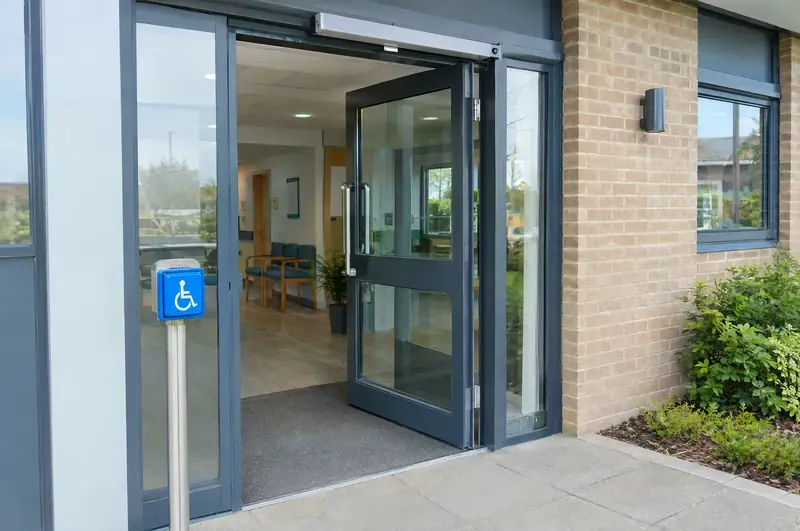
The door also needs a way to open it. Common choices are push pads, touch-free wave switches, motion sensors, radio buttons for people who need to open the door from further away, and card or fob readers for controlled access. Building regulations guidance in England, Wales and Scotland places push pads between 750 mm and 1000 mm above the floor, set back so the user is not in the door's path as it opens.
Signs telling people the door is automatic, and how to open it, complete the set-up. See touch-free and push-button activation for the options.
Who is responsible for the paperwork when a door is motorised?
When a manual door is fitted with an automatic operator, the finished door must meet the Supply of Machinery (Safety) Regulations 2008 before it is first used, and whoever motorises it may take on the manufacturer's legal duties for the finished door. In Northern Ireland the EU machinery rules apply instead, with the new EU Machinery Regulation applying there from 20 January 2027.
Those duties include assessing the risks, keeping a technical file, issuing a Declaration of Conformity, applying the conformity marking and handing over instructions. A properly carried out retrofit includes all of this, so ask for it whoever you use.
We set up, test and document automated doors with reference to BS EN 16005, and BS 7036-0 is the UK code of practice used alongside it for the risk assessment.
How does the installation work?
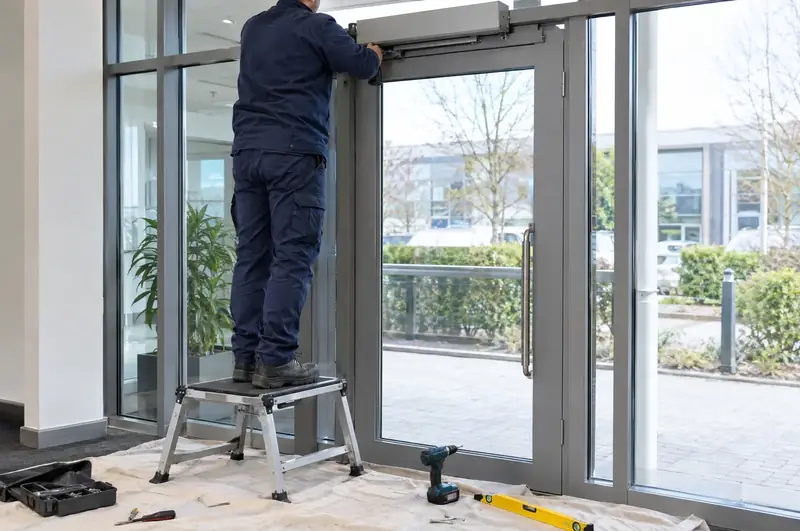
Automating an existing door is often done in a single visit once the parts are on site, with the door out of use only while the operator is fitted, set up and tested. The steps are:
- a free site survey to check the door, the space, the power supply and how the door is used
- a fixed, itemised written quote setting out the operator, safety devices, activation, any electrical or making-good work, the lead time and warranty terms
- a power supply near the door head, if one is not already there
- fitting the operator and arm, and removing the old door closer where it is no longer needed
- fitting the safety sensors, push pads or switches and any lock interface
- setting speed, force and hold-open time, then testing every safety function
- handover with the paperwork, a demonstration for staff, and advice on site checks and servicing
Work can be arranged outside opening hours where a business needs the door in use during the day.
After handover, the automated door needs the same care as any other powered door. We recommend a trained engineer checks the safety functions at least once a year, with busier doors serviced more often, and someone on site should carry out simple regular checks and keep a record. A door that is used heavily from day one, such as a main entrance, is worth putting on a service plan straight away, so the operator settings and sensors are checked before wear builds up. See automatic door servicing.
What goes wrong with a poor retrofit?
A poor retrofit usually fails because the operator was not matched to the door or the safety and paperwork steps were skipped. The most common problems are:
- an operator too small for the door's weight or the wind on it, so the door strains, slows or stalls
- the old door closer left in place, fighting the operator and wearing both out
- a lock or latch that does not release before the door tries to open
- no safety sensors on a full-energy door, or sensors that do not cover the whole swing area
- push pads placed where the user has to stand in the door's path
- no risk assessment, Declaration of Conformity or instructions at handover
Each of these is avoidable with a proper survey and handover. If you have inherited a door with any of them, a safety inspection will show what needs putting right.
Is automating cheaper than a new automatic door?
Automating an existing door is usually much cheaper than a new automatic door set, because the leaves, frame and glass are kept. As a guide:
| Option | Guide price | Priced |
|---|---|---|
| Automating an existing door | from £1,795 ex VAT (£2,154 inc VAT) | per door |
| Low-energy accessible operator | typically £1,795 to £2,995 ex VAT | per single door, with push pads |
| Automatic swing door | from £2,495 ex VAT | per door |
| New automatic sliding door set | typically £4,495 to £12,995 ex VAT | per door set |
| Home door opener | typically £1,495 to £2,995 inc VAT | per door |
A new door makes more sense when the existing door is in poor condition, too narrow for the people who use it, heavy enough to strain an operator, or when you want a sliding door where a swing door is now. Commercial prices exclude VAT; see the price guide or the guide price tool.
Questions
Can a fire door be made automatic?
Yes, with an operator suitable for fire doors, fitted so it does not affect the door's fire performance and linked to the fire alarm so the door closes when the alarm sounds. The survey checks the door's fire rating and how it fits the building's fire strategy.
Can my front door at home be automated?
Usually, yes. Home door openers fit to most sound front, back and internal doors, with a wall button and remote fob, and can be linked to an electric lock. See home automatic door openers for options and costs.
Will the door still open by hand?
Most swing operators allow the door to be pushed open by hand, and guidance expects low-energy swing doors to work in manual, powered or power-assisted mode. In a power cut the door can normally be opened by hand, and battery backup is available where the door must keep working.
Can a uPVC door be automated?
Some can. The door needs a strong leaf, good hinges and a frame that can take the operator's fixings, and some uPVC doors need reinforcing first. The survey checks this before we quote.
Do I need an electrician?
A power supply is needed near the door head. Where there is not one, the quote shows the electrical work needed so you can see the full cost before agreeing to anything.