Can an automatic door be on an escape route?
Yes, an automatic door can be on an escape route if it is arranged to let people out safely in an emergency, including when the power fails, the sensors fail or the fire alarm sounds. Doors on escape routes must let people out safely in an emergency, and automatic doors are set up to open, break out or be openable by hand, as the fire strategy for the building requires.
It helps to separate two ideas. An escape route is any route people use to get out in a fire, which often includes the main entrance. An emergency exit is a door provided specifically for escape. The rules are stricter for emergency exits than for an everyday entrance that also forms part of an escape route.
The building's fire strategy and fire risk assessment decide which doors are escape doors and what each one must do. If you are not sure, ask whoever holds them before choosing a door.
What does fire safety law say about doors on escape routes?
Fire safety law in each UK nation says that, where necessary for safety, emergency doors must open in the direction of escape and be easy and immediate to open, and that sliding or revolving doors must not be used for exits specifically intended as emergency exits. The law and the person who holds the duty differ by nation:
| Nation | Fire safety law | Who holds the duty |
|---|---|---|
| England and Wales | Regulatory Reform (Fire Safety) Order 2005 | The responsible person, usually the employer or whoever controls the premises |
| Scotland | Fire (Scotland) Act 2005 and the Fire Safety (Scotland) Regulations 2006 | The person responsible for fire safety under the Fire (Scotland) Act 2005 |
| Northern Ireland | Fire and Rescue Services (Northern Ireland) Order 2006 and the Fire Safety Regulations (Northern Ireland) 2010 | The person with fire safety duties under that Order and those Regulations |
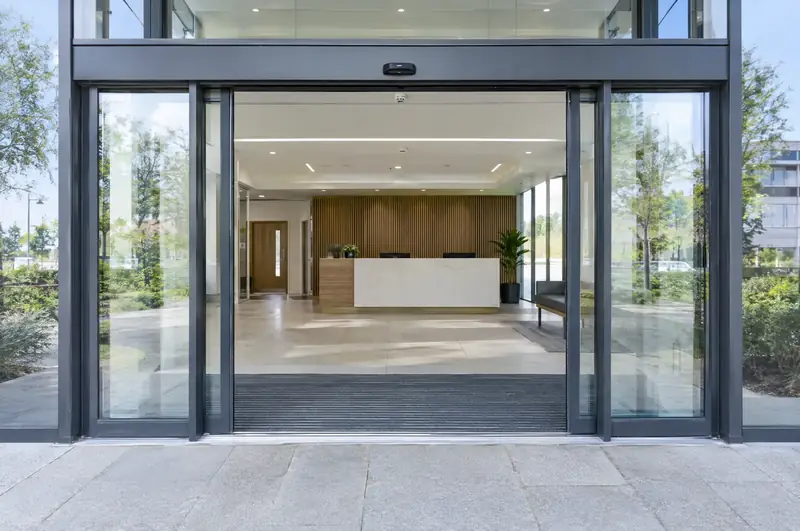
In practice, a dedicated emergency exit should be a door that opens outwards by hand, not an automatic sliding door. An automatic sliding door at a main entrance can still form part of an escape route, provided it is arranged so it cannot trap anyone.
How can an automatic door be made safe for escape?
An automatic door is made safe for escape by arranging it to give a clear way out whatever goes wrong, through break-out leaves, monitored fail-safe opening, or a conventional door alongside. Building regulations guidance in each nation covers this: Approved Document B in England, Wales's own Approved Document B, the Technical Handbooks in Scotland and Technical Booklet E in Northern Ireland.
Scotland's non-domestic Technical Handbook, for example, says automatic and revolving doors may be installed on an escape route if they either fail safely to outward opening from any position, or have a monitored fail-safe system that opens the door if the mains supply or the sensing device fails and opens it automatically when the fire alarm operates in that zone.
| Arrangement | How it works | Typical use |
|---|---|---|
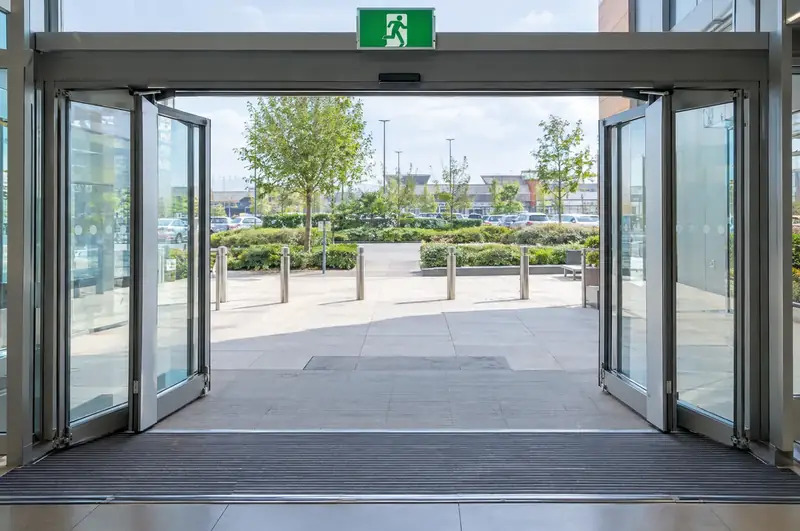
| Break-out leaves and screens | The sliding leaves, and often the side screens, can be pushed open outwards in the direction of escape from any position | Main entrances to shops, shopping centres and public buildings |
| Monitored fail-safe opening | The door opens and stays open if the power fails, a fault is detected or the fire alarm operates, using a monitored battery or similar system | Sliding doors where break-out is not used |
| Conventional door alongside | A non-automatic swing door of the width the escape route needs is provided next to the automatic door | Revolving doors and some sliding entrances |
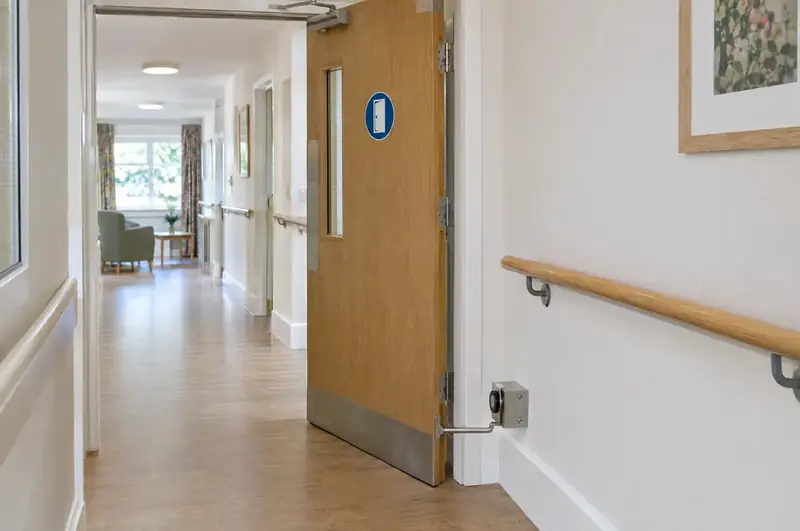
| Swing operator on an escape door | The door opens in the direction of escape and can be pushed open by hand at any time | Corridors, internal escape doors and final exits |
A break-out sliding door works as a normal automatic door day to day. The break-out function only comes into play when someone pushes the leaves in an emergency, and the door may stop until the leaves are put back. Signs on the leaves show that they can be pushed open.
An existing sliding door can sometimes be converted to break-out, but it depends on the frame, leaves and operator, so it is priced after a survey. See break-out escape route doors for doors designed for this job.
What happens to an automatic door when the fire alarm goes off?
When the fire alarm operates, an automatic door on an escape route is normally set to open and stay open, or to unlock so it can be pushed open, depending on the fire strategy. The door's controller is linked to the fire alarm through an interface, which usually involves the alarm engineer as well as the door engineer.
Locks need particular care. Approved Document B in England says electrically powered locks should return to the unlocked position if the fire alarm operates, and if there is a loss of power or a system error. If an automatic door is locked at night, the fire strategy must show how anyone inside can still get out.
Not every powered door should open on alarm. Fire doors and smoke-control doors usually need to close so they hold back fire and smoke, which is why each door's role is set by the fire strategy rather than by the door type. Our guide to power cuts and fire alarms explains the common set-ups.
How do automatic fire doors and hold-open devices work?
Fire doors that are held open must close automatically when the fire alarm operates, so any operator or hold-open device on a fire door has to release and let the door close. An automatic fire door uses an operator suitable for fire doors, fitted so it does not weaken the door's fire performance.
Guidance in England suggests electrically powered hold-open devices or swing-free closers where self-closing fire doors would otherwise be a barrier, and for residential care homes it describes free-swing closers for bedroom doors and hold-open devices for circulation spaces. These let people move freely day to day while keeping the fire protection.
Hold-open devices and door release units linked to the fire alarm need regular testing as part of the building's fire safety checks. See fire door hold-open devices, which are from £145 ex VAT per door as a guide.
What happens in a power cut?
In a power cut, an automatic door on an escape route must still give a way out, either by opening automatically or by being easy to open by hand. Workplace health and safety law expects powered doors to have safety features that prevent people being trapped or struck, and to be safe if the power fails.
In workplaces, a powered door must be able to be opened by hand where needed for safety, unless it opens automatically if the power fails. Northern Ireland's building regulations require a powered door to have a means of opening in a power failure, and guidance in England and Wales expects powered entrance doors to revert to manual control or fail safe in the open position.
Battery backup lets a sliding door open, or keep working for a time, when the mains supply is lost. Batteries wear out, so they should be tested at each service.
Who is responsible, and how should escape doors be checked?
Whoever holds the fire safety duty for the building is responsible for making sure escape route doors work, and the doors should be checked as part of the fire safety maintenance regime. In England and Wales that is the responsible person, and the Fire Safety Order requires fire safety equipment and devices to be kept under a suitable system of maintenance.
- site checks that break-out leaves open freely and are re-locked after use
- tests of the fire alarm link at the intervals set for the alarm system
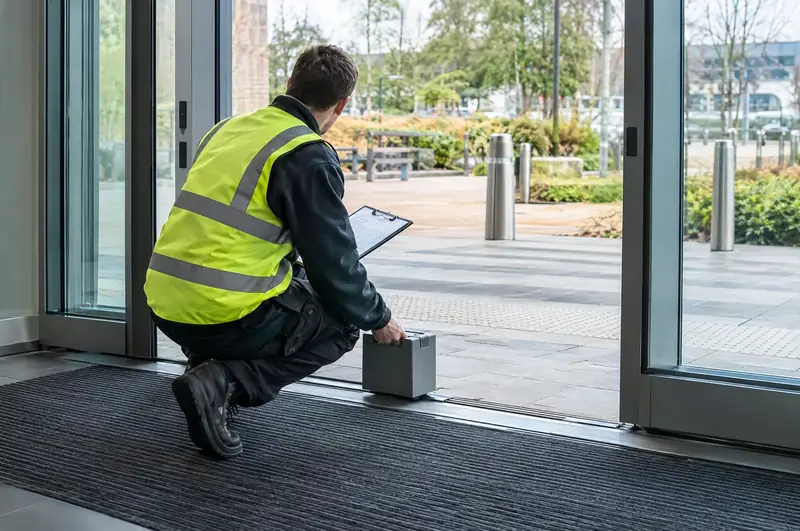
- service visits that test break-out, fail-safe opening and battery backup
- a written record of every test, fault and repair
Staff matter too. The people who open and close the building should know how to switch the door between modes, how to reset break-out leaves, and what the door should do when the alarm sounds, so a fault is noticed rather than worked around.
A safety inspection checks escape functions against BS EN 16005 and records the results. The visit price is agreed in writing before an engineer attends.
If you are adding or replacing a door on an escape route, a break-out sliding door set is from £7,995 ex VAT as a guide. For new doors and upgrades there is a free site survey, and it helps to have the fire strategy to hand.
Questions
Can a revolving door be on an escape route?
Not as an exit specifically intended as an emergency exit, which fire safety law rules out for sliding and revolving doors. Where a revolving door sits on a wider escape route, building regulations guidance expects special arrangements, often a conventional swing door alongside.
Who decides whether my automatic door needs break-out?
The fire strategy for the building and the fire risk assessment decide, usually prepared by a fire engineer or fire risk assessor for whoever holds the fire safety duty. For new building work, building control also checks the arrangement.
Do break-out doors need resetting after use?
Usually, yes. Once the leaves have been pushed out, they are swung back into line and locked in place, and the door returns to automatic use. Staff should know how to do this, and it should be part of the site checks.
Can I lock an automatic door on an escape route at night?
Only if the fire strategy allows it. If people can be in the building while the door is locked, there must be another safe way out, and electric locks on escape doors should release when the fire alarm operates or the power fails.
Does the fire alarm engineer need to be involved?
Often, yes. Linking a door controller or hold-open device to the fire alarm usually means work at the alarm panel or an interface unit, which your alarm engineer carries out or approves. We agree who does what before the work starts.