What makes healthcare and care home doors different?
Healthcare and care home doors differ from ordinary commercial doors because the people using them are more likely to be frail, disabled, unwell or confused, the buildings are in use day and night, and the doors play a part in infection control, fire safety and security at the same time.
A door that works well in an office can cause problems here. A fast door can unsettle residents, a noisy one disturbs sleep, a handle that everyone touches spreads germs, and a locked door on the wrong route can hold people in during a fire. Good specification starts with how each door is used and by whom.
The main areas to think about are entrances, corridors and cross-corridor doors, clinical rooms, residents' rooms and bathrooms, and staff or secure areas. Each has its own priorities.
Which door types suit which areas?
The right door type depends on the area and who uses it. This table gives a starting point, and the survey confirms what suits each opening.
| Area | Typical door choice | Key points |
|---|---|---|
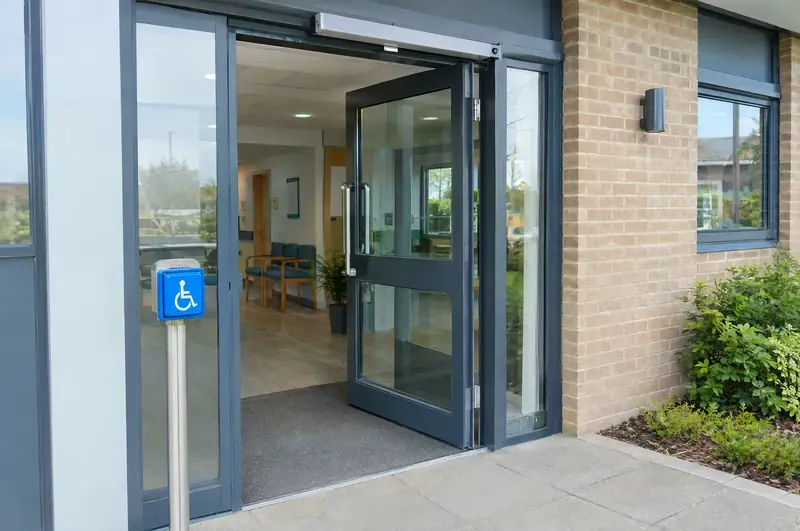
| Main entrance | Automatic sliding doors, often with a draught lobby | Wide clear opening, quick opening, protection from draughts |
| Wide openings for beds and trolleys | Telescopic sliding doors | A wider clear opening where side space is tight |
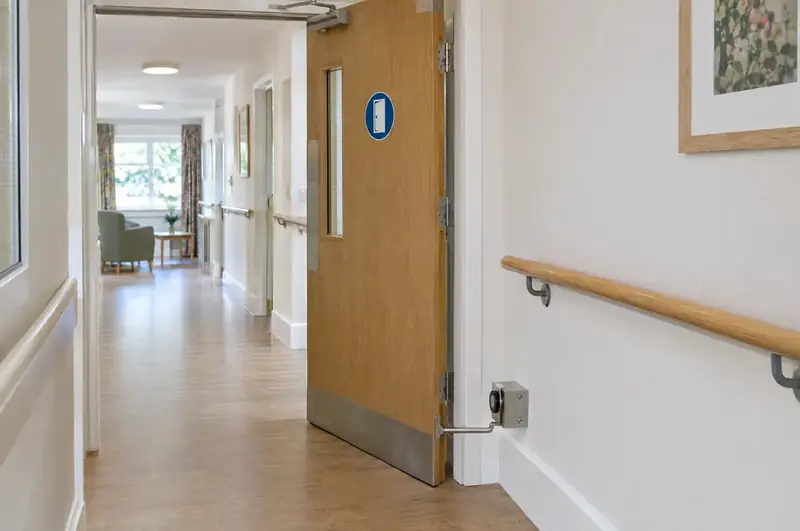
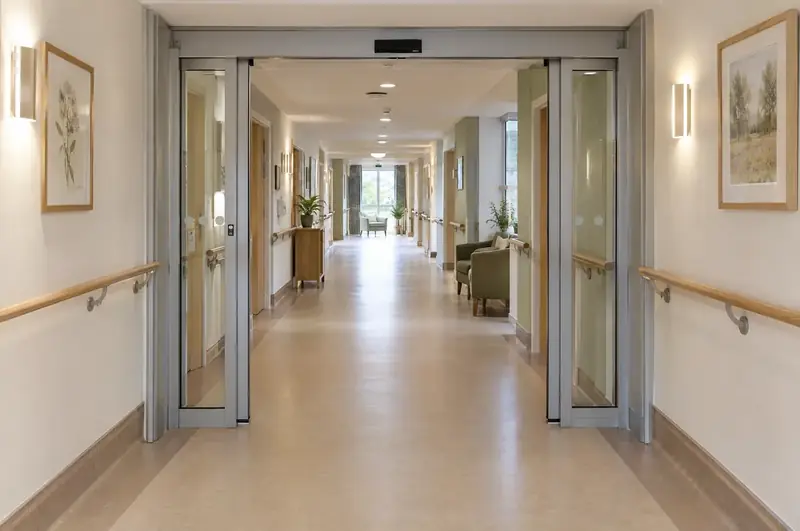
| Corridor and cross-corridor fire doors | Swing operators with alarm-linked hold-open | Open for staff and residents, close when the alarm operates |
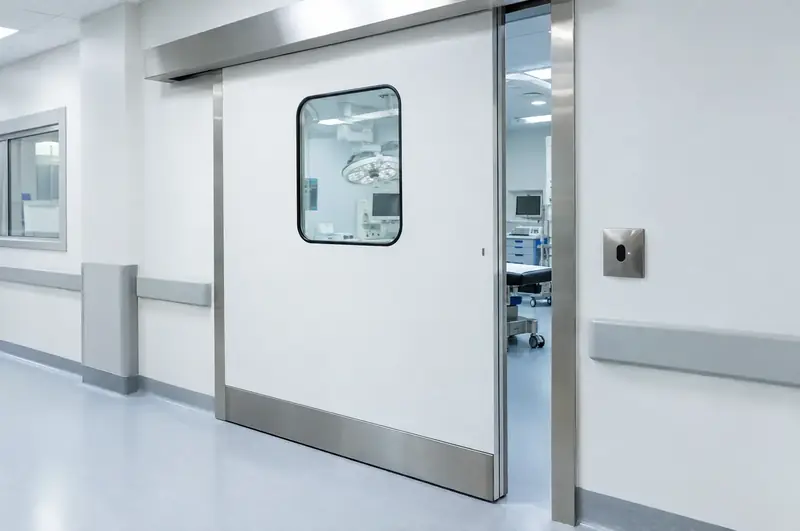
| Theatres, isolation rooms, laboratories | Hermetic sliding doors | Sealed when closed, opened without touch |
| Residents' rooms, bathrooms, day rooms | Accessible door operators (low-energy) | Gentle, quiet movement with a push pad or touch-free switch |
| Staff areas, stores, exits from secure units | Doors with access control | Card, fob or keypad, set up to match the fire strategy |
For internal doors across corridors and wards, see automatic internal doors. Our healthcare and care homes sector pages cover typical projects in more detail.
How do automatic doors help with infection control?
Automatic doors help with infection control by removing the need to touch handles and push plates, which are among the most touched surfaces in any building. Touch-free activation lets staff, patients and visitors pass through with clean or gloved hands.
Options include motion sensors at entrances, short-range wave switches beside internal doors, foot switches in clinical areas, and automatic opening from access control. Smooth door faces, easy-clean finishes and controls that can be wiped down all help cleaning routines. See touch-free and push-button activation.
Where air pressure or cleanliness matters, such as operating theatres, isolation rooms, pharmacy clean rooms and laboratories, a hermetic sliding door seals against the frame and floor when closed. It helps the room hold its ventilation regime, and it is designed to be opened without being touched.
Why are low-energy operators used for residents?
Low-energy operators open and close swing doors slowly and with limited force, which suits rooms used by older, frail or disabled people. Many residents can open a heavy fire door with the press of a large push pad, without needing help from staff.
Because low-energy doors move gently, they can sometimes be used with fewer safety sensors than a full-energy door, but that is decided by the risk assessment for each door. Hold-open time, speed and the activation method are set on site to suit residents. See low-energy or full-energy swing door operators?
Quiet running matters near bedrooms and at night. Modern operators are generally quiet, and slower closing, soft stops and careful set-up reduce the knocks and clicks that can wake residents.
How do corridor fire doors stay open safely?
Corridor and cross-corridor fire doors can be held open for everyday use if they are linked to the fire alarm. Fire doors that are held open must close automatically when the fire alarm operates.
In care homes this is often done with an automatic swing operator connected to the fire alarm, or with alarm-linked hold-open or free-swing devices on doors that do not need powered opening. When the alarm sounds, the device releases and the door closes, helping to hold back smoke and fire.
In England, building regulations fire guidance for residential care homes points to hold-open and free-swing devices made to BS EN 1155, with free-swing closers used on bedroom doors and hold-open devices in circulation spaces. Wales, Scotland and Northern Ireland have their own guidance, so check what applies to your building.
Fire doors are only as good as their condition. Gaps, damaged seals and untested devices let a door down when it is needed. Fire door hold-open devices are from £145 ex VAT per door as a guide, and the fire risk assessment for the building should say which doors are held open and how.
For new NHS buildings and extensions in England, Health Technical Memorandum 05-02, Fire safety in the design of healthcare premises, gives guidance on fire safety design. Ask the estates team or fire engineer which healthcare guidance applies to your building.
How do you balance resident safety and security?
Doors in care and healthcare buildings often need to stop some people leaving unaccompanied, keep visitors out of staff areas, and still let everyone out in an emergency. Access control on automatic doors is the usual way to manage this.
A keypad, card or fob reader can control who opens a door, and timed settings can change how a door behaves at night. The fire strategy decides how controlled doors behave when the alarm operates, for example releasing on an escape route. Doors on escape routes must let people out safely in an emergency.
Decisions about restricting a resident's movement are care and legal decisions for the provider, made with the resident, their family and the professionals involved, rather than door settings chosen by an installer. We set up the doors to match the plan you agree.
Care services are registered and inspected by the Care Quality Commission in England, which also regulates health care, the Care Inspectorate in Scotland, Care Inspectorate Wales, and the Regulation and Quality Improvement Authority in Northern Ireland. A written service and inspection record for each door is a straightforward way to show how the doors are looked after.
How should doors be maintained in buildings that never close?
Doors in hospitals and care homes work hard and rarely get a rest, so planned servicing matters more than in most buildings. No law sets a fixed interval. We recommend a trained engineer checks the safety functions at least once a year, with service intervals set by the manufacturer's instructions and how heavily the door is used, so the busiest healthcare entrances are usually serviced more often. Between visits, site staff should make simple regular checks and keep a record.
Plan visits around the building's routines: quiet times for main entrances, and agreement with ward or unit managers before work on internal doors. Each visit should leave a written record of what was checked, tested and found.
Doors in workplaces must be kept maintained and in good working order. Regular servicing and a written record are the usual way to show that. Automatic door servicing is from £145 ex VAT (£174 inc VAT) per door per visit as a guide, with the visit price agreed in writing before we attend.
New doors and upgrades start with a free site survey and a fixed, itemised written quote, with no obligation.
Questions
What is a hermetic door and where is it needed?
A hermetic door is a sliding door that seals tightly against its frame and floor when closed, so air does not leak past it. It is used where a room's air pressure or cleanliness has to be controlled, such as operating theatres, isolation rooms, some laboratories and pharmacy clean rooms. It is usually opened by a touch-free switch or foot sensor.
Can automatic operators be fitted to fire doors in a care home?
Yes, in many cases. The operator and the way it is fitted must not reduce the door's fire performance, and it must be linked so the door closes when the fire alarm operates. The fire risk assessment for the building should agree which doors are automated or held open, and the door must still close fully and latch where required.
How do we stop residents leaving without making the building feel locked?
Access control on selected doors, using keypads, fobs or timed settings, lets most doors stay free to use while particular exits are controlled. How those doors behave in a fire alarm is set by the fire strategy. Any restriction on a resident's movement is a care decision for the provider, and the doors are set up to match your agreed plan.
Are automatic doors noisy at night?
Modern operators are generally quiet, and most noise comes from worn parts, loose fittings or doors closing hard. Slower closing speeds, soft stops and good maintenance keep doors quiet. If a door near bedrooms is noisy, a service visit can usually find the cause.
Can work be done while the building is occupied?
Yes. Work is planned around your routines, with agreed times, safe working areas and as little disruption to residents and patients as possible. Tell us about infection control, security or access rules at the survey or when booking, so the engineers can follow them.