What is the difference between a sliding and a swing automatic door?
An automatic sliding door has leaves that move sideways along a track above the opening, while an automatic swing door has a hinged leaf that an operator pushes open and closes again. Both are driven by a motor and control unit, called the operator, and both use sensors or switches to open and safety devices to protect the people using them.
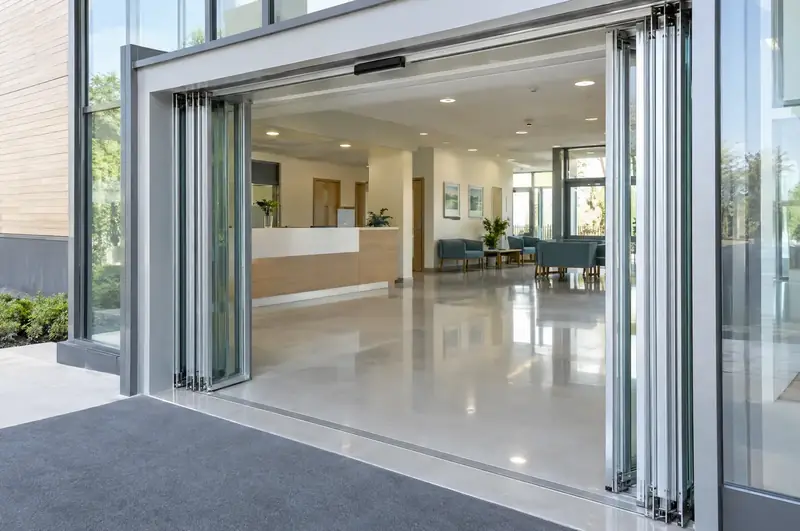
Sliding doors usually come as a complete door set: frame, leaves, side screens and operator. Swing door operators are often fitted to an existing hinged door, although complete new swing door sets are also available. Variations include telescopic sliding doors, which stack two leaves on each side for a wider opening, and automatic folding doors for narrow frontages.
When is an automatic sliding door the better choice?
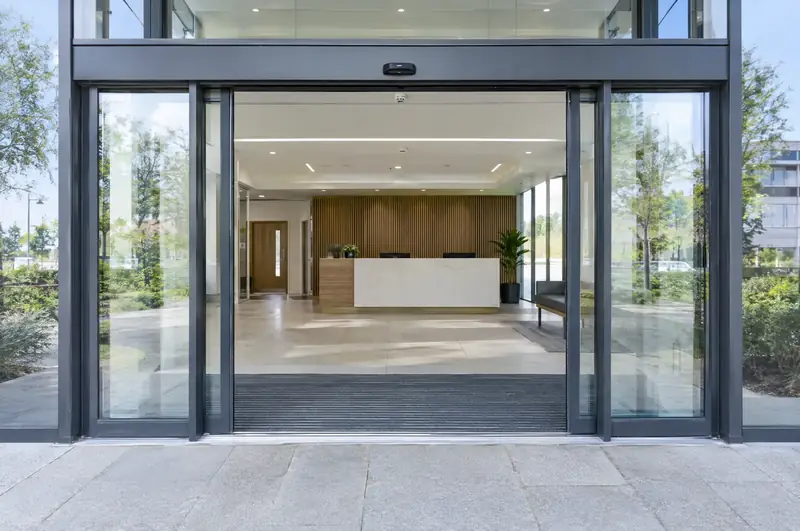
An automatic sliding door is usually the better choice for a busy main entrance where there is wall space beside the opening for the leaves to slide into. Because the leaves move sideways, nobody has to step back from a door swinging towards them, and people can pass in both directions at once.
Building regulations guidance in England notes that an automatic sliding door arrangement is particularly beneficial because it avoids the risks associated with automatic swing doors. Sliding doors also allow a shorter draught lobby, because no door swings into the lobby space.
Sliding doors suit:
- shops, supermarkets and shopping centres
- GP surgeries, clinics and hospital entrances
- offices and public buildings with steady two-way traffic
- entrances used by wheelchair users and people with prams, trolleys or luggage
The main limit is space. A bi-parting sliding door needs room for each leaf to slide clear of the opening. Where that space is tight, telescopic leaves reduce the wall space needed for the same clear opening.
When is an automatic swing door the better choice?
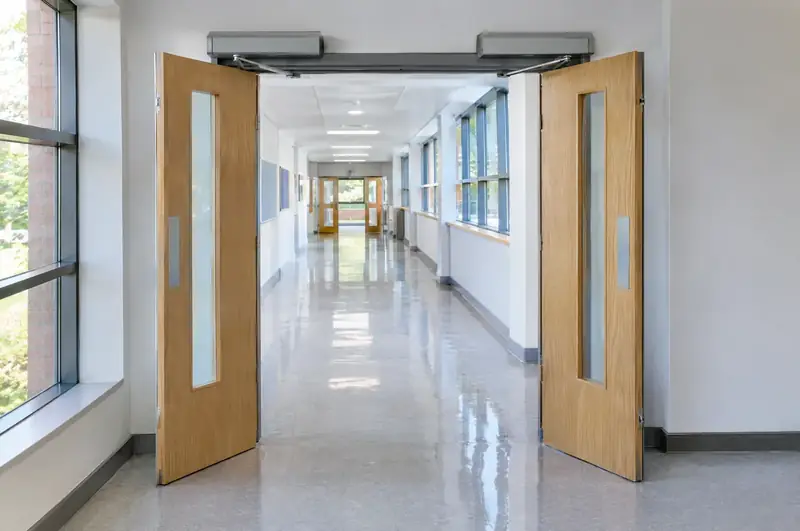
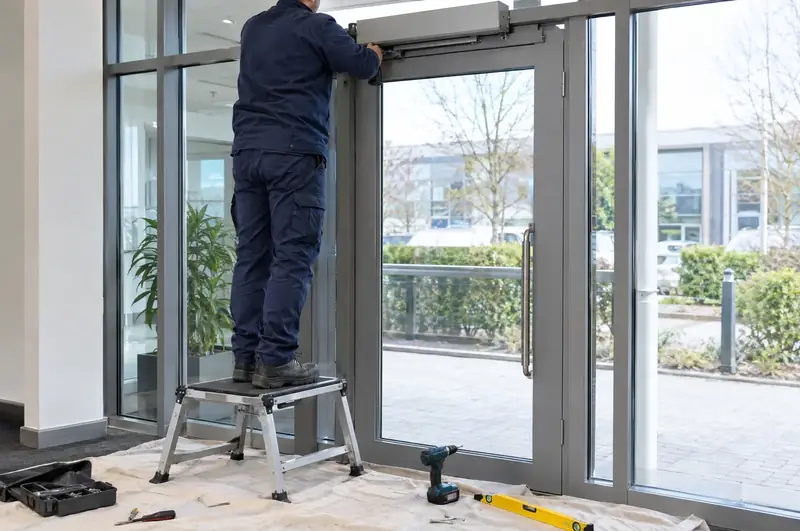
An automatic swing door is usually the better choice when you want to keep an existing hinged door, when there is no wall space beside the opening, or when the door is an internal, corridor or fire door. An operator fixed above the door opens the leaf with an arm and closes it again.
Swing operators come in two kinds. Low-energy operators move the door slowly and gently and suit doors with lighter traffic, while full-energy operators move it faster for busy doors and rely on safety sensors. Our guide to low-energy and full-energy operators compares them.
Swing doors suit:
- corridor and cross-corridor doors in hospitals, care homes and schools
- existing entrance doors that are in good condition
- fire doors, using an operator suitable for fire doors that lets the door close when the fire alarm operates
- accessible toilets, consulting rooms and offices
- narrow openings with no room for sliding leaves
The trade-off is the swing. The leaf sweeps an area on one side of the door, so that area must be kept clear and protected by sensors, and people approaching from that side need to know the door is about to open towards them.
How do sliding and swing doors compare?
Sliding doors are stronger on traffic flow and ease of use at busy entrances, and swing doors are stronger on cost, space and suitability for existing and fire-rated doors. The table sets out the main differences.
| Factor | Automatic sliding door | Automatic swing door |
|---|---|---|
| Space needed | Wall space beside the opening for the leaves | Clear floor area for the leaf to swing into |
| Busy two-way traffic | Well suited, as people can pass both ways at once | Suits moderate traffic; full-energy operators cope with busier doors |
| Existing door | Usually replaced with a new door set | Often kept, with an operator added |
| Fire doors | Fire-resisting automatic sliding doors are specialist products | Operators suitable for fire doors are widely available |
| Escape routes | Needs break-out or fail-safe opening, as the fire strategy requires | Can open in the direction of escape and be pushed open by hand |
| Main hazards | Closing edges and the gap between a leaf and the side screen | The swing area and the finger gap on the hinge side |
| Draught lobbies | Allows a shorter lobby | Needs a longer lobby to allow for the swing |
| Guide price | typically £4,495 to £12,995 ex VAT per door set | from £2,495 ex VAT per door |
Which is safer, a sliding or a swing automatic door?
Both types can be made safe, but they have different hazard zones, so they need different safety devices. BS EN 16005 is the standard for the safety in use of power-operated pedestrian doors, and we set up, test and document doors with reference to it.
On a sliding door, the main risks are being struck by the closing leaves and having fingers or hands drawn into the gap between a moving leaf and the side screen. Presence sensors in the opening stop the door closing on someone, and guards or sensors protect the side screens.
On a swing door, the main risks are being struck by the leaf as it moves and having fingers trapped at the hinge edge. Sensors fixed to the leaf watch the swing area on both faces, and a finger guard covers the hinge gap. Building regulations guidance in England and Wales also expects swing doors that open towards people to give visual and audible warnings.
Whichever type you choose, a site-specific risk assessment should look at who uses the door, including children, older people and disabled people. BS 7036-0 is the UK code of practice for that risk assessment, used alongside BS EN 16005.
Which type works on an escape route or as a fire door?
On an escape route, a swing door that opens in the direction of escape is the simpler choice, while a sliding door needs break-out leaves or fail-safe opening so it never blocks the way out. Fire safety law in each UK nation says sliding or revolving doors must not be used for exits specifically intended as emergency exits.
That does not rule out an automatic sliding door at a main entrance that also forms part of an escape route. It does mean the door has to be set up to open, break out or be openable by hand, as the fire strategy for the building requires. See break-out escape route doors and our guide to automatic doors on escape routes.
For fire doors, the usual approach is a swing operator suitable for fire doors. Fire doors that are held open must close automatically when the fire alarm operates, so the operator is linked to the alarm.
How much do sliding and swing automatic doors cost?
An operator added to an existing swing door is usually the lowest-cost route to an automatic door, and a new sliding door set costs more because it includes the frame, leaves, screens and operator. As a guide:
- automating an existing door: from £1,795 ex VAT (£2,154 inc VAT) per door
- a low-energy accessible operator on a single door: typically £1,795 to £2,995 ex VAT
- an automatic swing door: from £2,495 ex VAT per door
- an automatic sliding door: typically £4,495 to £12,995 ex VAT per door set
- a telescopic sliding door: from £6,995 ex VAT per door set
Commercial prices exclude VAT. Building work, a new power supply, access control and escape route features are priced on top. See the price guide or try the guide price tool.
How do you choose the right door for your building?
The right door is the one that fits the space, the traffic and the people using it, and that works with the fire strategy for the building. Work through these questions:
- Is there wall space beside the opening for sliding leaves, or is it tight?
- How many people use the door, and do they pass in both directions at once?
- Who uses it: the public, wheelchair users, older people, children, patients or staff only?
- Is the existing door sound enough to keep and automate?
- Is it on an escape route, a fire door, or linked to the fire alarm?
- Does it need locking or controlled access out of hours?
Two practical points often decide close calls. Security: both types can be locked out of hours, but a sliding door set usually has a lock built into the operator, while a swing door may need an electric lock or a separate locking routine. Weather: an exposed swing door can be pushed by the wind, so it may need a more powerful operator, while a sliding door is less affected and closes promptly behind each user, which helps keep heat in.
A free site survey answers these for your entrance and ends with a fixed, itemised written quote for the option that suits it, with no obligation.
Questions
Can a sliding door replace an existing swing door?
Often, yes, if there is wall space beside the opening for the leaves. The frame and screens are normally replaced with a new sliding door set, and some making good is needed. Where space is tight, a telescopic door, or keeping the swing door and adding an operator, may suit better.
Are automatic swing doors suitable for wheelchair users?
Yes. A swing door with a well-placed push pad or sensor and a long enough hold-open time works well for wheelchair users. Low-energy operators suit doors with lighter traffic, and building regulations guidance expects push pads to be placed so the user is not in the door's path as it opens.
Do automatic swing doors need sensors on both sides?
Full-energy swing doors normally do, because the leaf can strike someone on either face. A low-energy door may need fewer safety devices, but only where the site-specific risk assessment shows that is safe for the people who use it.
Can an automatic sliding door be a fire door?
Fire-resisting automatic sliding doors exist, but they are specialist doorsets tested as a complete unit. A more common approach is an operator suitable for fire doors fitted to a fire-rated swing door, linked to the fire alarm so the door closes when it sounds.
Is a revolving door an alternative to sliding or swing?
For very busy entrances a revolving door helps keep heat in, but building regulations guidance treats revolving doors as not accessible on their own. An accessible door, such as an automatic sliding or swing door, should be provided alongside. See revolving doors.