Is an automatic door a legal requirement?
An automatic door is not a legal requirement in itself, but a heavy or hard-to-open door can put disabled people at a substantial disadvantage, and the law expects that barrier to be dealt with. The duty falls on the service provider or employer, not on the door, so no door is accessible or compliant just because it is automatic.
Removing the barrier might mean an automatic door, a powered operator on the existing door, a lighter closer, a hold-open device or a different accessible entrance. An automatic door can help a business meet its access duties, but fitting one does not on its own guarantee that those duties are met.
What does the Equality Act 2010 require?
The Equality Act 2010, which applies in England, Wales and Scotland, requires service providers and employers to make reasonable adjustments where a physical feature puts a disabled person at a substantial disadvantage. For a physical feature, the Act says avoiding the disadvantage can mean removing it, altering it, or providing a reasonable means of avoiding it.
For services, the duty is owed to disabled people generally, not only to a particular customer who has already asked. That means a business should think ahead about whether its entrance works for wheelchair users, people with limited strength or grip, people using walking aids and parents with prams, rather than waiting for a complaint.
What is reasonable depends on the circumstances of each case, and a service provider is not required to make a change that would fundamentally alter the nature of its service. For many shops, surgeries and offices, a powered door at the main entrance is a proportionate and well-understood adjustment.
Employers have a parallel duty towards disabled staff and job applicants, which can include internal doors, toilets and routes through the building as well as the entrance.
What is the law in Northern Ireland?
In Northern Ireland the Equality Act 2010 does not apply. Disability access duties there come from the Disability Discrimination Act 1995, which was replaced by the Equality Act in Great Britain but still applies in Northern Ireland.
Under the Disability Discrimination Act 1995 as it applies in Northern Ireland, service providers must take reasonable steps where a physical feature makes it impossible or unreasonably difficult for disabled people to use a service, including removing or altering the feature, providing a reasonable means of avoiding it, or offering the service another way. The Equality Commission for Northern Ireland publishes guidance for businesses.
What do building regulations say about powered entrance doors?
Building regulations guidance on access applies to new buildings and to building work on existing buildings, and the details differ in each UK nation. It does not apply retrospectively to an entrance that is not being altered.
| Nation | Guidance | What it says about entrance doors |
|---|---|---|
| England | Approved Document M, Volume 2 (buildings other than dwellings) | A powered door should be used where a self-closing door would otherwise need more than 30 N at the leading edge to open from closed to 30 degrees, or more than 22.5 N from 30 to 60 degrees. External doors used by the public in new buildings should give at least 1000 mm effective clear width. |
| Wales | Approved Document M, issued by the Welsh Government | The same approach with a lower opening force limit of 20 N at the leading edge. External doors used by the public in new buildings should give at least 1000 mm effective clear width. |
| Scotland | Building Standards Technical Handbook (non-domestic), Section 4, under the building warrant system | An accessible entrance door should give a clear opening of at least 800 mm. Powered doors improve accessibility but must not add hazards, with sensors, signs and guarding. |
| Northern Ireland | Building Regulations (Northern Ireland) 2012, Part R and Technical Booklet R | The regulations require a powered door to have a means to prevent it trapping anyone and a means to open it if the power fails. Check Technical Booklet R for access details. |
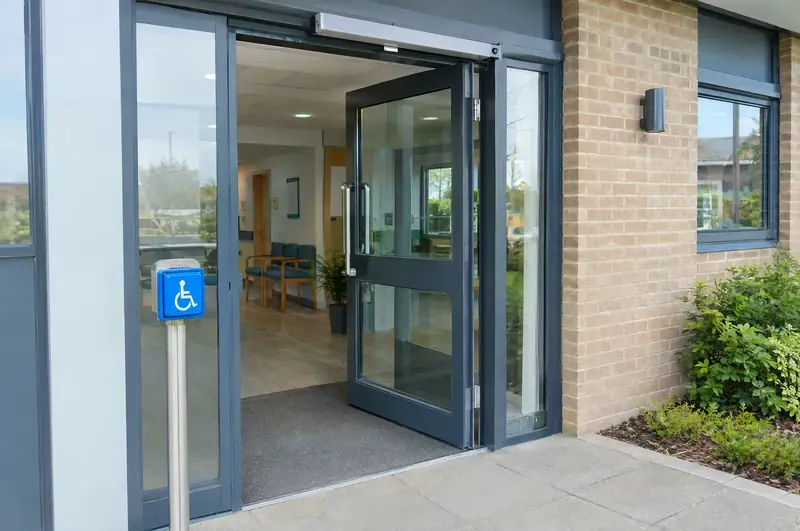
Guidance in England and Wales also expects powered entrance doors to open early enough and stay open long enough for safe passage, to stop if they begin to close on someone, and to revert to manual control or fail safe in the open position if the power fails. Push pads and other manual controls should be fixed between 750 mm and 1000 mm above the floor in England, Wales and Scotland, set back so the user is not in the door's path.
Guidance in England and Scotland treats revolving doors as not accessible on their own, so an accessible entrance door, such as a powered swing or sliding door, should be provided alongside.
Which type of automatic door helps most with access?
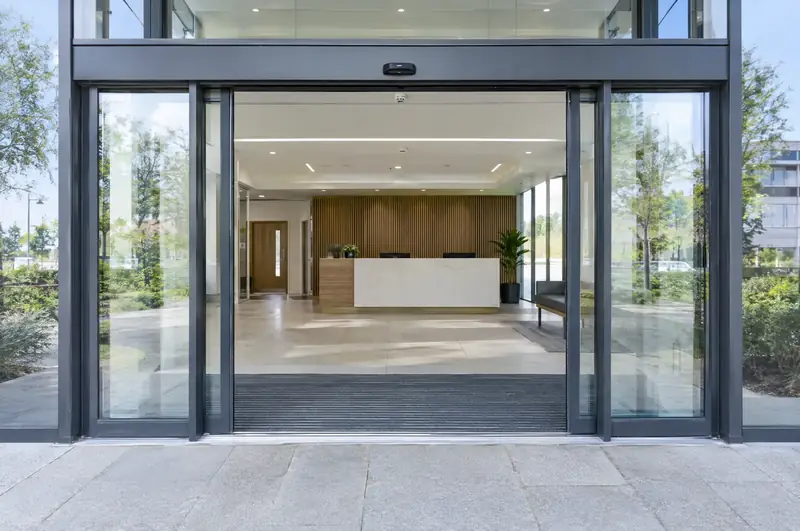
For a busy public entrance, an automatic sliding door usually gives the easiest access, while a low-energy swing operator is often the simplest adjustment for an existing door with lighter use.
England's guidance notes that an automatic sliding door avoids the risks associated with automatic swing doors, and that low-energy powered doors may be used where a door is not subject to frequent use or heavy traffic, because they open and close relatively slowly. See our guides to sliding or swing doors and low-energy or full-energy operators.
Details matter as much as the door type:
- push pads at the right height, clear of the door's swing, and easy to see against the wall
- a hold-open time long enough for someone who moves slowly
- touch-free switches where hygiene matters, and radio buttons for people who need to open the door from further away
- markings on clear glass at two heights, between 850 mm and 1000 mm and between 1400 mm and 1600 mm above the floor, under guidance in England and Scotland
- a level threshold and a door that does not block an adjacent route when open
What about internal doors, toilets and corridors?
Internal doors, accessible toilets and corridor doors matter as much as the entrance, because a disabled visitor or employee who gets through the front door still needs to reach the rooms and facilities inside. Heavy self-closing doors on corridors are one of the most common barriers in older buildings.
Low-energy operators with push pads are a common answer for accessible toilets, consulting rooms and offices. Where corridor doors are fire doors that must close in a fire, alarm-linked hold-open devices or automatic operators suitable for fire doors keep them open day to day and close them when the alarm sounds. See automatic internal doors and fire door hold-open devices.
Do homes need to meet accessibility law?
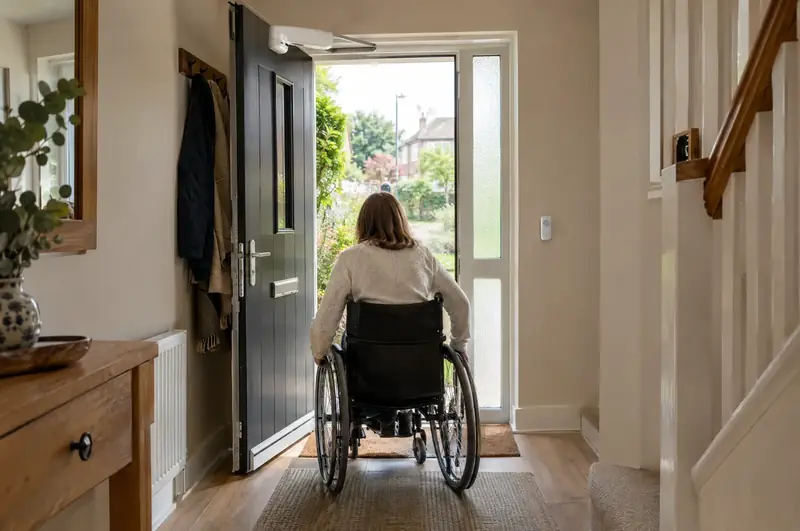
Equality law duties fall on service providers and employers, not on private households, so a door opener at home is a personal choice, often recommended by an occupational therapist. It can make a real difference for a wheelchair user or someone with limited strength, and for carers.
Disabled Facilities Grants in England and Wales can sometimes help pay for door openers in the home. In Northern Ireland the grant is run through the Housing Executive and normally follows an occupational therapist's recommendation, and in Scotland councils help through their Scheme of Assistance. Grants are means-tested, the council decides, and approval is needed before work starts.
Some installation work can also be zero-rated for VAT where HMRC's conditions are met. See home automatic door openers for options and costs.
How do you show you have taken reasonable steps?
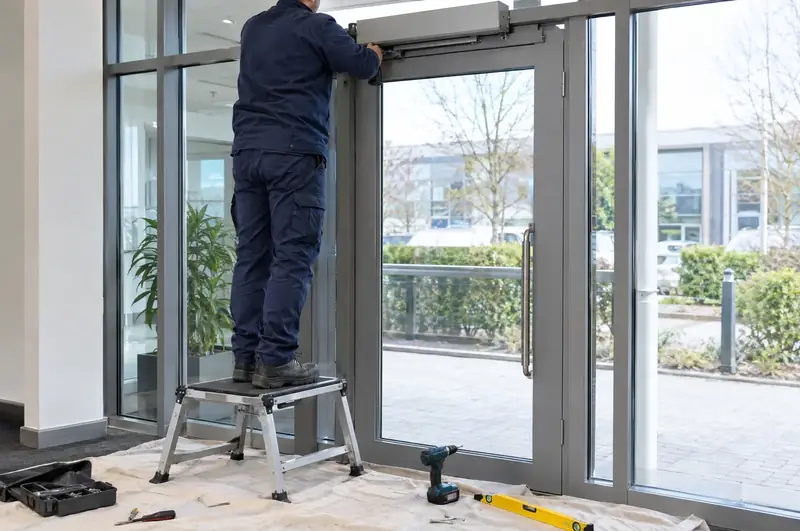
The best evidence is a clear record: a review of the entrance from a disabled visitor's point of view, the decision you made and why, and paperwork showing the door was installed, set up and maintained safely.
- Look at the entrance as a wheelchair user, an older person and a parent with a pram would.
- Take advice where needed, for example an access audit for a larger building.
- Choose the adjustment that removes the barrier, such as an accessible door operator or a new automatic sliding door.
- Have it installed with a site-specific risk assessment, set up and tested with reference to BS EN 16005.
- Keep it serviced and checked, with a written record.
- Make sure staff know how the door works and what to do if it fails.
As a guide, a low-energy accessible operator on a single door is typically £1,795 to £2,995 ex VAT, automating an existing door is from £1,795 ex VAT (£2,154 inc VAT) per door, and a home door opener is typically £1,495 to £2,995 inc VAT. For new doors, retrofits and home openers there is a free site survey and a fixed, itemised written quote.
Questions
Does the Disability Discrimination Act 1995 still apply?
Only in Northern Ireland. In England, Wales and Scotland it was replaced by the Equality Act 2010, which sets the reasonable adjustment duties there. In Northern Ireland the Disability Discrimination Act 1995 remains the main disability discrimination law.
Does my shop have to have an automatic door?
Not automatically. The duty is to make reasonable adjustments so disabled customers are not at a substantial disadvantage. If your entrance door is heavy or hard to open, a powered door is often the most practical way to meet that duty, but other options can sometimes work.
Do I need building regulations approval to automate a door?
It depends on the work. A new entrance or other building work brings in building regulations, and may need building control approval, or a building warrant in Scotland. The survey flags this, and the quote shows any approvals or associated work.
What about listed buildings?
The duty to make reasonable adjustments still applies, but listed building consent may limit physical changes. A slim operator on the existing door, or an accessible alternative entrance, is often possible. See our guide to shop doors, planning and listed buildings.
Is a push pad or a motion sensor better for accessibility?
Both work. Motion sensors open the door without any action, which suits busy entrances. Push pads suit doors that should only open on request, such as toilets or low-energy doors, and must be placed at the right height and clear of the door's swing.