Why do entrances lose so much heat?
Entrances lose heat mainly through air exchange: each time the doors open, warm air escapes and cold air comes in, driven by wind and by the difference in temperature between inside and outside. The more often and the longer the doors stay open, the more heat is lost.
In taller buildings the effect is stronger, because warm air rising inside pulls cold air in at ground level, a pattern often called the stack effect. Wind blowing straight at the entrance pushes air in, and a second open door elsewhere in the building can create a through-draught.
The door itself matters too. Single glazing, frames without thermal breaks and worn brush seals let heat out and draughts in even when the doors are shut. Staff working near the entrance feel it first, which is often what prompts a business to look at the problem.
What is a draught lobby?
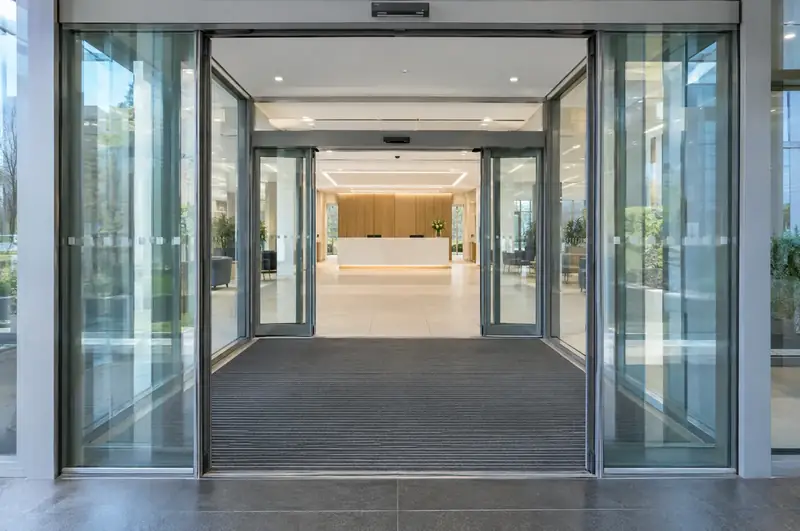
A draught lobby is a small enclosed space between two sets of doors, so that people pass through one set before the other opens. Warm inside air is not exposed directly to the outside, and wind cannot blow straight into the building.
A lobby works best when it is deep enough that the outer and inner doors are not open at the same time for most people walking through. If the lobby is short, both sets open together and much of the benefit is lost. The doors can be set so that one set closes before the other opens, where that suits the traffic.
An automatic entrance lobby is typically £14,995 to £34,995 ex VAT per lobby as a guide, depending on size, door types and the building work involved. Lobbies need floor space inside or outside the existing line of the entrance, so they are easiest to plan in a new building or a major refit.
Are revolving doors better at keeping heat in?
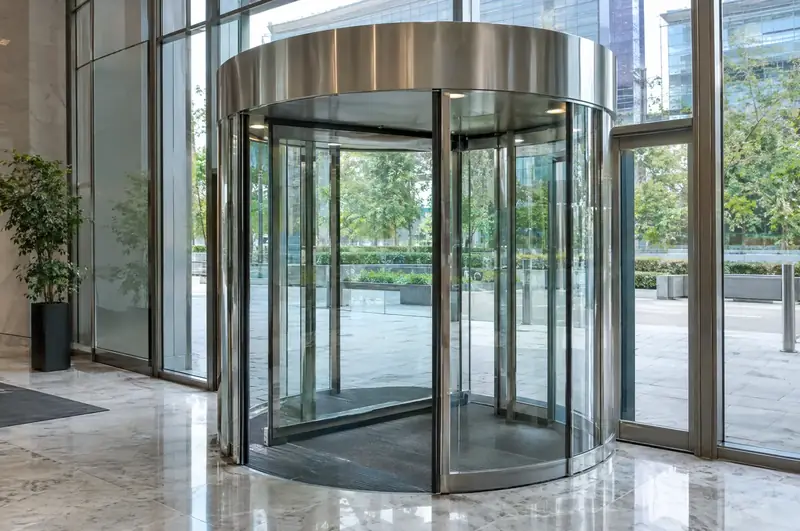
A revolving door keeps heat in well because at any moment at least one wing seals the opening, so the inside is never open straight to the outside. That makes it one of the most effective entrance types for draught control at busy, exposed entrances.
The trade-offs are capacity at peak times, cost and access. Wheelchair users, people with prams or luggage, people with assistance dogs and some older or disabled people may find revolving doors hard to use. Building regulations guidance treats revolving doors as not accessible on their own, so an accessible powered swing or sliding door should be provided alongside. Escape needs planning too: in England and Wales, fire safety law says sliding or revolving doors must not be used for exits specifically intended as emergency exits.
Revolving doors are typically £29,995 to £59,995 ex VAT per door as a guide. They are usually chosen for hotels, offices and other buildings with steady footfall and enough space at the entrance.
Do air curtains work?
An air curtain is a fan unit above a doorway that blows a stream of air down across the opening to reduce the exchange of warm and cold air. Many are heated, so they also warm people as they come in.
Air curtains can help where a door has to stand open for long periods, such as a shop in trading hours, and they take no floor space. How well they work depends on matching the unit and air speed to the door height and on how exposed the entrance is to wind. A heated air curtain uses energy itself, so running it on a timer or linking it to the door makes sense.
They work best alongside doors that close promptly, rather than instead of them.
Which option suits my entrance?
The right option depends on footfall, space, exposure to wind, budget and who uses the entrance. This comparison sets out the main differences in general terms.
| Option | Draught control | Space needed | Access and escape | Best for |
|---|---|---|---|---|
| Single automatic door, well set up | Moderate, depending on settings and footfall | Little | Straightforward | Most shops, offices and surgeries |
| Draught lobby | Good when deep enough | A lobby depth inside or outside | Good, with doors chosen for escape | Busy entrances in exposed spots |
| Revolving door | Very good | A drum at the entrance | Needs an accessible door alongside | Hotels, offices, high footfall |
| Air curtain | Helps when doors stand open | Above the door only | No effect on access | Shops that trade with doors open |
Many buildings combine options, for example a lobby with an air curtain, or a revolving door with an automatic sliding or swing door beside it. See sliding or swing? for choosing the door type itself.
Can door settings cut heat loss?
Yes. Changing how an existing automatic door behaves is often the cheapest way to reduce heat loss, because a door that opens less often, less widely and for less time lets out less warm air.
Settings an engineer can look at include:
- Hold-open time: how long the door waits after the last person passes. Shorter is warmer, but it must still suit slower users.
- Opening and closing speed: adjusted within the safe limits set for the door and its users.
- Reduced opening width: a partial or winter mode on sliding doors that opens to a narrower width for most people, with full width available when it is needed.
- Direction-sensitive sensors: so the door opens for people approaching, not for passers-by on the pavement or in the corridor.
- Programme switch use: exit only or off out of hours, so the door does not cycle for no reason.
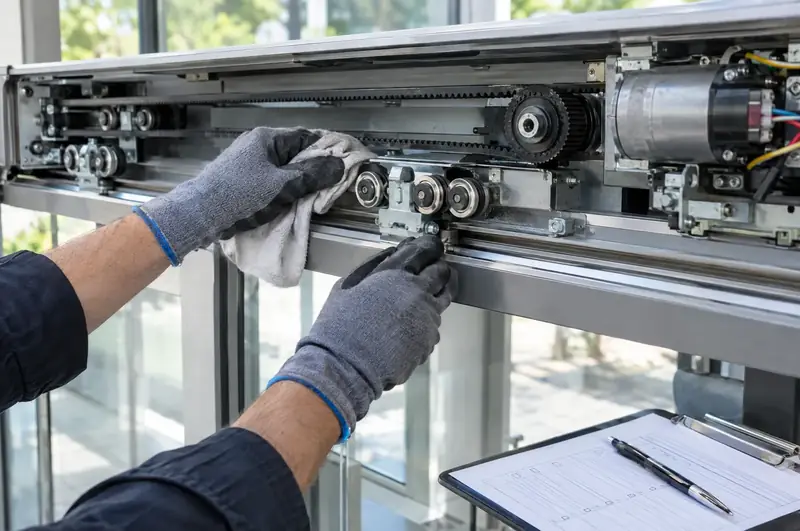
- Seals and brushes: worn seals and floor brushes replaced at a service.
Any change has to keep the door safe and accessible. A door that closes too quickly or opens too narrowly can catch slower users or stop wheelchair users getting through, so settings are agreed and tested with reference to BS EN 16005. Our automatic door servicing visits can include a review of settings and seals.
What do building regulations say about entrance energy use?
Building regulations set energy efficiency requirements for new buildings and for many kinds of building work on existing ones, and the details differ in each UK nation. In England the guidance is in Approved Document L, Wales has its own Approved Document L, Scotland covers energy in the Technical Handbooks, and Northern Ireland uses Technical Booklets F1 and F2.
Building regulations guidance on access to buildings applies to new buildings and to building work on existing buildings; the details differ in each UK nation. A lobby or revolving door therefore has to work for access and escape as well as energy, which is why the door choice, lobby size and settings are best agreed at design stage with the designer and building control.
If you are planning a new or altered entrance, a free site survey lets us check space, traffic and exposure, and you get a fixed, itemised written quote for the options that fit. See how much automatic doors cost for wider pricing.
Questions
How much energy will a draught lobby save?
It depends on the building, the weather, footfall, the lobby depth and how the doors are set, so there is no reliable single figure. A lobby generally makes the biggest difference at busy, exposed entrances to heated buildings. If you need a figure for a business case, ask a building services engineer or energy consultant to model it for your building.
Can we add a lobby to an existing entrance?
Often, if there is space inside or outside the current doors. Building one outside changes the frontage and may need planning permission, and building regulations may apply either way. See automatic shop doors: planning, listed buildings and conservation areas for the consents to check.
Is a revolving door accessible?
Not for everyone. Some wheelchair users, people with prams or luggage and some older or disabled people find revolving doors difficult. An accessible automatic swing or sliding door is normally provided alongside, so everyone has a way in. See automatic doors and accessibility law.
Will a shorter hold-open time cause problems for slower users?
It can if it is set too short. The hold-open time and closing speed have to suit the slowest regular users of the door, and the safety sensors must still stop the door closing on anyone in the opening. An engineer can find a setting that cuts needless open time without making the door harder to use.
Do sliding doors lose less heat than swing doors?
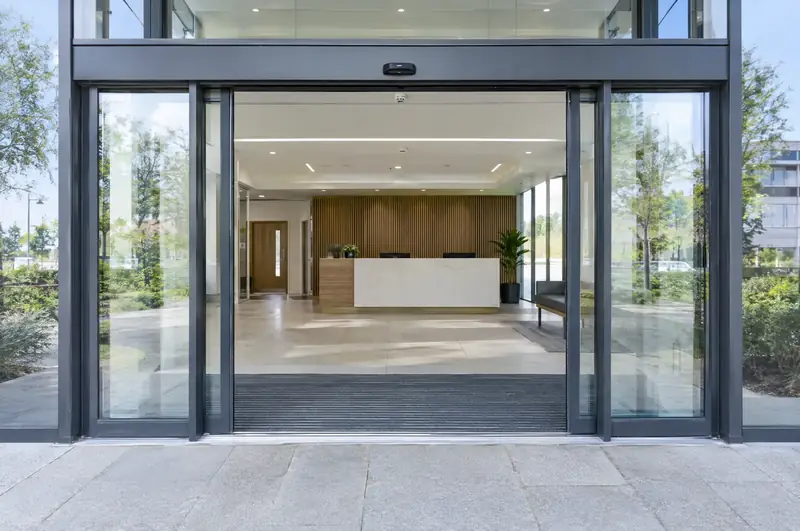
Not by nature. What matters most is how often and how long the door is open, the quality of the seals and glazing, and whether there is a lobby. Sliding doors suit busy entrances because they open quickly and do not swing into people, and a reduced opening width setting can help further.