What should an automatic door do when the power fails?
When the power fails, an automatic door should either open automatically or be openable by hand, depending on where it is and what the building needs. Workplace health and safety law expects powered doors to be safe if the power fails, and a door that traps people in or out when the lights go off is not.
There is no single right behaviour. A shop entrance might need to close and lock to stay secure overnight, while a door on an escape route must let people out. The behaviour is chosen for each door, recorded, and tested at servicing.
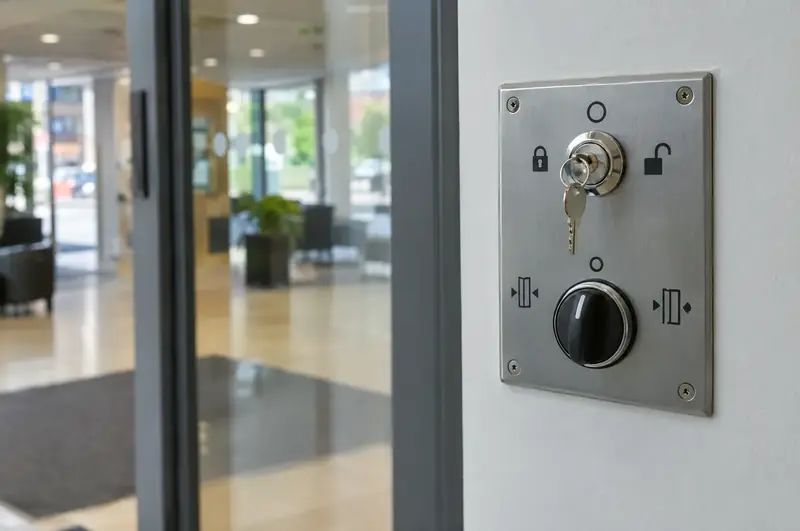
The programme switch beside the door often controls how it behaves day to day, with settings such as automatic, exit only, hold open and off. Staff should know which setting to use and who may change it, because a door left in the wrong mode can behave unexpectedly when the power or alarm changes.
What are the usual power failure behaviours?
Most automatic doors are set up to behave in one of a few ways when the mains supply is lost:
| Behaviour | What happens | Typical use |
|---|---|---|
| Manual push | The door has no backup and can be pushed or slid open by hand | Simple sliding and swing doors where hand opening is easy |
| Spring close | A swing operator's spring closes the door, which can then be pushed open like a door with a closer | Swing doors, fire doors, accessible doors |
| Battery backup, keep working | A battery runs the door for a limited time or number of cycles | Busy entrances that must stay usable for a while |
| Battery backup, open and stay open | The battery opens the door fully and leaves it open | Escape routes where the fire strategy needs the door open |
| Battery backup, close and lock | The battery closes the door and it locks | Entrances that must stay secure, where people have another way out |
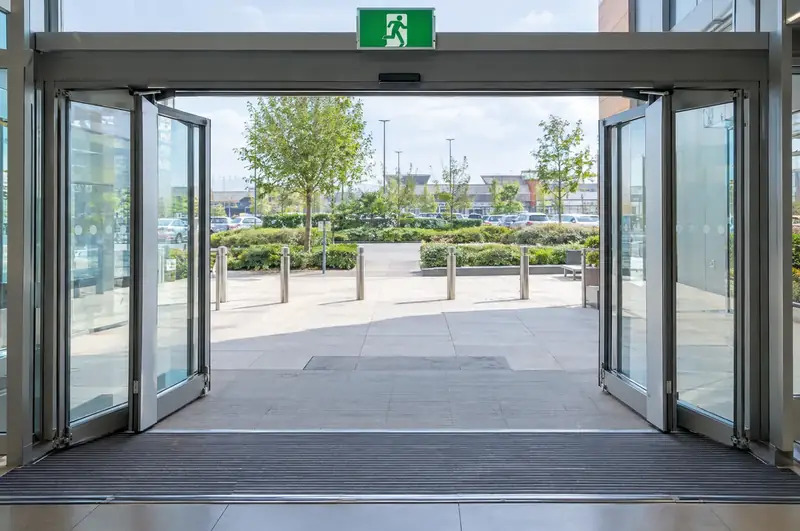
| Break-out | Leaves and side screens can be pushed outwards to clear the opening | Sliding doors on escape routes |
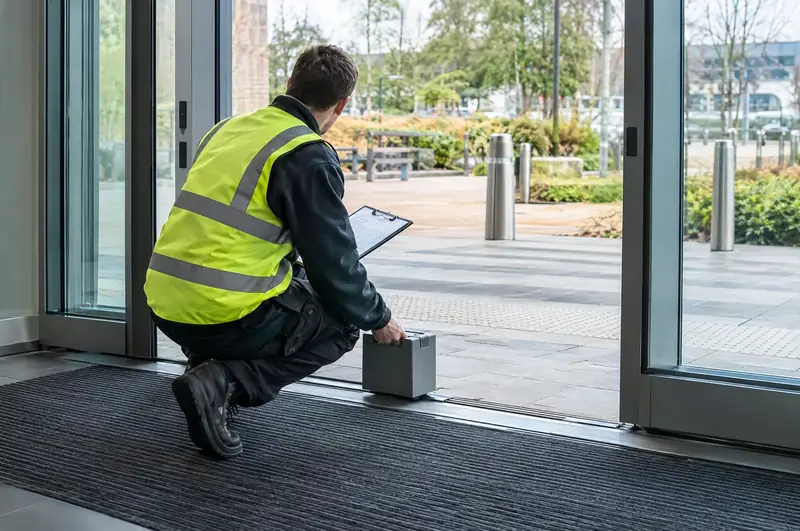
Batteries wear out, so a backup that worked when the door was new may not work now. Battery checks belong on every service visit.
What is a fail-safe or break-out door?
A fail-safe door is one that moves to its safe position when power or a monitored safety function fails. On an escape route that usually means opening and staying open, so people can get out even if the operator stops working.
A break-out door is a sliding door whose leaves, and often its side screens, can be pushed outwards by hand to give a wide opening in an emergency. It does not rely on power or electronics to open, which is why it is often chosen for escape routes. Break-out escape route doors are from £7,995 ex VAT per entrance as a guide.
Doors on escape routes must let people out safely in an emergency. Automatic doors on escape routes are set up to open, break out or be openable by hand, as the fire strategy for the building requires. In England and Wales, fire safety law also says sliding or revolving doors must not be used for exits specifically intended as emergency exits, so a dedicated emergency exit is normally a hinged door. See automatic doors on escape routes and fire safety for more detail.
How are automatic doors linked to the fire alarm?
An automatic door is linked to the fire alarm by a connection from the fire alarm panel, or an interface unit, to the door's controller. When the alarm operates, the door switches to the behaviour the fire strategy sets, which is usually opening for escape or closing for fire separation.
Typical alarm behaviours include:
- Escape route doors open fully and stay open until the alarm is reset.
- Fire doors with operators stop powered opening and close to hold back smoke and fire, while still being openable by hand for escape where needed.
- Doors with access control release on the escape side, so people are not held in.
- Lobby doors may behave differently on the inner and outer sets, as the strategy requires.
BS 7273-4 is the British Standard code of practice for how a fire alarm system actuates door release mechanisms. It sorts doors by how critical their release is, so a powered door on an escape route that cannot be opened by hand needs a more dependable link than a door held open for convenience. Your fire alarm engineer and door engineer should agree which applies to each door.
The link has to be tested. A door that should open on alarm but does not, or a fire door that stays open, is a serious fault. Routine alarm tests are a good time to check that every linked door responds as it should, and to note any that do not.
What are hold-open devices for?
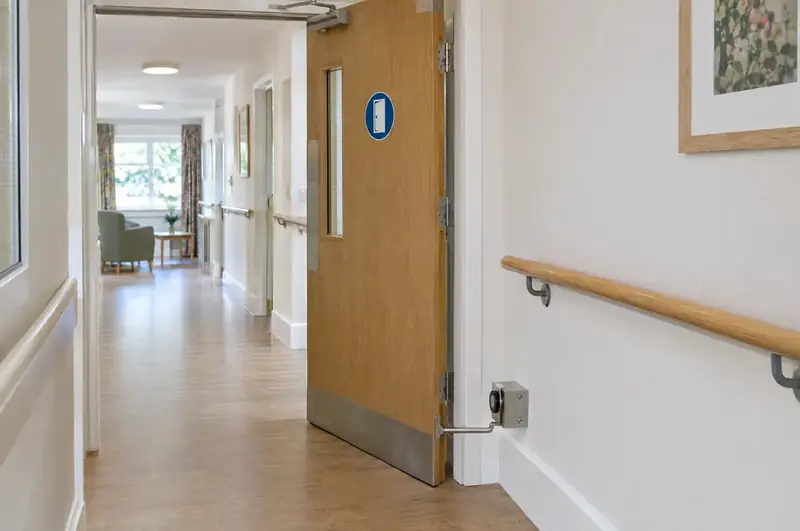
A hold-open device keeps a fire door open for everyday use and lets it close when the fire alarm operates. Fire doors that are held open must close automatically when the fire alarm operates.
Common types include electromagnetic hold-opens wired to the alarm, free-swing closers that let a door move freely until the alarm sounds, and battery devices that listen for the sound of the alarm. Each suits different doors and buildings, and devices that listen for the alarm are not suitable for every door. Electrically powered hold-open devices for fire doors are made to BS EN 1155. Fire door hold-open devices are from £145 ex VAT per door as a guide.
Wedges and door stops on fire doors defeat the purpose of the door. If staff keep propping a fire door open, that usually means the door needs a hold-open device or an automatic operator.
Who decides how the doors should behave?
The fire strategy and fire risk assessment for the building decide how each automatic door behaves in a fire alarm or power cut. The installer sets the door up to match and records the settings, but does not choose the strategy.
The person who must make sure the fire risk assessment is done and acted on is described differently in each nation:
- England and Wales: the responsible person under the Regulatory Reform (Fire Safety) Order 2005, usually the employer or whoever controls the premises.
- Scotland: the person responsible for fire safety under the Fire (Scotland) Act 2005, which covers employers and anyone with control of the premises to any extent.
- Northern Ireland: the person with fire safety duties under the Fire and Rescue Services (Northern Ireland) Order 2006 and the Fire Safety Regulations (Northern Ireland) 2010, which covers employers and anyone with control of the premises to any extent.
If the strategy is unclear, or the building has changed since it was written, ask a competent fire risk assessor to review it before doors are changed. For new buildings and building work, building regulations guidance on fire safety also applies: Approved Document B in England and in Wales (each nation has its own version), the Technical Handbooks in Scotland, and Technical Booklet E in Northern Ireland.
How do I check my doors are set up correctly?
Check that the behaviour of each automatic door in a power cut and a fire alarm is written down, matches the fire strategy, and is tested regularly. Many sites find the settings were never recorded, or were changed during a repair and not put back.
- List each automatic door, whether it is on an escape route, and whether it is a fire door.
- Note what it should do on power failure and on fire alarm.
- Ask for those behaviours to be tested and recorded at servicing, including batteries and alarm links.
- Make sure staff know the manual release and the programme switch settings, and who may change them.
- Review the list whenever the building, the alarm or the fire strategy changes.
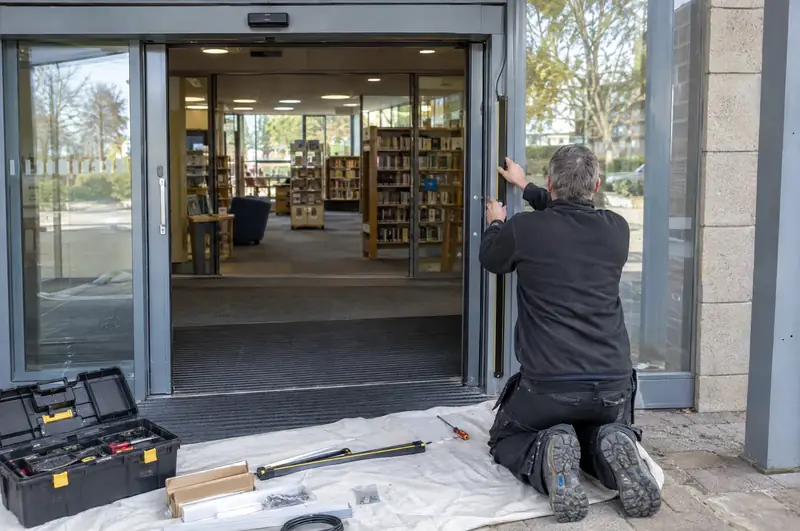
Our safety inspections check how each door behaves on power failure and alarm, with the visit price agreed in writing before we attend. Where doors need work, safety and compliance upgrades start with a free site survey and a fixed, itemised written quote.
Questions
Will my automatic door lock people in during a power cut?
It should not, if it has been set up correctly for its location. Doors on escape routes are set to open, break out or be openable by hand. A door that closes and locks on power failure should only be used where people have another safe way out. If you are unsure how yours behaves, ask for it to be tested and recorded.
How long does a battery backup last?
It depends on the door, the battery and its age. Some backups run the door for a set number of cycles, others simply open or close it once. Batteries lose capacity over time, so they should be checked at every service and replaced when they no longer pass.
Should an automatic entrance door open or close when the fire alarm sounds?
It depends on the fire strategy. Most entrance doors on escape routes open and stay open. Doors that form part of the building's fire separation close instead. The fire risk assessment for the building decides, and the door is set up to match.
Can a fire door have an automatic opener?
Yes, many fire doors can take an automatic swing operator, as long as the installation does not reduce the door's fire performance and the operator is linked so the door closes when the fire alarm operates. The door must still close fully and latch where that is required.
Should we check the doors when we test the fire alarm?
Yes, it is good practice to check that linked doors respond during alarm tests: escape doors open, fire doors close and hold-open devices release. Note any that do not and report them. A full test of each door's alarm and power failure behaviour belongs in the regular service or inspection.